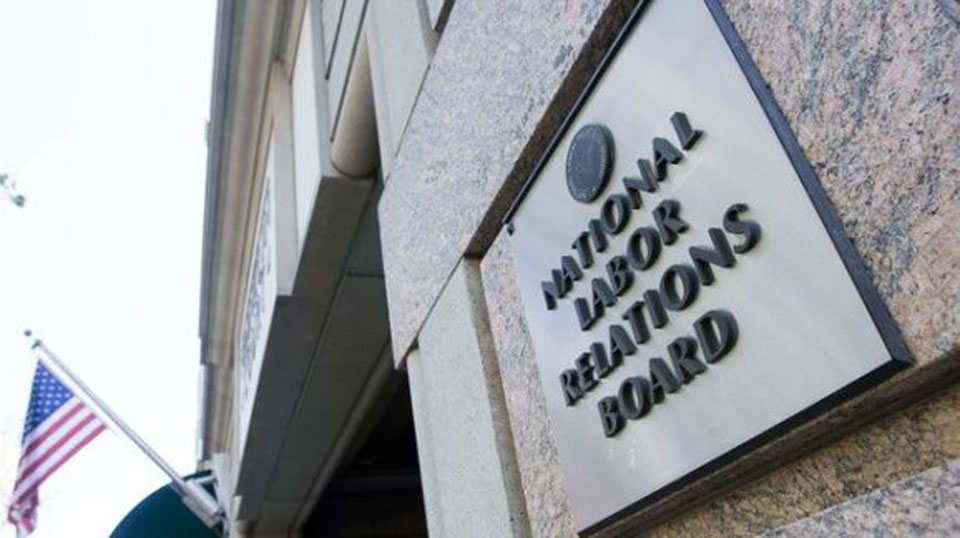
WASHINGTON—Crystal Carey, a top attorney at the anti-union law firm Morgan, Lewis & Bockius, and now Donald Trump’s nominee as General Counsel of the NLRB, ran into flak from senators who questioned her yesterday.
Worker rights advocates note that her conformation and placement in the position of General Counsel will severely weaken the ability of workers everywhere in the country to unionize.
Carey has been with the firm for at least seven years, after eight years as a National Labor Relations Board staff attorney. She spent much of the Senate Labor Committee confirmation session saying she would “carefully review” controversial issues—including the NLRB’s budget and staffing.
Carey’s nomination is important to workers, even though the labor board can’t make decisions right now because it lacks a quorum. That’s thanks to President Trump. He unilaterally and illegally fired former NLRB chair Gwynne Wilcox, the board’s first-ever African-American woman member.
The GOP U.S. Supreme Court majority backed Trump, thus firing her and neutering the board’s independence as well. That prompted Sen. Bernie Sanders, Ind-Vt., leading the committee minority, to declare that without Wilcox—and with only two members—“the board has been effectively shut down.”
No NLRB “makes it that much harder for workers form a union and improve their standards of living,” commented Sanders, the Senate’s most-outspoken supporter of unions and its longest-tenured one, too.
“Because the NLRB is dysfunctional,” Sanders said, “company CEOs have free rein to intimidate and coerce pro-union workers without recourse” by workers or punishment by the board. He politely omitted the NLRB’s punishments are extremely weak.
As a result, Sanders added, companies feel even freer to flout the board and labor law. He mentioned Amazon—which Carey’s firm represents—and Mauser Packaging in Chicago, where management is defying orders to bargain with the Teamsters, forcing a current month-long strike. Sanders also mentioned primary care MDs at Boston’s Mass General Hospital “where 88% voted to join a union.
“But with a fractured NLRB, it remains to be seen whether they’re going to be able to achieve that goal.”
A broken board puts even more responsibility and policy in the hands of regional directors, administrative law judges and especially their boss, the General Counsel. And that’s where Carey’s answers irked Hawley. His vote is vital, since the Senate’s ruling Republicans control the Labor panel by a 12-11 margin.
Hawley focused on Carey’s outspoken criticism of the Biden board, and especially its ruling last year outlawing mandatory worker attendance at “captive audience” meetings. In the sessions, bosses and hired union-busters—such as Morgan Lewis lawyers—can harangue workers. Some bosses illegally threaten to fire them or close plants.
The senator asked if Carey, given her views, would enforce the current board law, which bans mandating workers attend the meetings, without retribution if they don’t.
“I stand by everything I said” against that NLRB ruling against mandatory attendance at the meetings, Carey replied. “But my job would be to enforce the [board’s] decision.
“However, if…those issues come back” to the board, it “would be decided on a case-by-case basis” depending on the specific facts, she added. “There is prosecutorial discretion to determine whether and what and how that case moves forward.”
“That prosecutorial discretion worries me,” Hawley replied. “You’ve been very vociferously critical” of the captive audience meetings decision “and now you’ll have the discretion to enforce it.” Past General Counsels also had that discretion, Carey retorted.
Carey was slightly more responsive to Sen. Tammy Baldwin, D-Wis., about the NLRB money and personnel crunch. Trump’s budget for the fiscal year starting October 1 proposes a 14% cut in spending and envisions a 500-employee decline in numbers. Those rank-and-file workers are short-staffed, and have been for more than a decade.
“After I do an assessment and find we’re under budget” given the board’s increased workload, “I will commit to asking for more as needed,” Carey said. The board’s caseload jumped to 25,000 yearly, a 20% increase, since the coronavirus pandemic hit. More and more workers, notably young workers, realize unionizing is a way towards better jobs and conditions.
The AFL-CIO has yet to take a formal position on Carey’s nomination, but the labor-backed Economic Policy Institute and other pro-worker analyses oppose her.
“Morgan Lewis is one of the largest management-side law firms that currently represents corporations known for violating workers’ rights, including Amazon, SpaceX, Apple, and Tesla,” EPI said. “Morgan Lewis is also pursuing the legal challenge that the NLRB is unconstitutional.
“By nominating Carey as the NLRB General Counsel, President Trump reaffirmed the NLRB will rule on the side of employers over workers,” EPI added. The legal blog JD Supra noted the Teamsters oppose Trump’s Carey nod. “She has no place serving as NLRB General Counsel,” the blog quoted the union as saying.
Another publication noted Carey oversaw Amazon’s campaign against the Amazon Labor Union, now a semi-independent Teamsters local, when ALU won a nationally noted union recognition election at the firm’s Staten Island warehouse.
“Carey also expressed her disapproval of the Biden-era board,” JD Supra added. It said Carey told an American Bar Association panel last year that Biden board went too far not just in banning mandatory attendance at captive audience meetings but also in “restricting employers’ ability to educate workers on how unionization will negatively impact their relationship with management.”
Both showed the Biden-named board was “looking to completely eliminate the rights of employers to have these conversations at all.”
Lulit Shawan, writing for the Center for Law and Social Policy, was even more critical of Carey’s record. She called Carey’s nomination “a direct attack on worker’s rights.”
Carey’s “confirmation would severely weaken the NLRB’s ability to safeguard workers, protect collective bargaining and fair working conditions, and uphold fair labor practices, as well as shift the balance of power even further in favor of corporations. Carey also advocates limiting corporate oversight and mitigating union growth, stances bound to be reflected in the NLRB’s enforcement priorities upon her confirmation,” she wrote.
CONTRIBUTOR