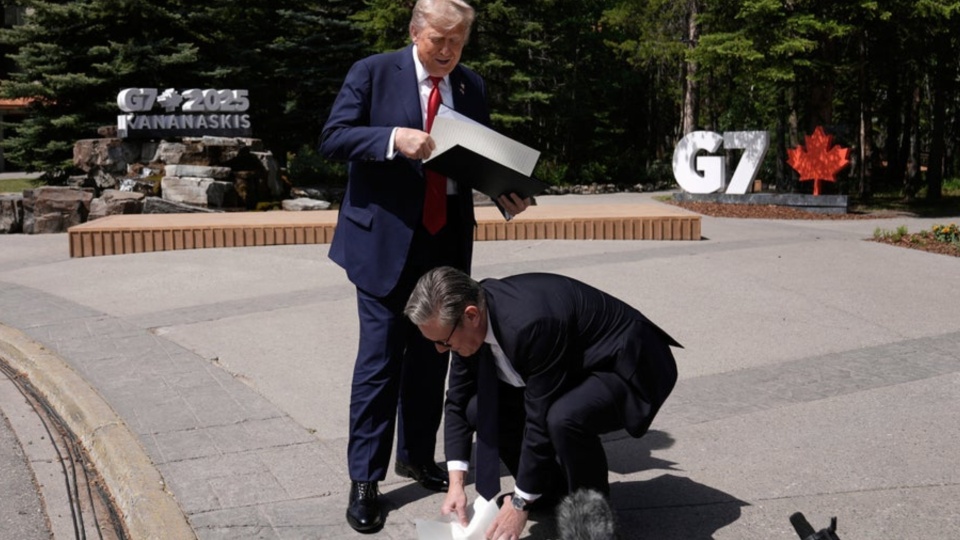
The enduring image from British Prime Minister Keir Starmer’s visit to the White House was the photograph of the United Kingdom’s leader stooping to gather the papers clumsily dropped by Trump.
The photograph managed to resemble a scene where a sycophantic English butler rushes to the aid of his master, and it served as a befitting metaphor for the current state of the so-called “special relationship” between our two countries.
The British Labour Party government is floundering in the face of America’s turn to madness. In the good old days of Bush and Blair, Britain could at least maintain the appearance of respecting global norms, even if the prime minister had to lie to do so.
Now, with all pretence abandoned, our leaders seem incapable of offering a coherent position on international affairs. Ministers cannot bring themselves to say whether there is a genocide in Gaza or whether the kidnapping of Maduro was legal, for fear of offending Mad King Don.
This nervousness is not unreasonable. Britain ceased to be a global power long ago, although the country’s leaders have yet to fully accept it. The United States dominates our economy like no other nation.
In 2023, U.S. companies held over $1 trillion in direct investment in the U.K., and in 2024, American cash accounted for a third of all foreign investment in commercial real estate. Iconic British brands such as Cadbury’s, Boots, and Morrisons are American-owned, while our media is saturated with U.S. entertainment products.
Our economic future is increasingly predicated on productivity gains delivered by U.S. technology. The so-called U.S.–U.K. “Tech Prosperity Deal” promises a further $31 billion from corporations such as Google, Microsoft, and OpenAI. At the same time, Palantir is being granted an expanding role in the National Health Service, despite widespread public concern over data privacy.
U.S. corporations—tech in particular—are embedding themselves ever more deeply in the British economy, leaving ministers increasingly dependent on, and pliable to, the demands of the American ruling class.
Nor is this dependence confined to economics. British air bases are willingly handed over to the U.S. military. An estimated 10-12,000 U.S. service personnel are stationed in the U.K., and while American visitors are always welcome, it would be preferable if they were not in uniform.
The United States also supplies key components of Britain’s nuclear deterrent, which relies on American technology to function. In practical terms, Britain is almost defenseless without the U.S.
It is therefore unsurprising that politicians across most parties in Britain cling to their now obsolete Atlanticist dogma. It has been the cornerstone of British foreign policy for nearly 80 years, and it’s easier for policymakers to pretend that nothing’s changed.
This government will continue to adopt a supine posture, as will both the Conservative Party and Reform UK, led by the Trump-adjacent serial grifter Nigel Farage. For the British right, sovereignty seems to matter only when discussing relations with the European Union. Far from taking back control, these parties appear positively enthusiastic about deeper subservience to U.S. capitalism and Daddy Trump.
Meanwhile, our bland and uninspiring prime minister is careful never to say or do anything that might upset President Trump or the tech barons around him. What irks many, however, is Starmer’s desire to appear tough—a toughness that is invariably directed downwards.
His government clamps down on protest, bans direct-action groups, and purges the socialist left from his own party, and yet can only seem to muster the most inoffensive criticism of the far-right regime across the Pond. Sir Keir is the boy in the playground who holds the bully’s coat while someone else gets beaten up.
At home, Starmer is the uncompromising former chief prosecutor, eager to crack down on dissent and look tough on migration. In Washington, he reverts to the timid English butler. Perhaps this is a fitting metaphor for twenty-first-century Britain.
As with all op-eds published by People’s World, the views reflected in this article are those of the author.
We hope you appreciated this article. At People’s World, we believe news and information should be free and accessible to all, but we need your help. Our journalism is free of corporate influence and paywalls because we are totally reader-supported. Only you, our readers and supporters, make this possible. If you enjoy reading People’s World and the stories we bring you, please support our work by donating or becoming a monthly sustainer today. Thank you!
CONTRIBUTOR