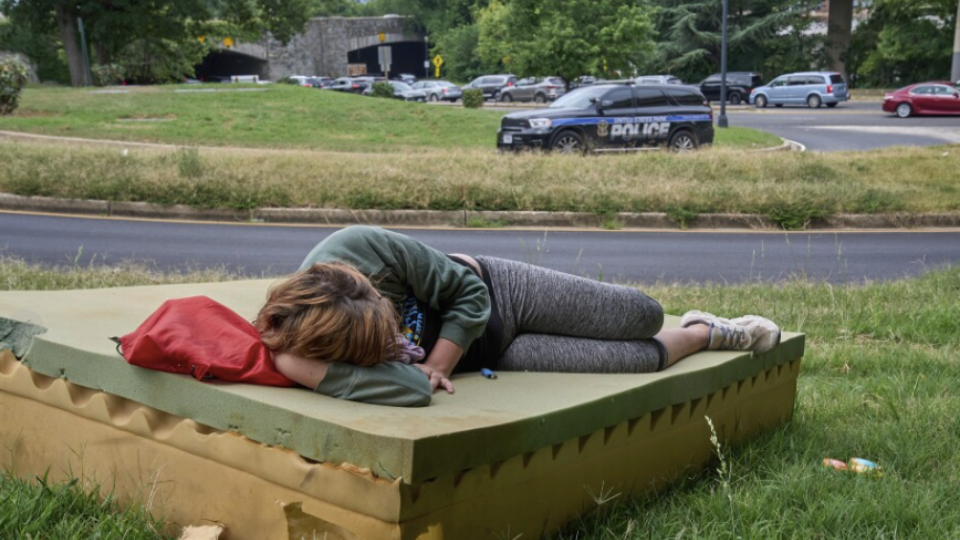
“The Homeless have to move out, IMMEDIATELY,” wrote President Donald Trump on his social media platform, Truth Social, on August 10. The next day, Trump issued an executive order that transferred control of Washington, D.C.’s police department to the federal government in order to aggressively crack down on crime and homelessness. At the same time, Trump ordered the National Guard to enter the city and assist in police action.
In a press conference, Trump stated, “We’re going to be removing homeless encampments from all over our parks, our beautiful, beautiful parks, which now a lot of people can’t walk on. They’ve been very, very dirty, very—got a lot of problems. But we’ve already started that. We’re moving the encampments away, trying to take care of people…[The police are] there getting rid of the people from underpasses and public spaces from all over the city. There are many places that they can go, and we’re going to help them as much as you can help. But they’ll not be allowed to turn our capital into a wasteland for the world to see.”
Many news outlets have picked up this story already, pointing out the falsehoods in Trump’s justification for his actions. After all, violent crime is down 26% year-over-year in Washington D.C., with crime in general being down 7% (according to the Metropolitan Police Department). D.C. Mayor Muriel Bowser added that the city is experiencing a 30-year low in violent crime.
One important aspect of this escalation in police action that has not received as much attention is determining where the unhoused people of Washington, D.C. are supposed to go. Around 5,000 unhoused people live in Washington, D.C., and moving them would be no small matter. “We will give you places to stay, but FAR from the capital,” Trump stated in the same Truth Social post. Although where those places are remains to be determined, as no concrete plan has been released by the administration.

A hint of a plan can be found in the ramping up of his reelection campaign in 2023. Trump released policy proposals that included banning “urban camping” and creating “tent cities” on inexpensive land where homeless people can live, where there would be doctors and social workers. Again, no plans on where such tent cities would be or how they would look have been released, but we should all be worried based on the Trump Administration’s track record for hastily produced detention centers. One only needs to look at Alligator Alcatraz, a site that is expensive, dangerous, and overtly cruel. It would be kinder to leave people unhoused in Washington, D.C. than to force them into torturous conditions in such camps.
There is a reason, however, why concrete and detailed plans on what to do with the unhoused population of Washington, D.C. have not been released: Trump doesn’t care about unhoused people. If he actually cared about long-term solutions, Trump would not have green-lit Elon Musk and DOGE’s dismantling of the U.S. Interagency Council on Homelessness earlier this year.
But perhaps even more egregious than the shuttering of the Council on Homelessness is Trump’s Executive Order from July 24, 2025, which ended support for “housing first” policies. Trump claimed in the order that housing first policies “deprioritize accountability and fail to promote treatment, recovery, and self-sufficiency.” Yet this is exactly what housing first policies do. There is an overwhelming amount of studies that show that housing first policies work, with 75 to 91 percent of households remaining housed one year after homelessness. Even the U.S. Department of Veterans Affairs has stated that the housing first approach was responsible for the dramatic decrease in veteran homelessness over the years.
Housing First policies make intuitive sense as well. Prior to George W. Bush’s ushering in of housing first as federal policy in 2002, the prevailing paradigm was that unhoused individuals must first enter into a rehab, resolve their underlying mental/behavioral health problems, and/or go through a series of programs before entering housing. The success rate of such pre-housing-first policies was less than stellar; many participants could not complete the requisite steps to obtain housing and instead remained unhoused.
Housing First reversed the approach. As the name suggests, housing is offered first, with work on underlying mental health and substance abuse taking place after the person is housed. After all, the safety and stability received from an apartment are invaluable tools in overcoming addiction or other issues. It is, without a doubt, easier to better one’s health when housed than when unhoused. Housing First promotes treatment, recovery, and self-sufficiency.
What is Trump’s alternative? In the same executive order, Trump suggests “shifting homeless individuals into long-term institutional settings for humane treatment through the appropriate use of civil commitment will restore public order.” Civil commitment—that is, involuntary commitment—for unhoused individuals is in no way humane. This is the criminalization of homelessness, full stop. This is the criminalization of poverty.
In what way would involuntary commitment promote self-sufficiency? In what way would it promote long-term recovery? How is someone who is institutionalized going to find a job and an apartment?
And let us remember that one of the largest causes of homelessness is a lack of affordable housing. The National Alliance to End Homelessness reported that there were only 35 affordable rental homes for every 100 extremely low-income renters. An overwhelming majority of extremely low-income renters are cost-burdened by rent. The risk of homelessness for these renters is incredibly high.
If you become sick, lose your job, and become homeless, you are now at risk of involuntary long-term imprisonment. If your family member becomes sick and medical bills bankrupt you, leading to homelessness, you are now at risk of involuntary commitment. If your job is cut due to federal economic policy, and you become homeless, you are at risk of involuntary commitment. If you flee your home due to being a victim of domestic violence, you are at risk of involuntary commitment. If you served your time in jail and are released but have nowhere to go, you risk involuntary commitment.
It should also come as no surprise that Trump is no friend of affordable housing development. His proposal for the FY26 Federal Budget would have seen a disastrous 44% cut to the Department of Housing and Urban Development (HUD). Thankfully, the final budget was not as devastating, but the proposal showed where Trump’s heart is.
The Trump Administration’s plan to address homelessness is not a mere kick in the unhoused population’s ribs—it is a push off a cliff and a removal of the ladder back up.
As with all op-eds published by People’s World, the views reflected here are those of the author.
We hope you appreciated this article. At People’s World, we believe news and information should be free and accessible to all, but we need your help. Our journalism is free of corporate influence and paywalls because we are totally reader-supported. Only you, our readers and supporters, make this possible. If you enjoy reading People’s World and the stories we bring you, please support our work by donating or becoming a monthly sustainer today. Thank you!
CONTRIBUTOR