WASHINGTON—Two of the nation’s biggest freight railroads, #1 Union Pacific and #4 Norfolk Southern–which UP plans to buy and gobble up in a monster megamerger—accounted for half of the rail industry’s safety accidents and federal citations in fiscal 2025, a new report says.
Unions note that as railroads push for mega mergers, plans to increase use of AI will add to dangers cited at the end of the last fiscal year.
The Federal Railroad Administration reported that for that fiscal year ending last September 30, it cited Union Pacific, which wants to buy Norfolk Southern for $88 billion, in 921 safety cases involving 1,219 violations. FRA levied $8.51 million in initial fines against Union Pacific. UP’s revenue in calendar 2025 was $24.5 billion.
Norfolk Southern was second FRA‘s case log: 527 safety cases involving 568 separate safety violations in fiscal 2025, and the agency levied $5.07 million in initial fines. Its calendar 2025 revenue was $12.2 billion.
Combined, the nation’s four other big Class I freight railroads, plus Amtrak, had 1,151 cases involving 1,550 violations, and FRA levied $14.75 million in initial fines against them. After railroad appeals, the total fines for all the railroads was cut to $30 million and FRA collected just over $21 million.
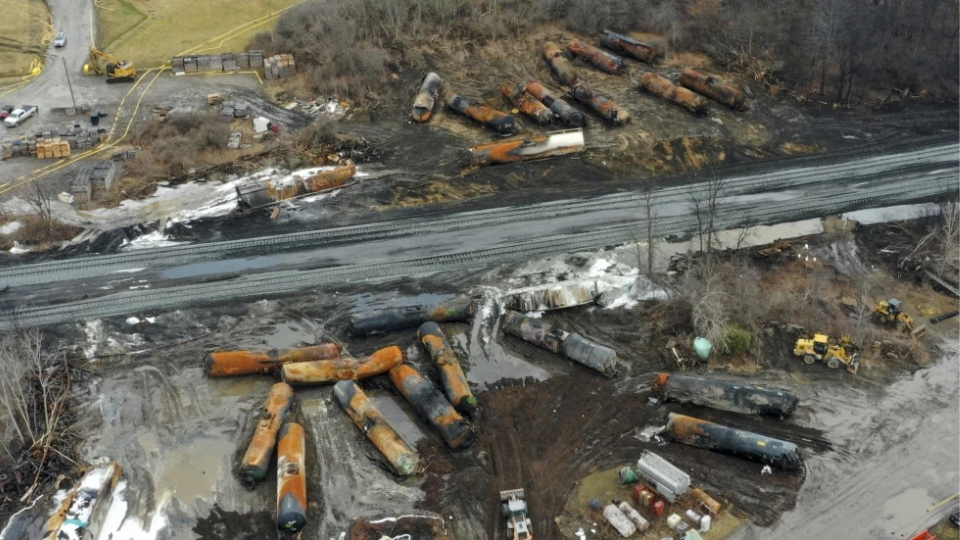
The Trump Federal Railroad Administration bragged it collected 25% more in safety fines in fiscal 2025, compared to fiscal 2024. The 2025 figure includes $3.2 million for breaking rules about carrying hazardous materials—such as the dangerous vinyl chloride and other chemicals loosed in the fire and a mushroom cloud in Norfolk Southern’s freight crash/derailment in East Palestine, Pa., in early 2023.
The AFL-CIO Transportation Trades Department hailed the increased enforcement. But, speaking for the 14 rail unions which together employ 115,000 rail workers, TTD President Greg Regan and Secretary-Treasurer Sheri Semelsberger said that’s not enough.
“While we appreciate the FRA’s enforcement of these fines, the industry’s underlying safety culture is alarming,” Regan and Semelsberger elaborated.
The federal government, the duo said, must step in and force the railroads, especially the six big Class I freight rail firms, to put safety over profits, because they won’t do it themselves. Though Regan and Semelsberger didn’t say so in this statement, the freight rail firms cater to the capitalist Wall Street financiers who invest in their railroads and demand profits and dividends above all.
Transport Workers President John Samuelsen went further and was blunter. The merger itself, he said, is a safety hazard—by increasing automation and decreasing human oversight and control.
“Eliminating human control of our transportation systems inevitably leads to disaster,” Samuelsen warned when Union Pacific unveiled the deal 17 months ago.
The safety cases in the report involve everything from derailments, to fatal injuries to workers, to 14 conductors caught between trains running too close to each other on adjacent tracks and killed in fiscal 2025 in what are called “shoving” incidents. And it doesn’t include the freight railroads’ long opposition to mandatory two-person crews on freight trains, which can stretch for a mile or more.
FRA mandated two-person crews on freight through lines during the Democratic Biden administration, overcoming arm-twisting by the six big freight railroads and their lobby. The railroads then challenged the two-person crew rule in U.S. District Court in Los Angeles, but lost the case on August 11.
A safety record like that cries out for more federal regulation of railroads, forcing safety measures on them, the AFL-CIO Transportation Trades Department said in a detailed statement marking National Rail Safety Week, which ran September 21-27.
Passenger rail commuters, the Transport Workers and Railroad Workers United all go even further. They not only demand rail safety as a priority before profits, but oppose the megamerger as a danger.
The Transport Workers, who represent the Norfolk Southern workers, blasted the merger when Union Pacific unveiled it 17 months ago. TWU President John Samuelsen cited Union Pacific’s “shameful safety record.”
The government caught the railroad “trying to meddle in a safety audit. There is no world where Union Pacific should be controlling a coast-to-coast rail network,” he said then.
“A supersized Union Pacific would be catastrophic for TWU rail workers, shippers, and the safety of millions of Americans who live and work near freight rail lines.
“The presence of a qualified human, or lack thereof, is making the difference between a safe outcome and a reckless one. Examples show policymakers and the traveling public that automation without human input and control across the transportation sector is unworkable and unsafe.”
“Union Pacific cut railroad jobs even as other freight railroads ramped up hiring after the pandemic. They are not to be trusted by railroad workers nationwide and the TWU will fight any attempt to ram through a merger that Wall Street might like but is bad for railroad workers and the safety of everyone,” added TWU Rail Division Director John Feltz.
Railroad Workers United, an organization of rank-and-file rail workers cutting across all rail crafts, also has no doubts the merger is a bad deal, for workers, for rail passengers on Amtrak and the commuter lines, for competition for shippers, for freight rail customers and for the country.
“Working railroaders have seen this movie before: Fewer carriers, fewer competitors, fewer jobs and ever greater power concentrated in ever fewer corporate hands,” it headlined a group of stories about rising opposition to the megamerger.
“The folks who build the railroad, move its freight and surrender their lives to its schedules are always promised that consolidation will make the railroad stronger. Curiously, the strength always seems to accumulate at the top.”
The TTD, the rail unions and the rail workers have all been pushing for comprehensive safety legislation, first authored by then-Sen. Sherrod Brown, D-Ohio, consulting with the unions after the East Palestine disaster. Then-Sen. J.D. Vance, R-Ohio, was an initial co-sponsor. But rail industry lobbying and campaign cash—and a key pro-industry weakening amendment Vance offered—derailed the measure. Vance, now Donald Trump’s vice president, has been silent on the issue.
In this Congress, the Transportation Trades Department and some union leaders push a less-comprehensive but bipartisan Safe Tracks Act, to ensure trained rail workers monitor automatic safety signal systems at all times. It would be a first step towards the more-comprehensive bill.
“In June, BNSF [Burlington Northern Santa Fe] Railway’s use of a computer-automated dispatching system nearly caused a hazmat freight train to collide with a track worker in Washington State. Fortunately, a human dispatcher caught the error and averted the catastrophe. This is only one in a list of examples where this technology failed,” Regan and Semelsberger said.
Overall, the TTD duo added, “The reality is rail workers continue to be put in unsafe situations and are injured, killed, or assaulted on the job. This year, at least three conductors have been injured and one was killed in separate workplace incidents.” That’s plus the 14 dead in the “shoving” cases.
The freight railroads have also sought more than 125 safety waivers in this calendar year alone and are lobbying the Trump FRA to let them roll engines and freight cars for 2,500 miles—literally from coast to coast—without brake inspections by qualified rail workers, Regan and Semesberger noted. The current limit is 1,500 miles.
And the freight railroads, all in the name of profits before people, and safety, also want more exemptions from testing warning gates, bells and lights at surface rail crossings with roads. That’s a hazard to cars, trucks, bicyclists, pedestrians and the trains themselves, such as crossings where long freight trains block Stony Island Avenue, a main commuter route on Chicago’s South Shore.
The Transportation Trades Department, rail unions and Railroad Workers United all push for federal legislation to force the rail carriers to put safety first. So do many shippers and short-line railroads, who fear the merger could put them out of business. The big railroads and their politically powerful lobby oppose mandated safety measures.
Union Pacific has been running ads for months marketing itself as the first coast-to-coast freight rail carrier in the U.S., even though federal officials have yet to bless the deal and even though hearings and evaluation could delay it for another year.
The Rail Passengers Association, speaking for rail commuters, opposes the megamerger, too. Except in the Northeast Corridor between D.C. and New York, where Amtrak owns the tracks, commuter railroads run on—and are subject to–schedules and maintenance, or lack of it, of freight railroads.
“The carriers promise more freight while assuring the public passenger trains will somehow fit into whatever capacity remains, an old railroad custom in which the corporation claims tomorrow’s profits while everyone else is asked to make do with yesterday’s railroad,” RWU said.
“If UP and NS want the power that comes with an empire, the public has every right to demand something more substantial than their assurances.”
No paywalls at People’s World
We hope you appreciated this article. At People’s World, we believe news and information should be free and accessible to all, but we need your help. Our journalism is free of corporate influence and paywalls because we are totally reader-supported. Only you, our readers and supporters, make this possible. If you enjoy reading People’s World and the stories we bring you, please support our work by donating or becoming a monthly sustainer today. Thank you!
CONTRIBUTOR