Hitting two birds with one stone, the U.S. government, top-level disturber of the peace now brandishing a Caribbean armada, is striking out against Venezuela—and Cuba too, indirectly.
The U.S. military on Dec. 10 seized a large oil tanker in the Caribbean bound for China. Then, on Dec. 16, President Donald Trump declared he was imposing a total blockade on all oil leaving Venezuela. The ship stolen last week had offloaded 50,000 barrels of oil to a smaller ship for delivery to Cuba just before U.S. helicopters landed soldiers on its deck.
Cuba depends on oil supplied by Venezuela. High U.S. officials want to cut off Cuba’s access and thereby deliver a decisive blow against its government. Presently, six other tankers sanctioned by the U.S. government and carrying Venezuelan oil are at high risk of being seized.
Cuba’s Foreign Relations Ministry issued a statement saying, in part:
“This act of piracy and maritime terrorism…represents U.S. escalation against Venezuela’s legitimate right freely to use and to trade its natural resources with other nations, including hydrocarbon supplies to Cuba…. [Such] actions have a negative impact on Cuba and intensify the United States’ policy of maximum pressure and economic suffocation, with a direct impact on the national energy system and, consequently, on the daily lives of our people.”

This reference to a “policy of maximum pressure” invites a look at ominous developments unfolding in Cuba as the maritime drama plays out. Cuba’s government has recently resorted to measures that are extraordinary enough as to indicate worsening crisis in the country.
The U.S economic blockade has led to shortages of supplies, food, and income. The impact over the course of decades has been wearing and cumulative. Now, death rates are up, and newer generations are decimated by migration.
Recent measures taken by Cuba’s government, explored below, strongly suggest Cubans face an emergency. U.S. activists responding to their government’s warlike preparations in the Caribbean—another emergency—have good reason to urgently build their solidarity, not only with Venezuela but with Cuba, too.
What follows here is a report on extreme measures recently taken by Cuba’s government. The object is to portray these measures as so unusual as to confirm the existence of Cuba’s last-ditch situation and, that way, motivate Cuba’s U.S. supporters toward action.
Dollarization
Cuba’s government recently introduced monetary regulations allowing citizens to buy and sell some goods and services using the U.S. dollar. A report published by a government-oriented news service refers to a “pragmatic recognition of today’s reality” and to “a partial and controlled dollarization of [Cuba’s] economy.” The government will be “allowing certain economic actors to trade in foreign currencies under specific circumstances.”

The new regulations apply to transactions with foreign manufacturers, investors, traders, shippers, financial institutions—and to families abroad sending remittances. The immediate goal is “to directly incentivize the generation of foreign exchange earnings, allowing those who contribute to this generation to keep a significant portion of their earnings in hard currency.”
The broader purpose is “to increase national production, improve the availability of goods and services, and create conditions for a future return to the strengthened Cuban peso.” Policymakers want to stimulate exports, augment the supply of goods available in Cuba, and increase both national production and foreign investment. Another goal, referred to as “reduction of distortions,” is elimination of informal or illegal foreign currency markets.
The new regulations allow “authorized commercial establishments…[and those] domestic suppliers supporting export or import substitution activities to use dollars and other foreign currencies in international transactions.” Parties permitted to use dollars include authorized self-employed workers, privately owned businesses, cooperatives, and state enterprises.
These parties have permission to deposit dollars in Cuban banks—dollars accumulated from exports of goods and services, from online sales, and from sales realized through the Mariel Special Development Zone. Banks will accept dollars purchased from foreign currency traders and dollars sent as remittances from families abroad.
The government’s new authorization of the U.S. dollar as a national currency may well be unsettling to Cubans perceiving implications of a dependency relationship with the northern neighbor. The necessity to have done so reflects the urgency of Cuba’s current situation.
Economic paralysis
Overtones of a new situation entered into the decision of the Cuban Communist Party’s Central Committee at its meeting on Dec. 13 to postpone the 9th Party Congress set for April 2026. Party congresses have generally taken place every five years since returning to a regular schedule in 2011.
Making the announcement, former president and party leader Raúl Castro emphasized the need to “dedicate all the country’s resources, as well as the effort and energy of the Party, Government, and State cadres, to resolving current problems, and to dedicate 2026 to recovering as much as possible.”
Likewise, the National Assembly of People’s Power, which was due to hold a full session this month, met only for a single day, Dec. 18, by video conference. In 2024, Assembly delegates met in person for two sessions for a total of 24 days.
A spokesperson explaining the shift stated that, as is “known by all, the electricity situation and the current state of the economy, and also difficulties with the [multi-virus] pandemic and the health situation…create a complex situation for carrying out the Assembly. There is the problem, too, of the rational use of resources.”

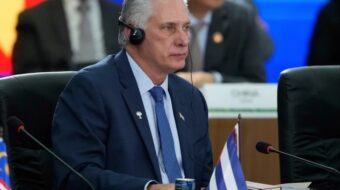
The 11th Plenum of the Communist Party’s Central Committee, taking place on Dec. 13, was also a one-day session; video conferencing provided access for members living outside Havana. Concluding the meeting, First Secretary Miguel Díaz-Canel, president of Cuba, mentioned particularly that:
“At the end of the third quarter, GDP has fallen by more than 4%, inflation is skyrocketing, the economy is partially paralyzed, thermal power generation is critical, prices remain high, deliveries of rationed food are not being met, and agricultural and food industry production is not meeting the needs of the population. There are also the costly losses caused by the devastating passage of Hurricane Melissa.…
“Donald Trump has just launched his pirates onto a Venezuelan oil tanker, shamelessly seizing the cargo like a common thief. This was the latest episode in an alarming series of attacks on small boats and extrajudicial executions of more than 80 people [now 99—editors], based on unproven accusations and amid an unprecedented and threatening military deployment in a declared Zone of Peace.…
“[However,] we are the children of a people who carried out a revolution 90 miles from the greatest imperial power on the planet and who have successfully defended it for more than six decades.… Only a heroic people who defend a revolution, who have the example of the history of that revolution, are capable of enduring what we have been living through all these years.”
Henry Lowendorf of the U.S. Peace Council, queried for this article, highlighted the central role of the U.S. government. He told People’s World: “The U.S. has been trying to crush the Cuban revolution for over 60 years. So far, it has failed. But with new intensity and the newly accelerated war on Venezuela, the U.S. is desperately working to cut off all life support to Cuba.”
A dark setting brightens a bit with good news out of California, however, as reported in the Cuban press. The Los Angeles Hands Off Cuba Committee led in organizing a shipment from Los Angeles to Cuba by way of Jacksonville, Fla., of a 40-foot container with medical supplies worth $1 million. Participating were members of the International Longshore and Warehouse Union and International Association of Machinists, along with Global Health Partners and the PanAmerican Medical Association.
It’s a small example of the much larger effort needed inside the U.S. to both relieve the immediate punishing effects of the blockade and build a campaign to end it permanently.
We hope you appreciated this article. At People’s World, we believe news and information should be free and accessible to all, but we need your help. Our journalism is free of corporate influence and paywalls because we are totally reader-supported. Only you, our readers and supporters, make this possible. If you enjoy reading People’s World and the stories we bring you, please support our work by donating or becoming a monthly sustainer today. Thank you!
CONTRIBUTOR