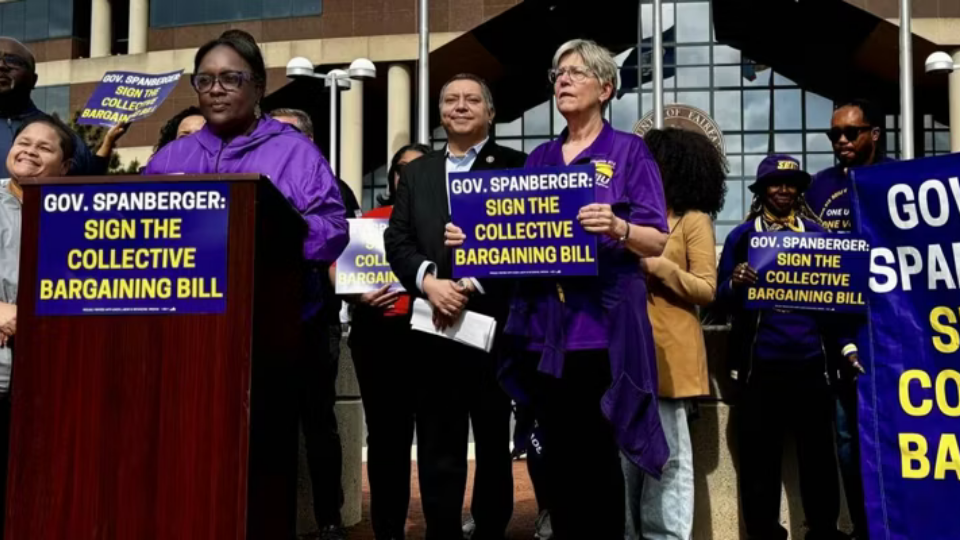
RICHMOND, Va.—Virginia Democratic Gov. Abigail Spanberger’s veto of a bill extending collective bargaining rights to all state and local public workers in the Old Dominion disappointed and dismayed leaders of major unions, plus the state AFL-CIO. The measure would have extended the rights to 500,000 workers.
And it also left some leaders saying Spanberger may not get union backing should she seek public office again. Spanberger was elected last year and, by the state Constitution, cannot run for consecutive terms as governor.
“Virginia public workers will remember who stood with them and who abandoned them when it mattered most,” the Virginia State AFL-CIO declared in its statement.
The new pro-worker Democratic-run General Assembly, whose larger majority rode in with Spanberger in the 2025 off-year election, passed the measure easily this year. The unions had fought for it starting in 2020, as part of their wide-ranging campaign to make the Virginia government more worker-friendly.
Despite a campaign promise to support collective bargaining, Spanberger was silent during the legislature’s session, leaving State Senate Majority Leader Scott Surovell and State Delegate Kathy Tran, both D-Fairfax, to marshal support for it. Surovell and Tran, the Democratic Caucus Chair, got every single Democrat in both houses to vote yes.
Other parts of labor’s campaign in Virginia include curbing corporate influence, especially of big utilities, in the state capital of Richmond, and repealing the commonwealth’s “right to work” law. That law, like an absolute ban on public worker collective bargaining, was passed in the 1940s reaction against FDR by the old-line racist Harry Byrd machine.
Lawmakers replaced the absolute ban in 2020 with a law letting public worker unions negotiate only with cities and counties, which passed local ordinances in advance to permit collective bargaining.
In purple-state Virginia, that meant collective bargaining for public workers in the D.C. suburbs and metro Richmond, but spotty permission in the Tidewater cities and almost none in heavily Republican Southside Virginia and the Appalachian mountain counties.
This bill extended collective bargaining to all public workers, without having to lobby governments to grant it, starting in 2028. One Spanberger objection was that 2028 was too soon for local governments to adjust. She wanted to delay it until 2030.
Spanberger demanded other changes, including letting a future governor nullify the law without a legislative vote. She also refused to pull a provision that state universities lobbied for, exempting their faculty from the law. Most of Virginia’s largest universities are state schools, including the University of Virginia, Virginia Tech, and Virginia Commonwealth. Lawmakers rejected her amendments in their “veto session.” So Spanberger vetoed the whole measure. She did not issue a veto message.
And that left the Virginia AFL-CIO, Teachers/AFT President Randi Weingarten, a New York City civics teacher, AFSCME President Lee Saunders, National Education Association President Becky Pringle, Virginia Education Association President Carol Sauer, the Communications Workers, Fire Fighters President Edward Kelly, and Teamsters President Sean O’Brien very unhappy.
The state AFL-CIO issued a “we’ll remember in the future” promise.
“For generations, Virginia’s ban on public sector collective bargaining has been a stain on our Commonwealth and deeply rooted in a history of denying workers, particularly Black workers, power and dignity on the job,” the federation stated.
“Workers have waited 78 years for Virginia to move forward. Today, Governor Spanberger chose to drag Virginia backward. Every public worker in Virginia will remember who stood with them and who abandoned them when it mattered most.”
“Shame,” said Weingarten, speaking for a coalition of public service unions. “Spanberger betrayed Virginia’s public service workers by going back on her campaign promise to support collective bargaining rights for the people who keep our Commonwealth and communities running every day.” She noted Spanberger’s predecessor, Trumpite GOP Gov. Glenn Youngkin, vetoed the bill, too.
“It is Orwellian for the governor to suggest she supports collective bargaining rights while introducing a version of the bill that delayed extending those rights to local workers until the next decade, inserted a kill switch…that would have effectively allowed a future governor to end collective bargaining without a single vote from the General Assembly, and took workers’ rights in Virginia backwards by weakening existing collective bargaining agreements and reducing worker protections.”
“For too long, anti-worker extremists sidelined working people while starving the public services Virginia families rely on, earning the state a reputation as one of the most anti-worker in the country,” said AFSCME’s Saunders, who chairs the national AFL-CIO’s Political Committee. “Governor Spanberger campaigned on the promise to end this historic injustice. But she has broken that promise by vetoing” the collective bargaining legislation.
“Governor Spanberger made a choice today, and working people will remember it. AFSCME members will continue fighting to ensure every public service worker in Virginia has a real voice on the job. This fight is far from over.”
CWA called Spanberger’s veto “stunning…that any Democratic governor, who ran on easing the cost burden of the working class, would say ‘no’ to such an opportunity” to do so by fully legalizing collective bargaining.
Spanberger “has broken faith with working people across the Commonwealth, turning her back on 500,000 Virginians working in public service…This veto aligns the governor with her predecessor, Glenn Youngkin,” a Republican, “rather than the working people who gave her their trust,” CWA said.
“Gov. Spanberger’s depressing actions in Virginia are an urgent reminder that unions and engaged citizens who care about labor rights must collectively demand more of our elected officials,” Teamsters President Sean O’Brien said.
“We must never assume lawmakers affiliated with any one political party are committed to standing with workers. We must build bipartisan coalitions that actually want to get something done for working Americans and have the backbone to do it.”
In their joint statement, NEA President Becky Pringle, a Philadelphia science teacher, and Virginia Education Association President Bauer, a York County elementary school teacher, recalled the racist past of the collective bargaining ban. The duo pledged they and other unions would continue to fight for full bargaining rights both in the legislature “and at the ballot box.”
“Public employees are not a special interest. They are our neighbors. They are the educators, bus drivers, social workers, librarians, custodians, and first responders who hold our communities together. Denying them the basic right to negotiate as equals with their employers is a step backward for Virginia and an affront to the dignity of public service,” the two teachers said.
“This decision also carries a deep racial and gender impact. Virginia’s public-sector bargaining ban is rooted in a Jim Crow-era effort to silence Black workers at the University of Virginia Hospital who organized for fair pay and dignity” in the 1940s. “Preserving that legacy today disproportionately harms women and workers of color, who make up so much of the public-service workforce and who have the most to gain from fair wages, safer workplaces, and a real voice on the job.”
Fire Fighters President Edward Kelly also slammed the veto. Both IAFF and the Teamsters have large shares of Republicans, either registered or as voters.
“As a candidate, Abigail Spanberger told Virginia’s public workers she would work with the General Assembly to ensure they had a voice on the job, and the right to collectively bargain,” Kelly said. “Our Virginia members and others stood with her throughout the campaign and helped put her in the Governor’s office, based on that commitment. With today’s veto, she has broken her promise.
“Firefighters keep their word every single day on the job. It’s a shame the governor can’t do the same.”
We hope you appreciated this article. At People’s World, we believe news and information should be free and accessible to all, but we need your help. Our journalism is free of corporate influence and paywalls because we are totally reader-supported. Only you, our readers and supporters, make this possible. If you enjoy reading People’s World and the stories we bring you, please support our work by donating or becoming a monthly sustainer today. Thank you!
CONTRIBUTOR