

Editor’s Note: In light of the fact that many members of the local community who have spoken out about Palestinian Liberation have faced severe harassment, we have elected not to publish the names of those quoted or interviewed.
ANN ARBOR, Mich.—At 10:25 pm on Tuesday, March 17th, the University of Michigan Central Student Government (CSG) voted to pass the Divest for Humanity Act—a Resolution brought forward by CSG’s Human Rights Party, which gathered over 1700 petition signatures to bring it up for an official vote. The Ad Hoc Student Committee formed by the Act will be assigned the following three tasks:
- Investigating whether […] investments in companies and financial institutions that are linked to the Government of Israel or its genocide is antithetical to the core missions of the University of Michigan
- Providing recommendations on how the university should proceed with investments in specific companies, financial institutions, stocks and bonds that are linked to the Government of Israel
- Providing recommendations for when any divestment should end, if the Ad Hoc Committee determines that divestment is the best course of action.”
Although the outcome is far from full divestment, even this battle was hard-won. A similar bill was brought to a ballot for a vote by the entire student body two years ago in 2024, when the Palestinian genocide was at the forefront of campus discourse. However, then-President Santa Ono struck the bill from the ballot before votes could be tallied. This time around, the bill was adopted in its entirety and will not need to advance to a student-wide ballot.
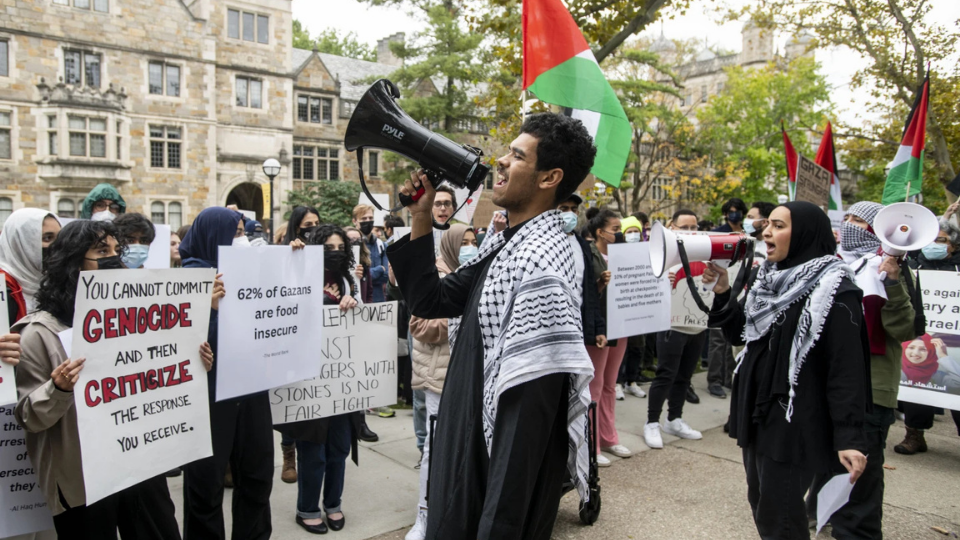
The debate for this 2026 iteration of the divestment bill took place against a very different backdrop: just eighteen days into a U.S.-led war on the nation of Iran. Although turnout for public comments was a little over half the size of the original group of over forty individuals who showed up the previous week to comment on the divestment act, every community speaker who appeared this time spoke in favor of the bill.
One CSG representative joined the community comments to challenge the crowd on why they did not speak about other genocides. Yet the representative quickly insisted that his comment had no connection to the Divest for Humanity Act when reminded about CSG rules barring representatives from discussing legislation outside of official debate.
The only other CSG Representative to speak during community comments opened the section by highlighting upcoming CSG Bill 15-099, which could bar members of the community who aren’t current faculty or staff from speaking in the future. The remainder of the public comments were focused on promoting the Divest for Humanity Act, and speakers took a variety of tactics. Some compared the Act to past student movements such as those to divest from South African Apartheid or Big Tobacco.
Others emphasized the threatening environment that the school administration’s reaction to the Pro-Palestine movement had created for international students and faculty, who now face increased threats of surveillance, Islamophobia, and potential deportation. Many speakers chided specific CSG representatives for behavior that they perceived as attempts to waste time in the discussion and stall a final vote on the bill.
One speaker attempted to draw their students’ attention towards their counterparts in Palestine, highlighting the Israeli Occupying Forces’ annihilation of Universities in Gaza. “I came to the CSG assembly meeting last week… I did not form a statement because I wasn’t sure quite what to say,” the speaker told People’s World.
“I came back to say something because I felt like being able to swing the pendulum in this direction would be nice, but also I felt like there were points that could be highlighted from our previous conversation. Specifically, I spoke about the genocide in Gaza being an education issue because if that is what we as a university want to concern ourselves with, education, I mean, then we should be concerned about [education in Gaza], too.”
Since 2023, the United Nations has recorded direct attacks on more than two hundred schools in Gaza and the complete destruction of fifty-three. In February 2024, The Intercept reported that Israeli Occupying Forces had destroyed every university in Gaza, and no institutions of higher education were left standing. The destruction of these universities also means the destruction of the dreams of the thousands of academics and students who were presently studying there or hoped to do so in the future. It also means the loss of untold amounts of Palestinian scholarship that would have been conducted at such institutions.
Another speaker played a voice recording sent by a University of Michigan professor currently living and working in Tehran, who offered a similar sentiment. Her message highlighted the immense destruction being wrought upon Iran by the Israeli Occupying Forces and the United States, and how schools and universities were being heavily targeted. “This resolution is the least you can do,” she said.
The two representatives who spoke during community comments repeatedly requested extended time to ask questions of many of the speakers. Public comments ended around 9:30 pm, exceeding the typical 45-minute time limit by over 20 minutes. It was then time for the council to debate the bill.
In contrast to the significant turnout for public comment, only five CSG council members chose to participate in the debate. One representative, a member of CFG’s Human Rights Party, began by outlining the bill’s historical precedent, citing both past University policy and reports on the destruction of Gaza by respected human rights watchdogs such as Amnesty International and the Human Rights Council. They also noted the number of students they personally spoke with about the bill who had family members killed by the Israeli military or who had been made to feel unsafe by the Israeli apartheid regime.
Another representative thanked community members for attending, then expressed skepticism about the bill, saying they doubted it would change anything on campus because of its “narrow” scope.
The next representative to speak accused the act’s proponents of using the resolution as a tool for political polarization just before CSG elections, which will be taking place at the end of the month. He encouraged attendees to delay action, continue dialogue, and to shift their focus to aggression being enacted against the people of Sudan, the people of Yemen, and the Uyghur ethnic groups in China.
“[That] is the textbook response of governments that are committing genocide,” a Human Rights Party representative fired back, then addressed the community participants, “Given the violence Israel has committed, if it was any other government, we would not be funding them anymore… You cannot have a country for just one People.”
Another Human Rights Party representative weighed in next. “We have talked. We have had dialogue. This has been on our minds day in and out…At what point do those conversations become productive? If all we have are conversations, then we are stalling the issue.”
This representative had the final word. “This resolution was not made to just talk about what was going on in Israel. We should not be investing in anything that is promoting violence abroad.” They again drew attention to the number of community members who turned out to speak at two separate meetings: “As you can see, a lot of people care a lot about this.”
Debate ended, and voting began to adopt the resolution without sending it to a student-wide ballot. Of the 31 representatives present, 19 voted “Yes”, 7 voted “No”, and 6 abstained. Upon announcement of the results, the participants who came for public comment applauded. Yet the celebration was brief, as the congregants quickly acknowledged that the fight for divestment was only just beginning.
Two of the Human Rights Party members who spoke at the debate gave statements to People’s World about what’s next for the University’s movement to divest from genocide:
“After this long year of successes and setbacks with Divest for Humanity, the people’s voices on campus are finally heard. While we can celebrate our first step towards divestment, we are nowhere near finished and must continue to pressure the regents. We must work diligently to get those who are willing to advocate for us within these administrative circles; people like Summit Louth for Central Student Government President and Amir Makled for Regent.”
“The passage of the Divest for Humanity Act student initiative is a major victory, but it is far from the end of the fight. It is a victory for the pro-Palestine, anti-genocide movement, and it is a victory in the fight to restore trust in expertise and truth. The University of Michigan student body and its representatives have spoken decisively in favor of humanity, the rights of all people, and against Israel’s genocide.”
“This initiative was one of, if not the most, student-backed student initiatives in the University’s history, garnering over 1,700 student signatures and passing the assembly by a vote of 19 to 7. The students have placed themselves on the right side of history, on the side of expertise, and on the side of Human Rights. Now is the moment when the students must ensure that the University Board of Regents and all of their elected officials join them!”
When discussing next steps, the Human Rights Party member noted, “We must show up to the Michigan Democratic Convention on April 19th to elect Amir Makled, a regent who will actually listen to the students. We must show up to the polls in August and November to elect Abdul El-Sayed to the U.S. Senate. Again, the passage of this Act is a major victory, and we must ensure that over the next year, we are changing who holds the seats of power at every level of government, and electing those who will stand with us in solidarity against Israel’s genocide of the Palestinian people and all violations of human rights.”
We hope you appreciated this article. At People’s World, we believe news and information should be free and accessible to all, but we need your help. Our journalism is free of corporate influence and paywalls because we are totally reader-supported. Only you, our readers and supporters, make this possible. If you enjoy reading People’s World and the stories we bring you, please support our work by donating or becoming a monthly sustainer today. Thank you!
CONTRIBUTOR


MOST POPULAR TODAY

As Iran war rages, Netanyahu builds ‘Greater Israel’ from Palestinian and Lebanese land
Trump’s catalog of constitutional crimes: Long and getting longer

The Case of the Hollywood 10: Movie moguls launch blacklist in 1947

Sixty monuments under fire: The U.S.-Israeli assault on Iran’s cultural memory

Trump’s Postmaster General says USPS may shut down in a year