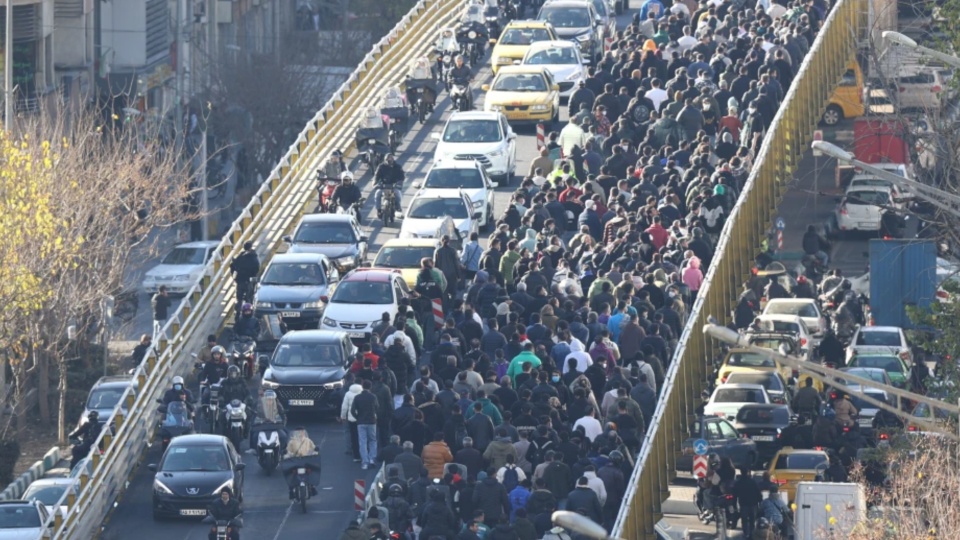
At the turn of the year, the Islamic Republic of Iran is facing its most significant internal crisis for many years. At the end of December, what began as localized frustration over a stagnant economy mutated into a full-scale national emergency.
Since Sunday, Dec. 28, the streets of Tehran have been filled with thousands of protesters who say they can no longer afford to live.
The latest spark of unrest, following on from a wave of strikes over recent years and the ongoing protests of the Women, Life, Freedom movement, is the catastrophic devaluation of the national currency. On Monday, Dec. 29, the Iranian rial plummeted to a historic low, trading at approximately 1.42 million to the U.S. dollar on the open market. Just month earlier, the rate stood at roughly 1.14 million to the US dollar.
The collapse of the currency has meant a massive cut in the value of wages for Iranian workers and their families, plunging more into even worse poverty than they were already experiencing.
Official figures from Iran’s statistics center show inflation reached 42.2% in December, while food prices have surged by a staggering 72% annually. Health and medical costs have also spiked by 50%, fuelling fears of imminent hyperinflation.
Exacerbating the government’s mismanagement, of course, are punishing sanctions imposed by the U.S., EU, and other Western powers. The combined impact of this economic turbulence—out-of-control inflation plus devastating sanction warfare—is a driving factor behind the widespread unrest in the capital Tehran and across many other major cities in the country.
The impact has also been felt in the commercial sector. In Tehran’s commercial heart, shopkeepers have initiated a strike they call “forced bankruptcy.”
From the Aladdin and Charsou mobile phone malls to the historic Grand Bazaar, shutters have been pulled down as merchants realize that every sale at current prices is a net loss, making it impossible to restock inventory.
The regime has, through President Masoud Pezeshkian, accepted the inevitable resignation of Central Bank Governor Mohammad Reza Farzin. His place has been taken by the re-appointed Abdolnaser Hemmati.
Hemmati, who previously led the bank and served as finance minister, was himself the target of a recent impeachment vote in 2025. To many protesters, his return is a sign that the regime has run out of ideas and is simply reshuffling the same failed leadership while the country burns. It is a move that has been met with derision on the streets.
While the bazaar strikes are making headlines, there is profound anger from the working class and the disenfranchised resulting in the recent demonstrations.
Monthly wages now average barely $100, far below the poverty line of $450 required for a household of three. The 2025 budget has only deepened the sense of “budgetary apartheid.” While the government has proposed a 20% increase in public sector wages, this is less than half the official inflation rate.
The government in Iran has also raised petrol prices recently, triggering warnings about a potential repeat of violent 2019 fuel protests in which security forces killed hundreds, in what was then the deadliest unrest since the 1979 Islamic Revolution.
Protesters have pointed out the bitter irony that while they are asked to “take a war formation” and endure austerity, the budget for ideological military wings has reportedly seen massive increases. One representative from Dehloran recently asked President Pezeshkian in parliament if he could “hear the crushing sound of the people’s footsteps.”
The demands of protesters have not been confined to the issues of wages and the economy but have become increasingly political, demanding regime change, with protests echoing to chants of “death to the dictator,” aimed at Supreme Leader Ali Khamenei.
The regime’s response has been the familiar mix of threats and force. Judiciary chief Gholamhossein Mohseni Ejei has warned of harsh punishments for “hoarding foreign currency,” while police have fired tear gas to disperse the biggest crowds seen since the protests following the death in custody of Mahsa Amini in September 2022. Hundreds of people were killed, more than 20,000 arrested, and several executed in connection with those demonstrations.
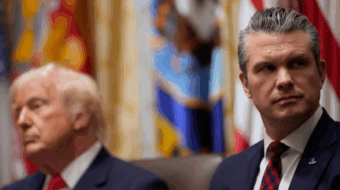
The situation in Iran is being watched closely by both Israel and the United States, as the threat of further action against the regime from both looms. President Donald Trump has recently threatened military action if Iran rebuilds its nuclear or missile programs, warning he will “knock the hell out of them.”
For the Iranian people, 2026 sees yet more uncertainty, arising from the internal pressures of a collapsing economy and the external pressures of both international sanctions and the threat of further military intervention.
As it moves into the new year, the Iranian government is under increasing pressure. It cannot match wages to inflation without triggering a hyperinflationary spiral, yet it cannot suppress a hungry and increasingly angry population indefinitely.
Khameni said on Sunday that “rioters must be put in their place,” apparently encouraging the security forces to crush protests. At least 15 people have been killed so far, according to rights activists.
For the millions of Iranians who have seen their life savings vanish in a matter of weeks, the demand is no longer for a new Central Bank director—it is for a new way of life entirely.
The struggles of Iranian workers, for democracy and social justice, are inextricably bound up with the demands for peace and resistance to foreign intervention.
It is clear that the existing regime in Iran is unstable and incapable of meeting the needs of the Iranian people.
Ongoing support for pressure from the working class and its organisations, allied with youth, students and women’s groups, to make changes in Iran that will favor the people, not a corrupt theocracy, will be vital as this year unfolds.
We hope you appreciated this article. At People’s World, we believe news and information should be free and accessible to all, but we need your help. Our journalism is free of corporate influence and paywalls because we are totally reader-supported. Only you, our readers and supporters, make this possible. If you enjoy reading People’s World and the stories we bring you, please support our work by donating or becoming a monthly sustainer today.
CONTRIBUTOR