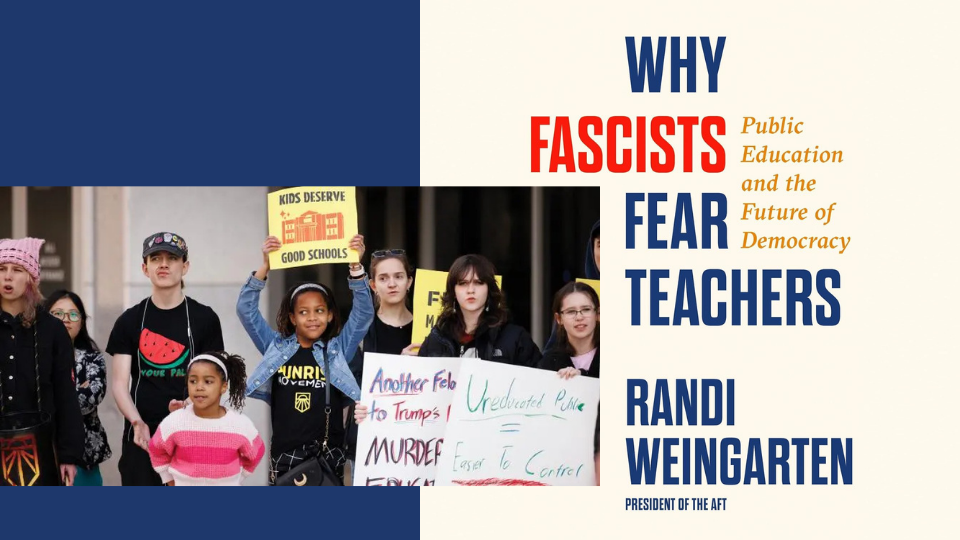
Like public school teachers generally, Randi Weingarten is a big fan of America and what she calls “American democracy.” She deeply believes in this country’s Constitutional processes—free elections, the Bill of Rights, checks and balances, everyday civic participation, and social institutions. In her new book, Why Fascists Fear Teachers, however, she shows that—in her words—fascists, authoritarians, the billionaire class, and anti-government ideologues are out to destroy those institutions, divide the people, and dominate not only the political instruments of power but also the way we think and act.
Using careful citations of media coverage of events, scholarly analysis, and well-researched reports, this book documents how Trump and his followers have led the charge to weaponize fears and anger about the declining U.S. economic position in the world, turning Americans against each other instead of solving problems. Her primary focus is on how Trump’s movement has targeted public school teachers, the institution of public education, and teachers’ unions as the leading edge of their destructive efforts. Weingarten details how Trump’s people and their devoted followers personally called her “the most dangerous woman” in the country and accused public school teachers of creating “terrorist cells” in their classrooms.
Weingarten explores the impact of authoritarian attempts to suppress education by banning curriculum that asks students to confront controversial topics, imposing book bans in schools and public libraries, and ridding schools of diversity and equity initiatives. She takes on the hard-right “Moms for Liberty” as a major example.
In 2022, this millionaire-funded group won a handful of close-margin school board elections, campaigning on false claims about schools performing “gender confirmation surgeries.” When they took power, they imposed book bans and targeted schools for censorship of controversial topics, prompting parent lawsuits. She notes one emblematic situation in the Central Bucks School District near Philadelphia, where the “Moms for Liberty”-controlled school board members refused to fix the schools’ air conditioning systems and instead spent millions defending themselves in lawsuits by parents. It was as if they were intent on financially devastating the school system rather than solving real problems.
Weingarten notes that ninety percent of Americans send their children to public schools and, regardless of their political affiliations, almost unanimously want an effective public education system. And while public school teachers and systems have weathered campaigns to privatize schools, to eliminate teachers’ unions, and to cut funding over the past two generations, Trump and his followers represent the greatest danger so far. She explores and documents numerous strategies Trump appointees and supporters have pursued since gaining power last January. The intent is to control the institution of education to undermine democratic processes. It is a power grab, Weingarten argues, by fascists, authoritarians, and oligarchs to deepen and extend their dominance of U.S. society. Controlling education through attacks on teachers and schools is meant to control how Americans think, she concludes.
Teachers aren’t taking this lying down, however. In the main chapters of the book, Weingarten outlines four fundamental roles that public school teachers play in sustaining the democratic order: teaching critical thinking skills, facilitating safe and welcoming spaces for children, creating opportunities, and building strong unions. Weingarten believes that fascists, authoritarians, and oligarchs are most afraid of these four pillars of education for which teachers are most directly responsible.
What is critical thinking? It is a term derived from decades of educational research on how people learn, develop independent thinking skills, and take constructive social action. Critical thinking must be distinguished from conspiratorial thinking. The word “critical” doesn’t mean that any fact or claim about reality is automatically wrong. Instead, it refers to confronting a fact or event through evidence-based inquiry, recognizing that researcher-scholars have studied most things in careful detail for many years in scientific ways, engaging in dialogue about the findings from differing ideological perspectives, and applying those findings to new situations. Students who participate in this process are more likely to be immunized from indoctrination, which is a process that demands belief and acceptance of mandated facts or theories—precisely the goals of Trump’s movement. Weingarten states that public school educators teach critical thinking and, therefore, are targeted by Trump’s followers for censorship and punishment.
For example, Trump’s attempts to ban teaching controversial topics like the history of slavery and racism, the human origins of climate change, or topics related to struggles faced by LGBTQ communities undermine the capacity for critical thought. In their place, Trump would impose a regimented curriculum that denies historical realities and human biological diversity, pretending instead that the past was only good and that humans can continue to destroy the planet’s atmosphere without consequence. In place of critical thinking, we have seen Trump officials deploy conspiratorial thinking—false claims about Tylenol causing autism, various false claims about vaccines, and absurd statements about human biological processes. Not only does conspiratorial thinking undermine the country’s technical and scientific capacity, making it the laughingstock of the world, but it also imposes a condition of indoctrination enforced by law.
By way of another example, when Trump said in a 2024 campaign speech that he’d “heard” George Washington “probably didn’t own slaves”—a claim no one in his campaign or even Trump himself genuinely believed—he was demonstrating the kind of indoctrination he demands. His false claim about Washington shows that he thinks schools should only teach positive “social archetypes.” Historian and teacher James Loewen defines social archetypes as sanitized or falsified versions of historical figures or events created to push certain myths or ideologies. Washington was a key leader in the founding of the U.S., which, according to the social archetype, was built on ideals like freedom and equality. But the reality behind the myth is that many of the key founders were slave owners, a fact that contradicts the myth.
Trump’s false statement is buttressed by the additionally fabricated claim that Washington freed his slaves in his will. The historical record, however, shows that Washington, in his will, freed only one of the hundreds of people he owned over the course of his lifetime. And while Washington had reservations about the institution of slavery—like several other prominent political figures of his time—he did nothing, given his outsized influence over the political direction of the country at the time, to end it. In fact, the historical record shows that many enslavers thought about doing away with slavery only because they disliked the insurrectionary element in this system, especially after the British military in 1775 promised freedom to Africans who joined London’s side. They feared that the British or other European powers would use a similar tactic in the future. After the revolution, the enslavers who dominated the Continental Congress and bankrolled the revolution preserved the system because their personal fortunes depended on it and because they couldn’t imagine a society in which they lived side-by-side with entirely free Black people. To be sure, other leading forces in the colonies were anti-slavery, but their influence over subsequent events—as evidenced by the outcome—was negligible in comparison.
These additional facts require critical thinking to wade through. They pose serious questions that should be struggled with, not avoided.
For example, if the U.S. was founded on freedom and equality, who did they believe deserved it? How did the “founders” reconcile owning people and gaining their wealth and power from that fact with these ideas about freedom and equality? Did they define the people in the “human” category as being from a particular racial and gender category? Since many “founders” are known to have privately opposed slavery on moral grounds, is it even appropriate now to claim that we should ignore their outdated values?
As these questions demonstrate, critical thinking about historical realities also demands an application of ethical reasoning. Ethics is a branch of philosophy, universal to all human societies throughout their histories, that questions what is right or wrong. It demands that we think about what justice is and how we know it. Specifically, ethical reasoning asks us to separate our logic, our inquiry using evidence and facts, and our assessment of right and wrong from received cultural norms or religious values, and the whims of the ruling class. It doesn’t ask us to abandon our inherited values; instead, it encourages us to question and potentially modify received morals. This element is foundational for the idea that humans can change and improve the world.
If we accept the demand that only positive myths about the past must be taught and studied, we will deliberately deprive young people—during a crucial period of their brain development—of the capacity to rationally determine what is right or wrong. And, by doing so, the resulting indoctrination may lead to the creation of a society where people believe that sustaining myths as such is acceptable by any means. That social order could encourage people to see it is reasonable to harm other people to preserve exploitative and oppressive social relations that just so happen to maintain the status quo dominance of the billionaire class. After all, despite whatever moral reservations he privately claimed to have, George Washington and most enslavers willingly used violence, up to and including killing, to control the lives of Black people they claimed to own.
The solution Weingarten sees to this problem—the world Trump wants to create—lies in a working-class-led struggle for democracy. That is the topic of the fourth chapter of the book, “Teachers Create Strong Unions.” About two-thirds of public school teachers are members of one of the two teachers’ unions, the National Education Association or the American Federation of Teachers. The contracts that determine their wages, benefits, and work conditions are always limited by laws that define curriculum, increasingly impose standardized testing, and support campaigns to cut funding for public schools, along with other fights related to the health and welfare of working-class kids and families. This reality elevates the political consciousness of most public school teachers who realize they are not just fighting to protect their standard of living, but are fighting for the families who rely on their schools. Weingarten cites the campaigns by Chicago public school teachers and their many successful fights to turn around that city’s complex school systems. She shows how “there’s no democracy without unions,” because they are the main vehicle for working-class power. Without unions, workers fight a losing battle against billionaires for mere self-preservation.
This book shows how public schools, teachers, and families are heroes at the heart of a decisive struggle for democracy. And Weingarten is a true believer in the necessity of winning this fight. Her book gives us hope that yes, we can.
Why Fascists Fear Teachers: Public Education and the Future of Democracy
By Randi Weingarten
New York: Penguin Random House, 2025
We hope you appreciated this article. At People’s World, we believe news and information should be free and accessible to all, but we need your help. Our journalism is free of corporate influence and paywalls because we are totally reader-supported. Only you, our readers and supporters, make this possible. If you enjoy reading People’s World and the stories we bring you, please support our work by donating or becoming a monthly sustainer today. Thank you!
CONTRIBUTOR