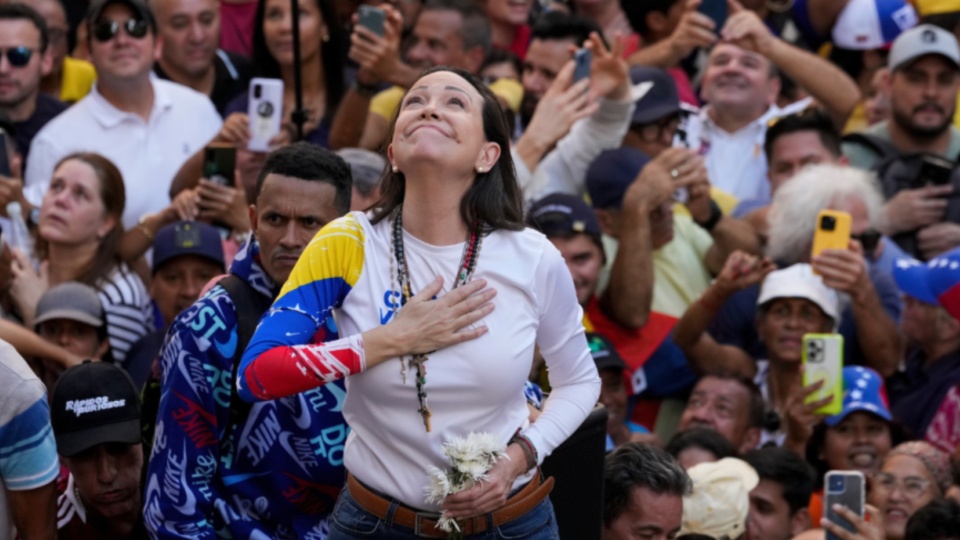
Venezuelan political leader María Corina Machado recently received the Nobel Peace Prize. Her selection prompted a flood of criticism, but the reporting hasn’t accounted for why it happened.
Despite the image it presents of itself, the Nobel Committee is not neutral in matters of world politics. In the case of its peace prize awardee this year, it is taking the side of the wealthy and powerful in Venezuela’s ongoing conflict of social classes.
María Corina Machado has long served Venezuela’s propertied elite in word and deed. She and her family epitomize Venezuela’s ruling class. As for the Nobel Committee, it has a record of neglecting to even consider candidates who are really fighting for fundamental, progressive political change.
Holding the fort
Over the past couple of decades, Machado has been a central leader in efforts to bring down governments led by Presidents Hugo Chávez and Nicolás Maduro that, under the aegis of Venezuela’s Bolivarian Revolution, have pursued regional unity and socialist change.
Encountering electoral defeats, right-wing opposition forces splintered and lost strength. Machado has pushed back, though, relying on irregular, often illegal, methods. Prosecuted, jailed, or threatened with legal consequences, other far-right Venezuelan figures left for exile, but Machado remains.
And she is very active:
- Machado signed a citizens’ statement of support for the failed right-wing coup against Chávez led by empresario Pedro Carmona Estanga in April 2002.
- Her Súmate organization attracted millions of U.S.-supplied dollars that were used for supporting right-wing electoral candidates and the irregular recall vote against Chávez in 2004.
- Machado was sentenced to 28 years in prison for her participation in the 2002 coup and for Súmate’s acceptance of U.S. funding. Chávez pardoned her.
- She went on to recruit and organize financial support for the “guarimbas.” These were violent, sometimes lethal, anti-Maduro Street demonstrations taking place in 2014 and 2017.
- According to one report, Machado in 2018 asked Israeli Prime Minister Benjamin Netanyahu to intervene militarily in Venezuela, and she allegedly participated in an assassination attempt against Maduro in 2014.
- From 2017 to the present time, Machado has repeatedly expressed support for U.S. economic sanctions against Venezuela.
- Machado collaborated with Venezuelan parliamentarian and fake president Juan Guaidó in arranging for the U.S. government to take over Venezuela’s Citgo and Monómeros oil companies and in depositing Venezuelan gold in the Bank of England. Based on those actions, a court disqualified her from occupying public office for 15 years. She was thus unable to run for president in 2024.
- When the Nobel Committee announced its decision, Machado stated on social media, “I dedicate this prize to…President Trump for his decisive support of our cause.” Analyst Ben Norton indicates, “Machado has openly called for the U.S. military to invade Venezuela … [She has] endorsed the U.S. military’s extrajudicial executions of Venezuelans in boats in international waters.”
- According to budsoffshoreenergy.com, Machado “wisely calls for privatizing Venezuela’s oil and gas industry.”
Top of the heap
The credentials of Machado’s family as foremost among Venezuela’s owning and ruling class are beyond question. According to mazo4f.com, Machado “grew up with the idea inculcated by her family that she owns our country and deserves through divine right to rule over it.”
The report continues: Her father Enrique Machado Zuloaga was a major shareholder and president of the Caracas Electricity Company. He owned a big share of Sivensa steel company, of which her uncle Oscar Machado Zuloaga was president. Her father had shares in the Mercantile Bank, VIASA airlines, and Tacoa investments, established by Caracas Electricity Company, to “diversify” its holdings.
Maria Machado’s first cousin, Luis Ignacio Mendoza Machado, was formerly president of VIASA Airlines, which on being absorbed by Spain’s IBERIA Airlines, has been a source of commissions for the Machado Zuloaga business group. The family has also been noted as one of the “major slave owners” in Venezuela’s colonial era.
Machado’s mother, Corina Parisca Pérez, a former tennis champion, “belongs to one of the wealthiest families in the country.” She joined her daughter in signing the decree installing the coup government in 2002. She was named to the National Electoral Council, along with Pedro Carmona Estanga, the coup leader himself.
Machado’s former husband, Ricardo Sosa Branger, is a “member of one of the most ultra-conservative families of Caracas.” A report states that, “The Branger family is part of the…oligarchy that controlled the agri-food industry in the center of the country until 2014.”
Friends where it counts
María Corina Machado has ample welcome in elite circles in the United States. She graduated from the Dana Hall School in Wellesley, Mass. In 2009, she spent four months with Yale University’s World Fellows program, which annually hosts 16 “global leaders” who “contribute to Yale’s intellectual life.” Included have been Alexei Navalny, the Russian dissident who died in prison in 2024, and Jake Sullivan, national security advisor in the Biden administration.
President George W. Bush spent an hour with Machado in the Oval Office in 2005. She was visiting in her capacity as head of Súmate, which, according to the White House, defends “the electoral and constitutional rights of all Venezuelan citizens.”
Machado’s affection for the United States government is reciprocated. In August 2024, a few right-wing U.S. congresspersons communicated with the Prize Committee, saying, “We write to you in support of the nomination of María Corina Machado for the Nobel Peace Prize.”
Nobel bias
Nobel Peace Prize recipients have often been individuals or organizations loyal economically and politically to the established order. Others have facilitated the signing of treaties, the ending of wars, and the formation of peace-oriented international organizations.
Awardees have included states, organizations, agencies, legal groups, and individuals that provided relief for refugees, victims of humanitarian disasters, and prisoners. Practitioners of non-violence do get recognition, but Mahatma Gandhi, protagonist of a political upheaval, did not.
When socialist states or socialist groups face troubles, candidates associated with that process sometimes find themselves in line for the prize. Andrei Sakharov, Lech Walesa, Mikhail Gorbachev, and Andrei Sakharov were all honorees whose wins accompanied the fall of the Soviet Bloc. Henry Kissinger and Vietnamese Communist Le Duc Tho won the Prize in 1973 after negotiating the ceasefire in Vietnam. (The latter refused the award.) Kissinger had facilitated anti-communist blood baths in Chile and Indonesia.
President Juan Manuel Santos received the Nobel Peace Prize for the 2016 Peace Agreement between his Colombian government and the FARC Marxist insurgency. Once the agreement was signed, the latter no longer existed.
A final note: The award this year to Machado reflects sordidness of two kinds. Monied interests chose Machado, and the process was fraudulent. Just after midnight on Oct. 12, the Polymarket prediction platform registered 3.75% probability that Machado would win the Prize and 69% a few hours later, when the announcement was made. Three betters won 25,000 euros. Someone got rich from a leak, it would seem.
As with all op-eds published by People’s World, the views expressed here are those of the author.
We hope you appreciated this article. At People’s World, we believe news and information should be free and accessible to all, but we need your help. Our journalism is free of corporate influence and paywalls because we are totally reader-supported. Only you, our readers and supporters, make this possible. If you enjoy reading People’s World and the stories we bring you, please support our work by donating or becoming a monthly sustainer today. Thank you!
CONTRIBUTOR