MOUNT CLEMENS, Mich.—With a high-stakes union election set to close Wednesday night, over 350 workers at the Axalta Coating Systems plant are organizing and fighting to join the United Auto Workers (UAW) in a vote that could reshape one of the nation’s largest automotive paint suppliers.
The workers, who once had union representation when the plant was owned by Ford, say years of management changes—from DuPont to Axalta—have brought steady cuts to staffing and benefits, inconsistent workplace rules, in addition to safety concerns and growing fears of austerity under a planned merger.
The looming election comes as Axalta prepares to merge with AkzoNobel, creating a global coatings conglomerate with a reported $17 billion in annual revenue and an enterprise value of $25 billion. Workers at the Mount Clemens facility, which supplies paint to all of the Big Three automakers, say the corporation’s real plan is not growth but cutbacks.
“They don’t follow any policies anymore from DuPont,” said Jared Greenia, who works in maintenance on the B shift. “They have what they call ‘Management Select.’ If you walk 100 feet in any direction from the center of the plant, you’re gonna find a different set of standards, rules, etc. and that shouldn’t be. There should be a common policy for every worker, and we’ve had enough.”

Greenia told The Valley Labor Report that the merger’s internal plan makes no mention of expanding the customer base. “So, with that,” he said, “there is only one other way of bringing in that kind of money.” Austerity, cutbacks, and layoffs.
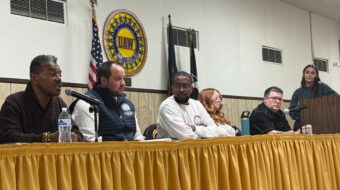
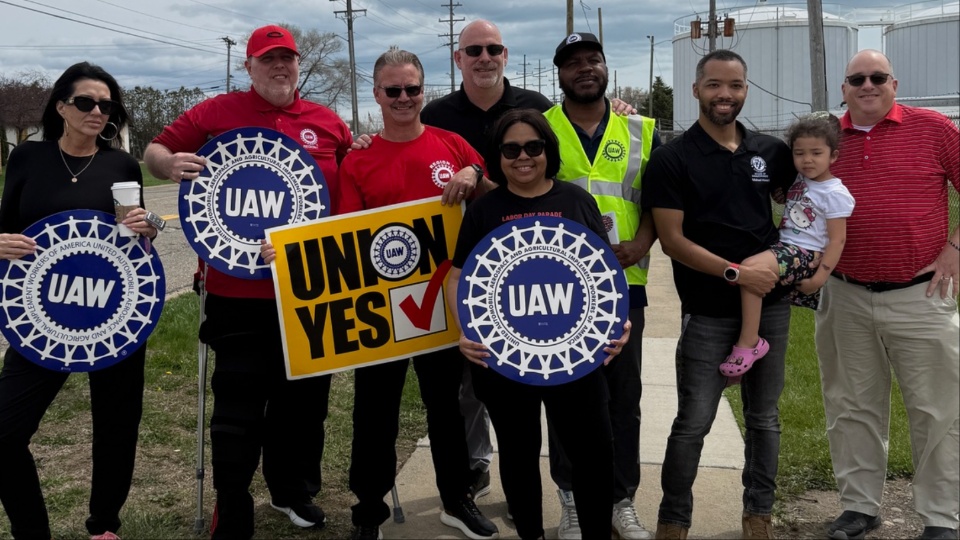
People’s World spent the afternoon outside the plant gates Tuesday speaking to workers and organizers as they geared up for the election. The workers were previously represented by UAW Local 400 when the plant was a Ford facility, but the union was later decertified. A prior organizing attempt under DuPont in 2016 fell short on election day. Now, under management by Axalta, the workers here are trying to bring it home.
“Axalta, they basically kind of run the market in the automotive paint industry,” Jason Bastien, lead organizer for UAW Region 1, told People’s World. “All the paint on all the cars you see comes out of this facility.”
Bastien described a relentless anti-union campaign by Axalta, which hired a union-busting firm, the Cummings Group. “First, it was two [busters], and now it’s a dozen of them,” he said. “Frankly, it is one of the largest union-busting operations that I’ve ever dealt with.”
The company’s operating budget for union-busting is roughly $3,700 per day plus expenses. “But our support is still very, very strong for these workers,” Bastien said.
Ray Pecoraro, Assistant Director of UAW Region 1, framed the fight in broader terms. “Having a voice, having a union, having some guidance, having people to lean on, could be the difference between being gainfully employed or on the unemployment line,” he said. “We see it so much in today’s society with rampant corporate greed.”
Pecoraro noted that the plant runs on eight different shifts, making organizing a logistical challenge. He also connected the Axalta workers’ struggle to the UAW’s recent Stand Up Strike against the Big Three. “Believe it or not, we made $16 billion in profits for them, and they wanted to give us a 10% reduction,” he said. “It is just greed at levels that we haven’t seen.”

Outside the plant gates, they pointed to a staggering statistic: In the last decade, the top 25 corporations that UAW represents made a combined $563 billion in profits. Yet $530 billion of that was funneled back to shareholders in the form of stock buybacks and dividends.
“Instead of going to jobs, new plants, infrastructure, wages, you name it, these guys just got richer and richer yet keep claiming broke at the bargaining table,” Pecoraro said. “Give me a break.”
For Linda Mitchell, a production operator at Axalta, the decision to organize is deeply personal. “I like my job. I enjoy conversation with co-workers. I share their joys and the burden of their losses… but the stress caused by Axalta supervisors and management,” she said. “The nausea, anxiety, sleepless nights even when things are going well.”
Mitchell described being singled out for scrutiny, unfair treatment, and retaliation. “How do you navigate the terrain with no advocate?” she asked. “No strategy is ever successful when you don’t have an advocate to represent you. That’s why I’m organizing with the UAW.”
As the election approaches, workers are making their final appeals to one another. “I’ve worked at this company for 15 years,” said Greenia. “With today’s financial concerns, I cannot take the risk of a reduction in pay or benefits. I’m voting yes to keep what I’ve earned. I’m voting yes for the union!”
Tricia Graves, a lab quality tech on the first shift, added: “In the lab, we’ve been left out and ignored by the company. Compared to other companies with chemical labs, we’re underpaid. It’s an insult. I’m voting yes for the respect we deserve!”
The Axalta workers’ vote is the latest front in a growing wave of new union organizing across Michigan—from the auto plants to the hospitals. And as Pecoraro suggested, the stakes could not be clear: When 1 percent hoards the wealth, the 95 percent fights back.
“If you think you’re gonna be able to accumulate everything with 1% of the people, and forget the other 95%,” Pecoraro said, “guess what, that 95% is gonna attack you eventually. That’s where the UAW’s slogan of ‘Eat the Rich’ comes from.”
We hope you appreciated this article. At People’s World, we believe news and information should be free and accessible to all, but we need your help. Our journalism is free of corporate influence and paywalls because we are totally reader-supported. Only you, our readers and supporters, make this possible. If you enjoy reading People’s World and the stories we bring you, please support our work by donating or becoming a monthly sustainer today. Thank you!
CONTRIBUTOR