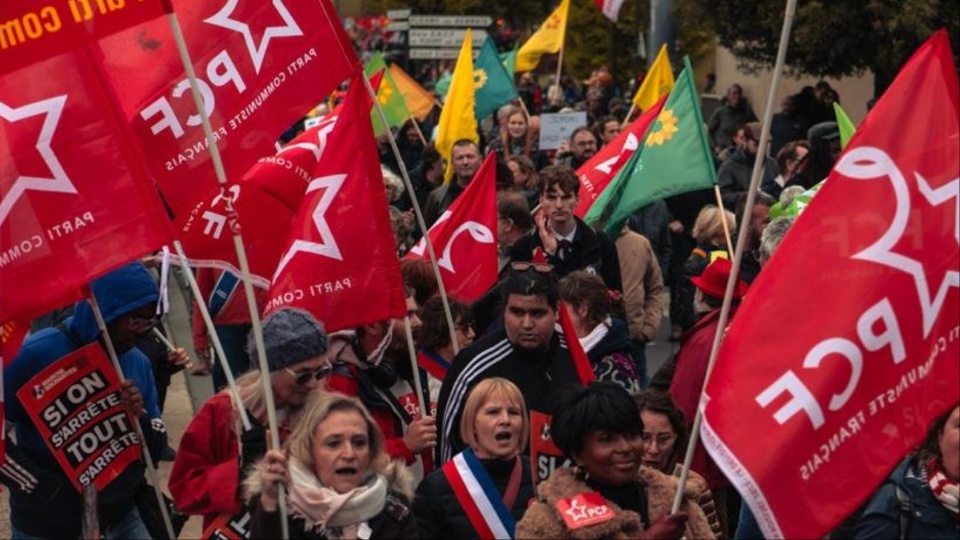
PARIS—As France enters a period of profound social upheaval, the country’s high school students have stepped to the front lines of the class struggle, joined by trade unionists, retirees, and other popular forces, to demand an end to the war economy and the austerity policies of President Emmanuel Macron.
Over the past several weeks, a wave of student mobilizations has swept the country, with blockades shutting down nearly 900 high schools in October alone, coupled with a nationwide general strike on Nov. 5. The youth are linking their immediate struggles against the deterioration of public education to the broader fight against austerity, privatization, and the rising threat of the far-right and imperialist war.
People’s World recently met with Emma Save, a representative of the Mouvement des Jeunes Communistes de France (Young Communists Movement of France, the MJCF), to discuss the scale of the student uprising, the fight to abolish the Parcoursup university admissions system, the importance of student-worker unity, and the political horizon for the French left.
This interview has been edited for clarity and length.
People’s World: The scale of the high school mobilization in France right now is unlike anything seen in a long time. Can you describe what is happening on the ground and the demands driving this movement?
Emma: The current mobilization is unprecedented in its scale, particularly in high schools. On Oct. 1, we reported that nearly 900 high schools had been blocked, including more than 400 with our initiative or participation. These figures illustrate the scale of the movement, although the number of blocked schools fluctuates from one day to another.
The MJCF has been working for years to politicize high school students around Parcoursup, the deterioration of educational conditions, and the broader struggle for equal access to education. We are among the forces initiating blockades, helping students organize in hundreds of schools.
One important initiative has been our cahiers de doléances (grievance notebooks). Students use them to document the problems they face, formulate collective demands, and make their experiences visible in the public debate. This is a way to develop political consciousness and encourage students to organize collectively.
PW: Parcoursup has become a lightning rod for this anger. For our readers in the U.S. who may not know, what is it, and why is it a tool of social selection?
Emma: The deterioration of educational conditions is tangible. Schools lack teachers and support staff, classes are overcrowded, buildings are sometimes run-down or unhealthy, and students face increasing uncertainty about their future.
Parcoursup is the national platform used to manage applications to higher education. It institutionalizes social selection rather than guaranteeing every student access to the education they want. Selection criteria can include academic records and the high school a student attended.

Because educational opportunities and resources vary considerably between territories and social backgrounds, these criteria reproduce existing inequalities. Students from working-class backgrounds are particularly affected by a system in which access to higher education is constrained by the number of available places.
Our demand is therefore not simply for a more transparent admissions platform. We demand the abolition of Parcoursup and selection, the creation of enough places in higher education, the recruitment of teachers, and a genuinely public orientation service that allows every young person to choose their future.
PW: We are seeing a real convergence between students, teachers, parents, and workers. How does the MJCF understand the link between the struggle for public education and the broader class struggle?
Emma: The struggles over education are connected to wider social issues: low wages, rising living costs, deteriorating working conditions, and the weakening of public services. The Sept. 29 mobilization around public services was an important opportunity for high school students to join a broader trade-union demonstration.
For communists, this is crucial. Education does not exist outside the capitalist economic system. When access to qualifications depends on social background, when public education lacks resources while other spending priorities are protected, and when young people face precarious employment after their studies, these are interconnected political issues.
As Lenin said, class consciousness does not develop automatically. Our task is to help turn justified anger into collective organization, clear demands, and a lasting movement linking students and workers. That is why we are calling for renewed mobilization in schools and for a mass strike and demonstrations alongside workers.
PW: The far-right, particularly the National Rally (RN), often tries to capitalize on the anger of working people by blaming immigrants and scapegoating oppressed people. How is the MJCF confronting this threat, especially when incidents of looting or destruction sometimes occur on the fringes of protests?
Emma: The RN can present itself as an opponent of the political establishment and claim to speak for people who feel abandoned. However, rather than organizing a collective struggle against economic inequality and the power of capital, its politics focus heavily on immigration, national identity, and law and order.
The events surrounding spontaneous demonstrations have created an opening for the far-right. The MJCF considers that the looting and destruction reported on the fringes of the Oct. 17 mobilization weakened the movement by shifting public attention away from its demands.

Such actions can alienate people who otherwise support students’ and workers’ legitimate grievances, while giving the government an opportunity to frame the entire mobilization as a public-order problem. The far-right then uses the resulting fear to promote its own security-focused agenda.
Our disagreement with this approach does not mean that we defend police repression. We condemn disproportionate police violence against students and demonstrators. We also reject the idea that restoring order is a substitute for addressing the reasons why people are mobilizing.
The far-right’s response to social anger must be challenged politically, through solidarity and collective organization. We need to demonstrate that workers and young people have common interests, whatever their backgrounds, and that racism weakens their ability to fight for better wages, public services, education, and decent living conditions.
PW: The MJCF recently committed to supporting a communist presidential candidacy, that of Fabien Roussel of the French Communist Party (PCF). How does the youth movement connect the immediate street struggles to the electoral arena?
Emma: We see the election as an opportunity to put forward an alternative to decades of neoliberal policies that have weakened public services, undermined industry, and increased insecurity for young people.

We want the mobilization to have a political outcome beyond the immediate demands. It should help young people understand that the problems they experience are not individual failures but the consequences of political and economic choices. The election provides a platform for presenting our proposals, while organizing and mobilization are what give those proposals the force to become reality.
For communists, fighting the far-right means more than opposing its rhetoric. It means confronting the material conditions that allow it to gain influence, while building a credible socialist alternative based on equality, social rights, anti-racism, and the transformation of the capitalist economic system.
No paywalls at People’s World
At People’s World, we believe news and information should be free and accessible to all, but we need your help. Our journalism is free of corporate influence and paywalls because we are totally reader-supported. Only you, our readers and supporters, make this possible. If you enjoy reading People’s World and the stories we bring you, please support our work by donating or becoming a monthly sustainer today. Thank you!
CONTRIBUTOR