Over the last six months, Rodney Taylor has watched the Trump administration’s rapid increase in immigration enforcement from a detention cell in rural Georgia.
Taylor, a 47-year-old who had both of his legs amputated as a child, came to the United States from Liberia when he was 2 years old for medical care. In January, he was arrested and detained at Stewart Detention Center, where he has witnessed the facility become more crowded. Without enough beds, he said, men slept in common areas. Without access to enough toilets, he said they defecated in the showers. He says he has lost weight, because he can’t get enough nutritious food.
In a statement, Brian Todd, a spokesperson for CoreCivic, the private company that runs Stewart, denied that detainees had to defecate in showers and said they are provided with three nutritious meals a day.
Across the country, civil rights attorneys and detained immigrants report similarly dire conditions. Statistics released by Immigration and Customs Enforcement in late July showed the agency holding nearly 57,000 people, a 45% increase since Trump’s inauguration.
This rapid growth means the Trump administration must quickly find places to put people. The U.S. has a gargantuan network of prisons and jails, and in the last six months, that infrastructure, built for the criminal system, has been redeployed to accomplish Trump’s immigration goals.
The Marshall Project analyzed ICE detention data provided by the Deportation Data Project and processed by the Vera Institute of Justice and found that from late May to late June, ICE had used 432 facilities to hold immigrants, up from 315 over the month leading up to Trump’s second inauguration. Since Jan. 20, ICE has put people in at least 45 facilities that had not detained immigrants in more than a decade of available data.
ICE did not respond to questions for this story.
Here are some of the strategies that the Trump administration has used to blur the dividing line between the criminal system and the immigration system during its first six months to detain more and more immigrants.
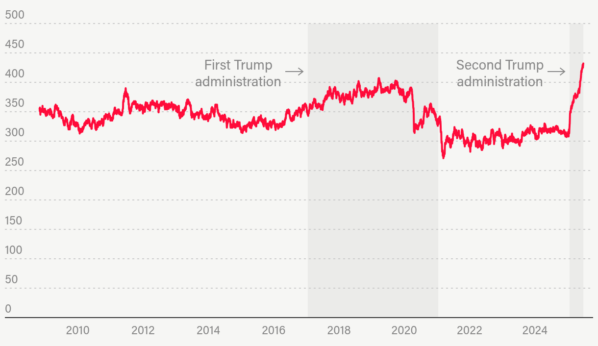
…As It Detains Historic Numbers of Immigrants
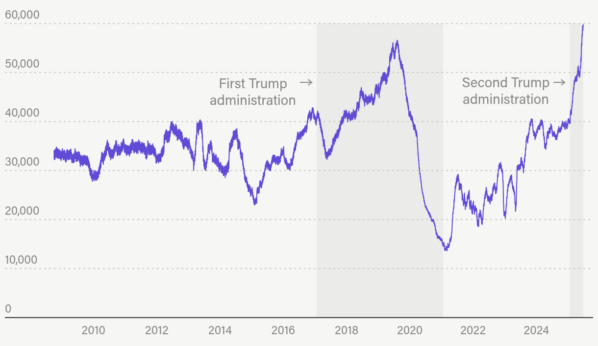
Source: U.S. Immigration Customs and Enforcement, compiled by the Deportation Data Project and Vera Institute of Justice
Using federal jails and prisons
Two weeks after Trump’s inauguration, ICE agents pulled up to the federal jail in Los Angeles, which holds people awaiting trial on criminal charges, with busloads of migrants. An employee at the facility was alarmed and wrote a statement that was shared with U.S. senators. “Employees have been told that they can’t turn them away and have to make room to house them,” the statement said. “We have not been trained or employed for this purpose.”
Since then, the number of people being held in federal Bureau of Prisons facilities for ICE has swelled from a few dozen, to more than 1,300, according to Benjamin O’Cone, a spokesman for the bureau. As of July, they were being held at federal prisons and jails in Miami, Atlanta, Kansas, Philadelphia, New Hampshire and Brooklyn.
Once in federal prison facilities, detainees find themselves in a system ill-equipped to track them, creating havoc for attorneys and family members seeking to reach them. One attorney representing people in a remote New Hampshire prison said for months it was virtually impossible to set up phone calls with clients there, and that lack of access to lawyers delayed and interfered with immigration proceedings. This attorney asked not to be named because they fear further jeopardizing their access to clients.
Reopening shuttered facilities
A federal judge once called Leavenworth Detention Center “an absolute hell hole.” In a 2021 letter to federal officials, the ACLU of Kansas pointed to stabbings, suicides and homicides that occurred with “alarming frequency.”
The facility, operated by CoreCivic under a contract with the U.S. Marshals Service, was shuttered in 2021, after the Biden administration issued an executive order banning the use of private prisons by the Justice Department. But the building remained standing, and CoreCivic wants to reopen it to hold ICE detainees.
Other facilities, including federal and state prisons, have gone through a similar cycle.
Criminal justice experts like Eunice Cho, senior staff attorney at the ACLU National Prison Project, said that when shuttered facilities are resurrected, it underscores why constructing new buildings or expanding old ones can be treacherous. Once a prison is built, there are business motives to find ways to put more people in it, for one purpose or another.
Expanding contracts with private companies for more space
Even though Biden ended private prison contracts for the federal prison system, he left them in place for ICE, and many detained immigrants are in facilities run by private companies.
Companies like GeoGroup and CoreCivic have secured new or expanded agreements for immigrant detention across the country, including in California, Mississippi, Oklahoma, Kansas, Michigan and New Jersey. During an earnings call this spring after soaring stock prices, CoreCivic President Damon Hininger celebrated what the Trump administration has meant for business, saying that “never in our 42-year company have we had so much activity and demand for our services.”
Many of the facilities have troubling histories. CoreCivic’s South Texas Family Residential Center in Dilley, came under fire during the first Trump administration because it housed children separated from their parents; a toddler died in 2018 shortly after being released. The center was closed last year, but CoreCivic has now reopened it to hold families and children, and in court filings, civil rights lawyers say their clients have had poor access to medical care, food and education for children.
Paying for local jails’ space
Local jails across the country are detaining immigrants, sometimes with the promise of rewards, or the threat of punishments. The Marshall Project identified more than 150 local jails that are together holding more than 6,600 detainees for ICE.
In some places, sheriffs are required by law or pressured through other means to hold immigrants for ICE. In Florida, Gov. Ron DeSantis pushed a law in 2022 requiring counties with detention centers to cooperate with ICE. The Trump administration has sued the city of Los Angeles and the state of New York to try to force their cooperation, and has, in other instances, threatened to withhold federal funding from places that won’t cooperate with ICE.
“It’s easier to get sheriffs and counties to sign on to holding people for ICE than it is to build brand new facilities,” said Austin Kocher, a professor who studies immigration at Syracuse University.
Supercharging existing facilities
The Trump administration has been able to quickly detain a growing number of migrants because of the foundation built and maintained by past administrations, both Democratic and Republican. Some of the facilities with the largest growth in the number of detainees since his inauguration have been in operation for years.
Stewart Detention Center opened in Lumpkin, Georgia, in 2006. Since the beginning of the new Trump administration, the number of immigrants ICE has detained at Stewart has risen sharply. From inauguration day to late June, the population of Stewart increased by more than 600 people.
Amilcar Valencia is executive director at El Refugio, an organization that provides help to people who are visiting loved ones at Stewart. He said they’ve gone from helping about 20 families in a weekend, to regularly serving 40 to 60.
“The system was already built, and what [Trump] is doing is just to use it to its max capacity, using the tools of the system to inflict pain,” Valencia said.
The Marshall Project
We hope you appreciated this article. At People’s World, we believe news and information should be free and accessible to all, but we need your help. Our journalism is free of corporate influence and paywalls because we are totally reader-supported. Only you, our readers and supporters, make this possible. If you enjoy reading People’s World and the stories we bring you, please support our work by donating or becoming a monthly sustainer today. Thank you!
CONTRIBUTOR