The Corporation for Public Broadcasting announced earlier this month it will shut down after Congress voted to take back $500 million in federal funds, jeopardizing the operations of PBS and the educational children’s content it has produced for decades. Now, the Trump administration is reportedly looking at PragerU as its preferred alternative to PBS’ programming.
PragerU (short for Prager University) is a media organization founded by conservative talk show host Dennis Prager, which received much of its early funding from the likes of fracking billionaires Farris and Dan Wilks.
PragerU touts itself as a “free alternative to the dominant left-wing ideology in culture, media, and education,” while critics maintain that it purposely distorts scientific findings and whitewashes history to suit far-right narratives. The nonprofit has also played a role in furthering the careers of far-right political commentators like Ben Shapiro and Candace Owens, who have made a living largely by downplaying the impacts of slavery and racism on African Americans.
Since 2023, PragerU has partnered with states like Florida, Oklahoma, and Montana to incorporate its videos into the curriculum in public school classrooms. This includes a cartoon series featuring two children named Leo and Layla who travel through time to go on adventures with various historical figures.
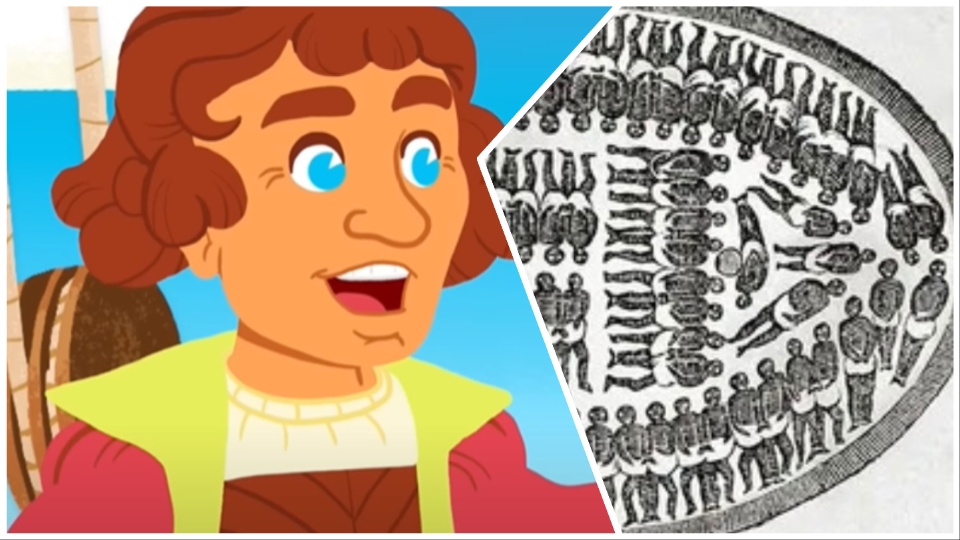
One such video resurfaced on social media recently and includes a cartoon Christopher Columbus describing indigenous peoples of the Americas and Caribbean as little more than uncivilized cannibals. “The place I discovered was beautiful, but it wasn’t exactly a paradise of civilization, and the natives were far from peaceful…. in Europe we draw the line at things like eating people and human sacrifice. Some of the native folk from where I just left do those things regularly,” the cartoon Columbus says.
It should be noted that Columbus landed in the Americas 14 years after the start of the Spanish Inquisition, whose victims likely wouldn’t have considered Spain under King Ferdinand II to be “a paradise of civilization.” Also, Columbus set sail 400 years after European crusaders infamously cannibalized Muslims at the siege of Ma’arra, and Western Europeans practiced “medicinal” cannibalism for centuries after Columbus’s death.
When questioned about slavery, the cartoon Columbus downplays the horrors of the trans-Atlantic slave trade. “Slavery is as old as time and has taken place in every corner of the world, even amongst people I just left. Being taken as a slave is better than being killed, no?” (So much for “give me liberty or give me death.”)
This line of reasoning—that slavery in the Americas wasn’t much different than previous forms of slavery—is repeated by outright white supremacists who push the myth that the Irish were the “first slaves” in the U.S. These alternative histories are being repackaged to create a whole new generation of miseducated Americans.
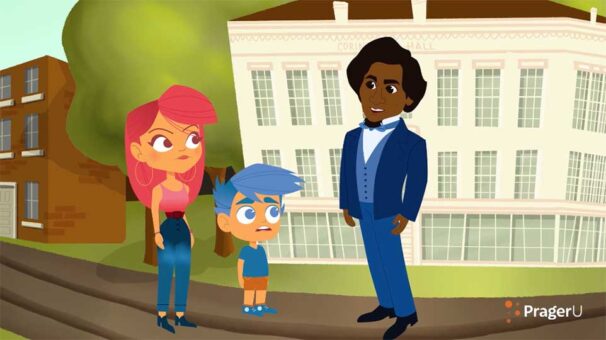
The latter include children in Florida who are now taught that some Black people “developed skills” under chattel slavery that “could be applied for their personal benefit,” to quote the state’s 2023 academic standards in social studies.
That MAGA conservatives feel they need to make children’s cartoons to promote pseudo-historical narratives about slavery reflects the wider counter-reaction against the 2020 Black Lives Matter protests and works like The 1619 Project. Fighting against well-funded attempts at right-wing historical misinformation and distortion includes revisiting how and why slavery in the Americas was fundamentally different from slavery in previous circumstances.
Of course, slavery existed for centuries prior to the trans-Atlantic slave trade in countless societies. But specific forms of labor relations (slaves and slave owners, serfs and landlords, wage laborers and capitalists) must be analyzed within the context of the given mode of production (slavery, feudalism, capitalism), as different forms of labor relations can exist within different modes of production. Slavery in the Americas was as hyper-exploitative and brutal as it was because it helped give rise to, and existed within, the capitalist mode of production.
Slavery as a distinct system of production is primarily centered on use-values (the direct utility of a given commodity), whereas capitalism is a system of production centered on exchange-values (the proportion in which one commodity is exchanged for other commodities).
From a Marxist economic standpoint, an enslaved person is a form of fixed capital (an asset used repeatedly in the production of a product), while under capitalism, labor-power itself is commodified for exchange-value and is a form of variable capital. While slavery produces use-values that can then be converted into exchange-values, the system of slavery ultimately does not organize production for the maximalization of exchange-value, unlike capitalism. Chattel slavery within the U.S. and other areas of the Americas crossed such economic boundaries.
Enslaved people in pre-capitalist societies such as ancient Egypt, Greece, or Rome, for example, would be put to work on state projects such as building pyramids, roads, and other forms of infrastructure that serve as use-values that cannot be exchanged. Enslaved people in the Americas, by contrast, were forced to work on cultivating and harvesting cash crops like cotton, sugar cane, and tobacco, as well as in mining for gold, silver, and diamonds, that could then be exchanged on the market.
Enslaved people in the Americas were made to work under backbreaking conditions in order to fully exploit the surplus value of their labor and to maximize the exchange value of the commodities they produced.
While obviously there was never a point in history where it was enviable to be enslaved, it is these differences that help us better understand why enslaved people in the Antebellum South were made to work from dawn to dusk (if not longer), and why enslaved people in Brazil were infamously worked to death, as slave owners found it cheaper to simply buy their replacements rather than provide adequate sustenance for their long-term survival.
And it is these horrific conditions that in turn cultivated racist mythologies and fields of pseudo-scientific racist research whose stench continues to linger in the United States and elsewhere; most notability in the fascist MAGA movement which has been described as being more-so neo-Confederate than neo-Nazi (though neo-Nazis are of course included within this “untied front of the right”).
In keeping with its overall proliferation of misinformation and half-baked conspiracies, the MAGA movement is engaged in an effort to whitewash U.S. history in classrooms to satisfy a billionaire-approved neo-Confederate worldview. Donald Trump has explicitly condemned historians like Howard Zinn, author of the best-selling A People’s History of the United States, as propagandists who want students to be “ashamed of their own history.”
This could not be further from the truth as American history told by Trump and company could hardly be considered our “own history,” but rather history as narrated by racist billionaires.
As working-class Americans, it is imperative that we resist and reject these efforts to whitewash U.S. history so that future generations of students do not fall victim to the siren songs of the MAGA movement. By exposing the fallacies of these pseudo-historical right-wing narratives, we can hope to continue the work of clearing away the stench of racist mythologies in the U.S. that serve to undermine solidarity across different sections of the American working class.
As with all op-ed articles published by People’s World, the views reflected here are those of the author.
We hope you appreciated this article. At People’s World, we believe news and information should be free and accessible to all, but we need your help. Our journalism is free of corporate influence and paywalls because we are totally reader-supported. Only you, our readers and supporters, make this possible. If you enjoy reading People’s World and the stories we bring you, please support our work by donating or becoming a monthly sustainer today. Thank you!
CONTRIBUTOR