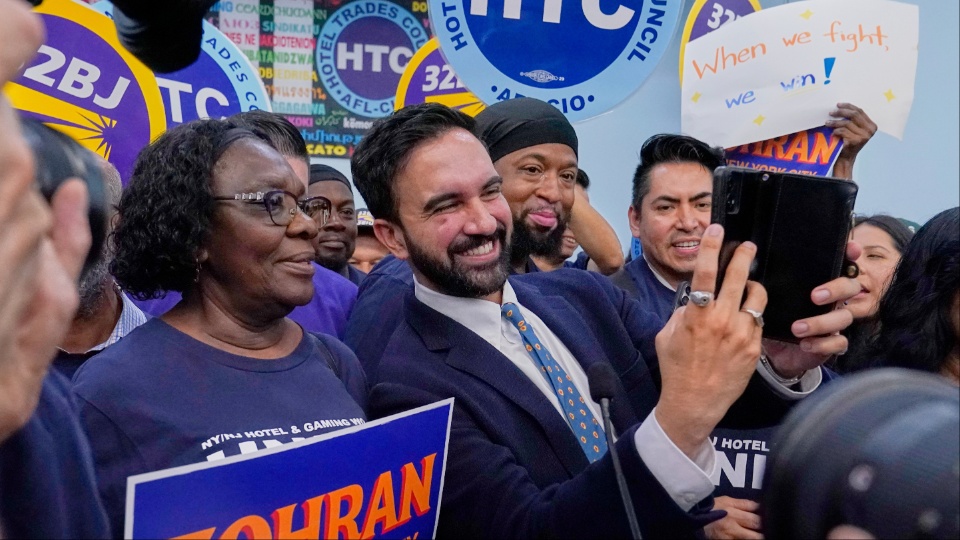
Zohran Mamdani won the New York City Democratic mayoral primary on June 24 with 56% of the vote in the final runoff, but several prominent Democrats have still not endorsed him.
Those withholding support include Senate Majority Leader Chuck Schumer of New York, Sen. Gov. Kathy Hochul of New York, House Minority Leader Hakeem Jeffries of Brooklyn, and Sen. Cory Booker of New Jersey.
During the primary, many top Democrats backed either disgraced ex-Gov. Andrew Cuomo or incumbent Eric Adams, who’s dodging corruption charges and cozying up to Donald Trump. Adams ultimately withdrew from the race after falling behind, while Cuomo was soundly defeated. With the primary concluded, Mamdani is the Democratic Party’s nominee.
So, why do these leaders still refuse to endorse their own party’s nominee? After all, these are the same people who consistently excoriate left critics claiming they only helped Trump win.
These leaders and their ilk also mainstreamed the idea of “Vote Blue, no matter who.” Somehow, though, they are failing to follow their own electoral mantra.
Not a socialist party
Like many Democratic Socialists, Mamdani chose to run for office as a Democrat. This was likely his most viable path to victory. Unfortunately, many top Democrats cannot accept a self-identifying socialist in their ranks.
To be clear, the Democratic Party at its core is still very much a capitalist and imperialist party representing the more liberal elements of the ruling class. Nancy Pelosi made this clear in a 2019 interview, responding to questions about the popularity of Bernie Sanders and AOC, “That [socialism] is not the view of the Democratic Party.”
Interestingly though, polls show that two-thirds of Democratic voters view socialism favorably while only half view capitalism that way. Socialism is also viewed positively by over three-fifths of Americans under 30. Sanders, the most recognizable political figure to identify as a socialist, regularly polls as the most popular politician in the country.
No social democracy for you
Following the collapse of the New Deal-era Democrats and the homogenization of neoliberalism in the party during the Bill Clinton era, centrism became the new “third way.” The social democratic and working-class elements of the party were dismissed as unrealistic and vilified through redbaiting.
This neoliberal Democratic Party has been finding more and more cracks in its armor, especially during Sanders’ 2016 and 2020 presidential campaigns. However, Democratic Socialists remain a very small fraction of the party, and the most progressive of politicians who emerge in it feel the pressure to moderate their policies and proposals.
Even Mamdani’s boldest, for instance, do not take on the revolutionary character of past socialist experiments or even the egalitarian vision that left social democracy had at its height. Rather, they are center-left social democratic policies in line with much of what the European left has espoused for the last quarter-century.
Free buses, childcare, freezing rent, and public grocery stores are not radical proposals that seize the productive forces of society. However, these public programs that benefit the vast majority of New Yorkers do represent a shift in Democratic Party politics—there’s not doubt about that.
Mamdani’s proposal to increase the corporate tax rate from 7.5% to 11% to match New Jersey and his policy to raise taxes on those making over a million a year via a 2% wealth tax would redistribute wealth in an intolerable direction—from the 1% to the 99% to the tune of about $10 billion per year. This is unacceptable for many top Democrats.
Chuck Schumer brushed off a question about endorsing Mamdani and his allies being primaried by stating that, “Democrats are united; we are fighting the high costs people pay.” That Democratic unity does not, apparently, extend to the Mamdani campaign which contains the boldest proposals to address affordability that have come out of anybody in the Democratic Party in years.
Gov. Hochul too refused to endorse, and in an interview said she was “concerned about the policing community and the environment for businesses.” This kind of tone-deaf politics—worrying about corporate profits while one in four New Yorkers are living in poverty—exemplifies the third way neoliberalism that’s been at the heart of Democratic Party politics for more than three decades.
Avoiding the inconvenience of actually having to take any position, Sen. Booker simply claimed that he would not make an endorsement in New York City politics. That despite the fact that back in 2009 Booker endorsed billionaire Michael Bloomberg, who isn’t even a Democrat and then received $26,000 in campaign funds for the race.
House Minority Leader Hakeem Jeffries was asked directly if he would endorse Mamdani. He responded with some non-committal verbiage to avoid the question.
Certainly, many of these Democrats are uneasy about Mamdani’s economic policies and his label of Democratic Socialist. However, another central reason he has not received endorsements from these leaders is his critique of Israeli policy against Palestine.
The red line of Israel
Mamdani had many viral moments during the campaign, but none circulated online more than the debate in which he was asked what place he would first visit if he becomes mayor. Every other candidate besides him and Brad Lander groveled at the chance to show their devotion to Israel by making a journey there. Mamdani said he would “stay right here in New York City.”
Mamdani was then pressed with several follow-up questions about Israel. To be clear, the mayor of New York City has no authority over U.S. foreign policy. The moderators asked whether he would visit Israel and whether Israel has a right to exist as a Jewish state. Mamdani responded that it has the right to exist “as a state with equal rights.”
This was a key moment in the campaign, as his response went beyond the acceptable critique of Israel in mainstream Democratic politics. Democratic leaders are allowed to criticize Prime Minister Benjamin Netanyahu, the ruling Likud Party, or the extreme right governing coalition. However, Mamdani’s response hinted that Zionism, as a supremacist ideology, is also up for a hard look.
Even though it was not a scathing rebuke of the racist and colonial Zionist ideology expressed by many of Israel’s leaders, his answer pushed back on the idea of an exclusively Jewish state in a way that is palatable to many Americans through the framework of equal rights.
Furthermore, Mamdani was asked if he would welcome Netanyahu to New York City and responded: “No, New York City would arrest Benjamin Netanyahu. This is a city where our values are in line with international law; it’s time that our actions are also.”
The last straw for many Democratic Party leaders, though, was Mamdani’s refusal to condemn the phrase “Globalize the Intifada.” Mamdani has never used this phrase himself but simply said he would not police the speech of activists. After the media onslaught, he eventually changed his mind.
These Democratic Party leaders and media mouthpieces fixated on his refusal to condemn a phrase used by the Palestinian movement all over the world. Meanwhile, they refused to condemn the most evident genocide in world history.
AIPAC over party
The refusal by top Democratic Party leaders to endorse a Democratic nominee for a major office is not normal. It is not simply ideological either. The material interests at stake make it unlikely that Democratic Party officials will ever endorse Mamdani before the general election, except perhaps at the last possible moment before the vote takes place, and even then, it would only be to save face.
And what are some of those material interests? Campaign cash, for a start.
AIPAC—the American Israel Public Affairs Committee—spent $53 million on the 2024 U.S. general election alone, which does not even account for the vast amounts of money spent by entrenched affiliated interests such as the American Israel Education Foundation, United Democracy Project, and The Washington Institute for Near East Policy. Taken together, they represent the bulk of the U.S. lobbying effort aligned with the Israeli government.
Schumer has received more than $1.7 million in AIPAC donations throughout his career. This money, along with his ultra-Zionist views, led him to speak at a “March for Israel rally” in 2024 amidst the current iteration of genocide against Palestinians.
Hochul took a trip to Israel immediately after the Oct. 7, 2023, attacks. The journey was paid for by a non-profit group that also funds illegal settlements in the West Bank. Hochul even ordered flags to be illuminated orange for the Israeli captives killed by Hamas but has made no similar gesture for the Palestinian prisoners killed in Israeli military detention, including children.
Booker, who has tried to kneecap the Boycott, Divestment, Sanctions (BDS) movement, is a tried and true AIPAC loyalist. It was leaked that he texts the AIPAC president gleefully like they are two teenagers. Booker’s career has been bankrolled by AIPAC to the tune of almost $900,000. This is why he gets on the Senate floor to scream about integrity while endorsing Israeli genocide.
Jeffries has received about $1.7 million from AIPAC. The House Democratic leader has consistently labeled critiques of Israel as antisemitic and brushed off questions about a ceasefire by robotically repeating that he stands with Israel.
Mamdani is unlikely to receive endorsements from any of them as long as he comments on Palestinian liberation in any capacity.
No endorsement, no problem?
Despite the lack of endorsements from these Democratic Party leaders, Mamdani is still way ahead in the polls for the November general election. Meanwhile, the national Democratic Party is polling at -30% in terms of favorability.
Perhaps the non-endorsements of these leaders will be beneficial for Mamdani. As the establishments of both parties garner more and more critique, they lose their popularity and credibility.
Not having the Democratic Party machine will certainly dissuade some wealthier Democratic voters. But could this signal a real change in the Democratic Party? Could this capitalist party go beyond the neoliberal, corporate strategies of the last four decades? Could it become a (Social-) Democratic Party?
Or will it collapse like the Whig Party in the 19th century? It is difficult to predict, but it is certain that a growing slice of the voting base is tired of the most unfettered versions of capitalism and imperialism that Democratic leaders have for too long either failed to challenge or themselves presided over.
Whether or not this one campaign by Mamdani changes the Democratic Party, it certainly shows that a mass base exists for socialist economic programs and for a change in the United States relationship with the Israeli government.
Though a mayoral candidate is not likely to effect change across the entire national party, the people of New York are sending a strong message to the Democratic Party: They don’t want neoliberal “third way” candidates anymore.
As with all op-eds published by People’s World, the opinions expressed here are those of the author.
We hope you appreciated this article. At People’s World, we believe news and information should be free and accessible to all, but we need your help. Our journalism is free of corporate influence and paywalls because we are totally reader-supported. Only you, our readers and supporters, make this possible. If you enjoy reading People’s World and the stories we bring you, please support our work by donating or becoming a monthly sustainer today. Thank you!
CONTRIBUTOR