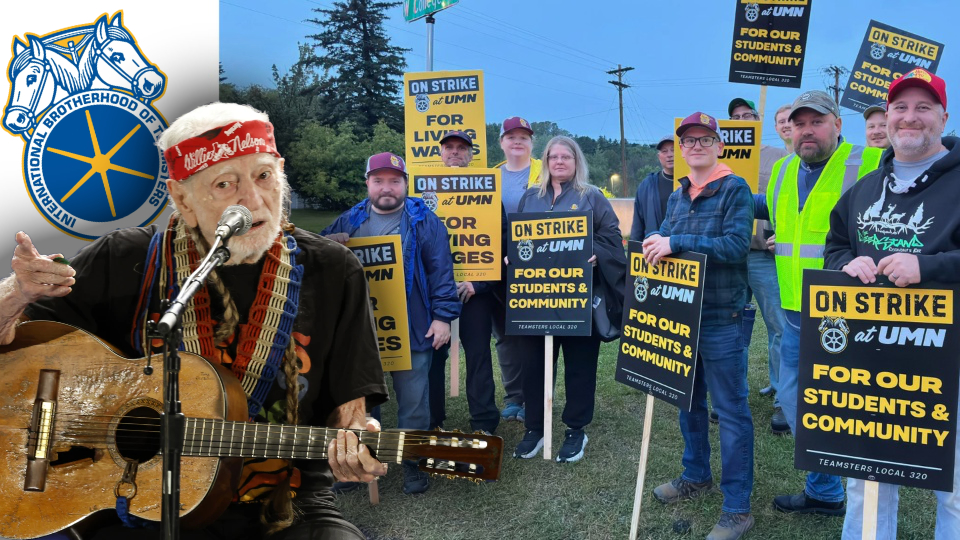
MINNEAPOLIS—More than 1,400 education service workers across the University of Minnesota’s five campuses went on strike last week to put workers and students before profits.
Teamsters Local 320, the union representing cooks, cleaners, groundskeepers, and other service workers who “make the UMN run,” noted that among the top issues for the workers were a 3.5% raise and the rejection of the university’s union-busting tactics.
The administration had suddenly changed Local 320’s contract expiration date to the winter months in order to take away bargaining leverage during the school year and to isolate the Teamsters from other unions on campus, all of whom share a summer contract expiration.
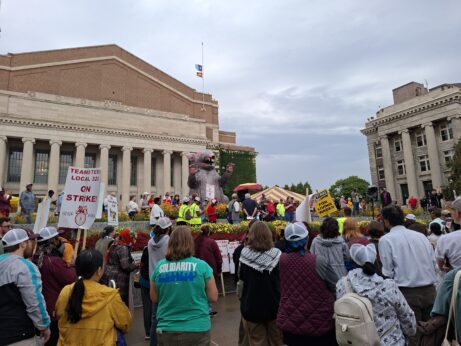
Late on Friday, the union reached a tentative agreement with the university, ending the five-day strike. The striking workers won their 3.5% raise, and a Farm Aid concert planned for campus, which Willie Nelson had threatened to cancel, will go ahead.
What motivated the strike
The average unionized service worker makes $26.11 per hour, which is approximately $11 per hour less than the median wage in Minnesota. Rebecca Cunningham, the UMN president, is paid a salary that equates to about $481.00 per hour.
“UMN’s workers should not be facing systemic poverty and racial disparities driven by the university’s own policies. With a $6 billion endowment and $71 million budget surplus, UMN should be dismantling inequity, not reinforcing it,” said Brian Aldes, Secretary-Treasurer of Teamsters Local 320, in a statement.
Additionally, the company that manages the university’s food service operations, Chartwells Higher Ed, has harassed and unfairly disciplined workers.
Charley Smith, a food service worker at Middlebrook Hall at the UMN Minneapolis campus, a graduate of the UMN, and a member of Teamsters Local 320, told People’s World: “I love working within the university community and helping students, but many of us can barely afford to survive with what the university pays us.”
Smith said many of his co-workers face harassment on the job. “We went on strike because we deserve a living wage and a safe workplace free from harassment.”
Teamsters Local 320 held rolling strikes against the university at all campuses. The first strike started at 10:00 p.m. last Monday on the Crookston and Morris campuses. Then the strikes continued on Tuesday at 4:00 a.m. on the Duluth, Grand Rapids, Waseca, and Austin campuses, and on Tuesday at 7:00 p.m. on Minneapolis and St. Paul campuses.
Intimidation met with solidarity
As the strike continued throughout the week, the university regressed to using intimidation tactics against the workers, including policy brutality. According to a letter from Teamsters Local 320 general counsel, on Sept. 10, the University of Minnesota Police Department and Hennepin County Sheriff’s Office deputies “executed a coordinated effort to intimidate protesters engaged in a lawful picket on public property.
“Picketers were handcuffed, zip-tied, and charged with crimes for daring to engage in their constitutionally and statutorily-protected right to protest and picket…. The attempt to scare and intimidate union members is unlawful and unacceptable,” the general counsel stated.
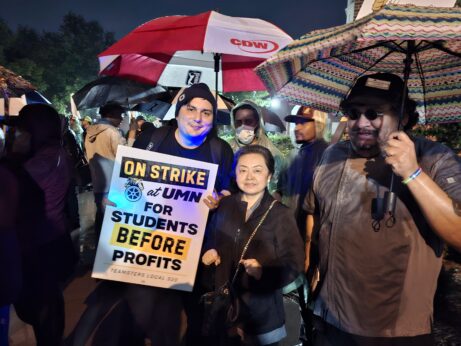
The university’s schemes did not deter student and community support for the striking workers. Throughout the week, students could regularly be seen joining in rallies, thanking workers, and bringing cookies and snacks to support picket lines.
Several UMN students told People’s World that it was unfair that UMN rubber-stamped the largest tuition hike in over a decade while simultaneously refusing to pay service workers fair wages and cut spending by 7% on academics, student services, and research.
Other union members also showed up to support striking workers. Kris Johnson, a member of the nurses’ union Minnesota Nurses Association and a graduate of the UMN Minneapolis campus, joined workers on the picket line and at a rally.
“As a union member, a mother of a public school student, and a former student at this university, I wanted to show up to support the UMN educational service workers,” Johnson said. “With all of the gardening, facade care, landscaping, and cleaning that they do, the service workers make the university so much more beautiful. They deserve dignified wages for their hard work.”
Teamsters Local 320 business agent Jackson Kerr concurs: “This fight is more than just the University of Minnesota. With the attacks on public sector workers across the country, this is emblematic of how workers across the country are feeling.”
Willie Nelson says no to union-busting
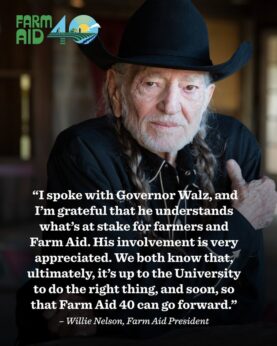
In another act of community support, Farm Aid president and musician Willie Nelson called Gov. Tim Walz to advocate on behalf of the striking workers. The Farm Aid 40 concert is scheduled for Sept. 20 at the UMN Minneapolis campus, which will take place for the first time ever in Minnesota.
Prior to the tentative agreement, Farm Aid was resolute about not crossing a picket line and put the responsibility to resolve the strike squarely on the shoulders of the university. In a statement, the organization declared:
“The farm and labor movements are intertwined. Time and again farmers and workers have shown up for each other in solidarity. We are proud that the Teamsters support our festival each year! Our artists, production team, and partners have made clear that they will not cross a picket line.”
FarmAid organizers also warned of “devastating” financial implications if the festival was forced to cancel. Farm Aid noted that “the expenses already incurred to bring this historic event to Minnesota may well threaten the survival of our organization after four decades of service to family farmers.”
However, the university stubbornly remained dismissive of workers’ demands, which then prompted Willie Nelson to call Walz to intervene.
Victory
This outpouring of solidarity from students, farmers, labor, and community helped Teamsters Local 320 and the UMN workers that they represent secure a big victory and an end to the strike, with the announcement of a tentative agreement coming around midnight on the evening of Sept. 12.
The next day, Teamsters Local 320 issued a joint statement with the University of Minnesota saying the two sides had “come to a resolution to support the greater good of our University students, faculty and staff, farmers and Minnesota residents.”
It noted that “The Farm Labor Movement originated in Minnesota and the Dakotas with a proud history that is recognized to this very day. The University of Minnesota began as an agricultural school and remains a vital part of Minnesota agriculture.”
The farmer-labor movement, organized in Minnesota in the early decades of the 20th century, remains one of the most successful coalitions in U.S. history. As the Farmer-Labor Party, it elected hundreds of candidates to state and national office and forced through major pro-people reforms in the state during the Great Depression. Though it eventually merged with the Democrats to form the Democratic-Farmer-Labor Party, the movement survives as the most progressive wing of electoral politics in Minnesota.
The strike of Teamsters Local 320 and the support it gained from Farm Aid stands as an example of how farmer-labor solidarity still resonates today.
We hope you appreciated this article. At People’s World, we believe news and information should be free and accessible to all, but we need your help. Our journalism is free of corporate influence and paywalls because we are totally reader-supported. Only you, our readers and supporters, make this possible. If you enjoy reading People’s World and the stories we bring you, please support our work by donating or becoming a monthly sustainer today. Thank you!
CONTRIBUTOR