For several decades, both major parties, bankrolled by big business, watched as deindustrialization, mass layoffs, and a changing tech-driven economy hollowed out the former industrial heartland. Working-class communities, feeling betrayed by a Democratic Party that embraced neoliberalism and a Republican Party that offers only false populism and a fascistic grab for total political control, have been left searching for representation.
I’m from Detroit, the Motor City, where the auto industry’s roots run deep. My family has generations of union members who worked at General Motors, Ford, and Chrysler (before the last was bought out and reconfigured as Stellantis). And in Michigan, we know firsthand what happens when industry leaves town seeking lower wages and higher profit margins. It impoverishes people in working-class neighborhoods, our schools lose funding, and our social services decline.
Yet, a new study from the Center for Working-Class Politics (CWCP), the Rutgers LEARN labor education program, and the Labor Institute points to a potential, and very possible, roadmap out of this crisis. The data confirms what working people, like the autoworkers in Detroit, have long known: bold, working-class politics centered on economic justice is not just popular—it is a winning message capable of reclaiming the Rust Belt from the MAGA right and the corporate Democrats who enabled them.
Four pillars of working-class politics
The report’s findings were echoed by the class-oriented agenda put forward by United Auto Workers President Shawn Fain, who articulated the core issues, based on internal union polling, that unite the whole of the working class: wages, healthcare, retirement, and time.
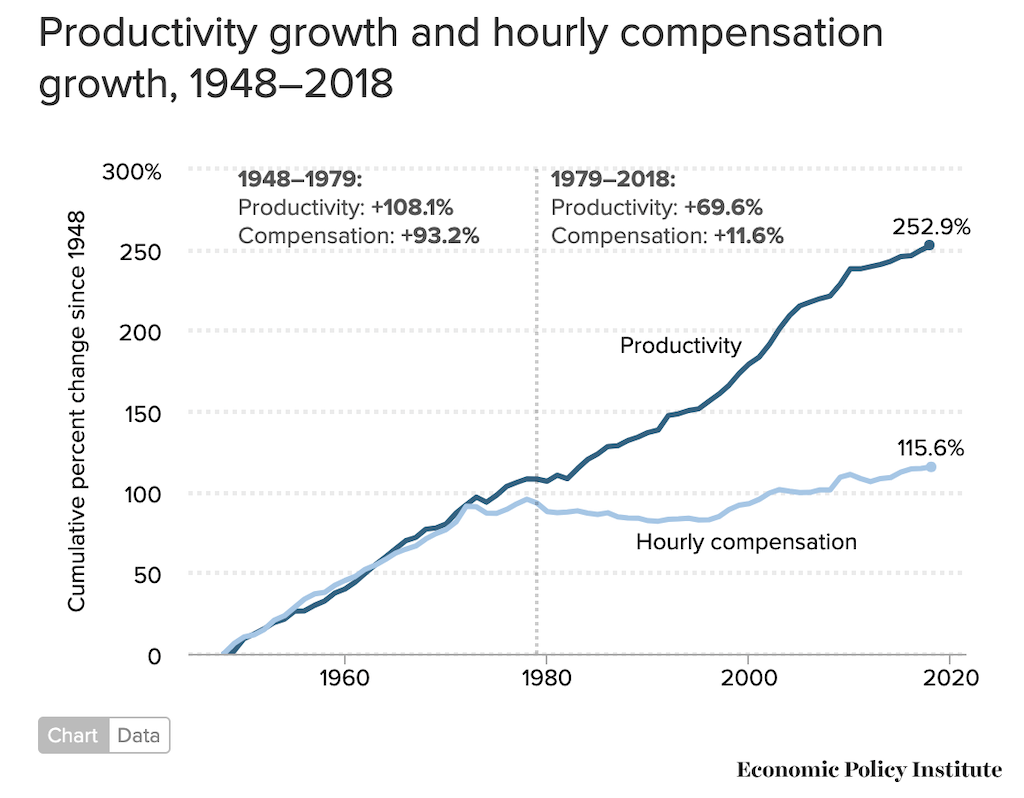
“Our lives are not meant to be consumed by work,” Fain stated, championing the demand for a shorter work week with no loss in pay and even pay increases. He powerfully illustrated the systemic nature of the crisis, pointing to a chart showing that while worker productivity has soared since 1980, wages have flatlined.
“The working class didn’t see rising productivity get rewarded with more money in our pockets. Instead, the profits went to the top. To the billionaire class.”
These numbers cut to the heart of the matter. The problem isn’t a lack of wealth—workers are the most productive we’ve ever been, and we reside in the richest country in the history of the world. Rather, it’s a monopolized economy where, as the CWCP report notes, a handful of corporations and elites hoard the value created by workers. Small businesses and family farms are also hit hard by the monopolization of the capitalist economy.
So it’s only natural that economic policies that directly challenge corporate monopoly power are overwhelmingly popular. It’s a material basis which can lead to what the Communist Party USA historically called an anti-monopoly program.
The CWCP study, surveying 3,000 voters across Pennsylvania, Michigan, Ohio, and Wisconsin, found that “economic populist messaging yielded net support of +45 points.” Critically, messages that “directly named corporate greed and economic elites as the problem outperformed the softer, ‘populist-lite’ alternative.” Think of “populist-lite” as a critique of just a “few bad apples” among the capitalist class that are simply “not fair,” which characterized the Democratic Party campaigns of 2020 and 2024.
On immigration, the pollsters asked these 3,000 voters if they would support “granting legal status to all illegal immigrants who have held jobs and paid taxes for three years and not been convicted of any felony crimes.” Remarkably, a whopping 63.3 percent supported that statement.
The poll data also demonstrated the profound distrust voters have for the Democratic Party. This disillusionment is not, as pundits of the “Left” and right claim, primarily about “culture war” issues. By “culture issues” what is really meant is the championing of what the CPUSA calls democratic struggles—centering the fight for equality for women and oppressed peoples, affirmative action, diversity initiatives, and so forth.
The study found that when the exact same popular economic message is delivered by a Democrat instead of an independent candidate, it suffers an 8.4% decline in approval on average. According to this study, this “Democratic penalty” was even higher among working-class, rural, and Latino voters. However, among African Americans and Asians, the “penalty” was not the case. Rather, the Democratic candidate did 13 points better among African Americans and 18 points better among Asian voters.
On the whole, the study found that the most frequent theme was that Democrats “fail to get results, don’t listen enough, and don’t fight hard enough for the people who elect them.”
This all but confirms that the problem of “reaching blue collar workers” has nothing to do with so-called culture issues, but is about a fundamental failure of political representation. As Fain analogized, referencing the 1980 Mouseland film: “We elect upper-class people to represent worker issues and expect them to fix our problems.”
Independent politics and the struggle for democracy
The takeaway many observers will point to from this data is that the immediate solution lies outside the major two parties. And the data compellingly shows high support for a new political force. Consider that 57% of Rust Belt respondents supported the creation of an “Independent Workers’ Political Association,” with significant backing from Republicans and independents. This “Workers’ Political Association,” which does not exist, was created by the researchers with the intent of testing the waters with voters for an explicit independent workers’ party.
And as the researchers pointed out, this “party” must be built on a sharp, economically progressive program. Popular policies identified in their report that would be championed by such an independent movement were:
- Stop big companies that receive tax dollars from laying off tax-paying workers.
- Guarantee a decent-paying job to anyone who wants to work, and if the private sector can’t provide it, the government will.
- Raise the minimum wage so every family can lead a decent life.
- Stop drug company price-gouging and put price controls on food cartels.
However, a truly successful workers’ movement must also fully embrace what the CPUSA terms the democratic struggle. In the first place it means building a broad, popular front led by the working class capable of delivering a decisive blow to the fascist threat currently facing our country, the immediate defense of democratic rights, and the ability to fight forward.
Fain was correct when he suggested that in this political moment, the most viable path forward for our class is to build a working-class led mass movement from below, not being singularly focused on a “new labor party.” This mass movement is the space where true working-class political independence can grow, he said. And this absolutely includes running trade-unionists at every level for public office—however they can get elected.
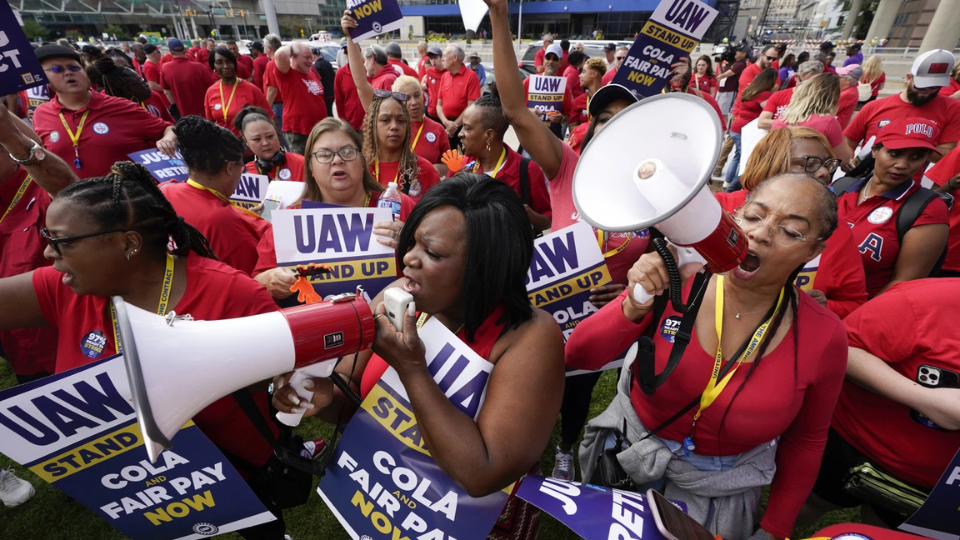
He also pointed to the overwhelming public support the UAW had during the Stand Up Strike in 2023 to illustrate building this mass movement. When working class people take direct action against big business, he said, it is very popular among the American people.
And while Fain correctly identified the core economic pillars and powerfully stated that the billionaire class “will try to divide us by race, by gender, by who we love,” a comprehensive program must explicitly and organically link the fight for class-wide economic demands with the battle against racism, for full equality for women and LGBTQ people, for the defense of voting rights, and for the full rights and unionization of immigrant workers.
These struggles against oppression are not separate from the class struggle; they are essential to winning it. In fact, as former CPUSA General Secretary Gus Hall said, “these are basic class questions” necessary to unite the whole of the working class.
The message from the data and from the growing and militant picket lines, in defense of immigrant workers against workplace ICE raids, and the massive peoples’ protest movement against Trump, is clear. Our working class is ready for political independence. We are ready for a politics that directly names our enemy—the monopoly capitalist class—and fights for our interests without apology. The task now is to continue building that political independence as well as the necessary and powerful mass movement capable of waging that fight.
As with all op-eds published by People’s World, the views reflected here are those of the author.
We hope you appreciated this article. At People’s World, we believe news and information should be free and accessible to all, but we need your help. Our journalism is free of corporate influence and paywalls because we are totally reader-supported. Only you, our readers and supporters, make this possible. If you enjoy reading People’s World and the stories we bring you, please support our work by donating or becoming a monthly sustainer today. Thank you!
CONTRIBUTOR