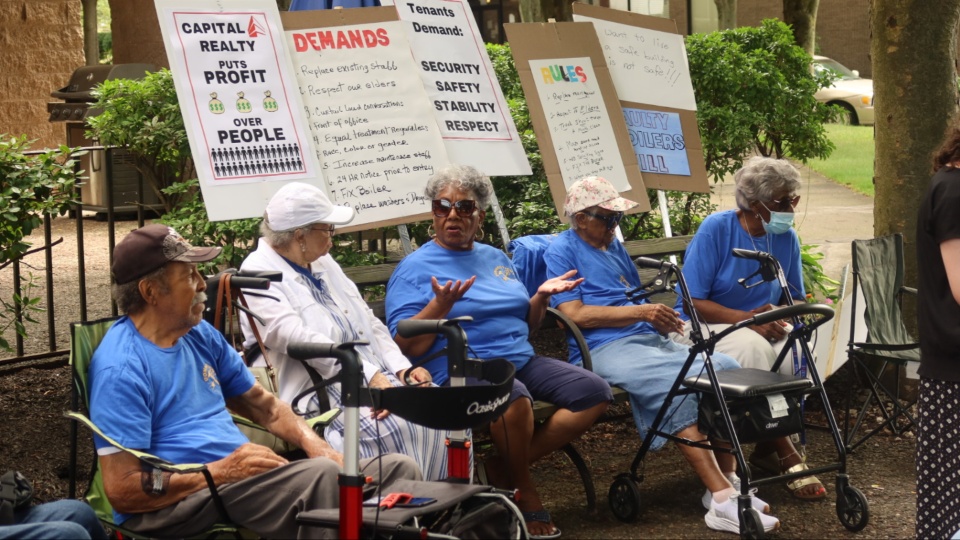
The courageous tenants around the country who rent their homes from Capital Realty Group are making history in their fight for fair treatment, dignity, and accountability from their landlord.
The unprecedented nature of their organizing, which has taken place across state lines, opens doors for tenants everywhere as they join forces under the banner of the national Tenant Union Federation. Seven buildings have already joined this campaign since its kickoff in August, when the Park Ridge Tenants Union—an affiliated chapter of the statewide Connecticut Tenants Union—went public with its demands for collective bargaining with their massive corporate landlord, the Capital Realty Group of Spring Valley, N.Y.
The Capital tenants who’ve organized so far are located in New Haven, Conn., Detroit, Louisville, Ky., Kansas City and Lee’s Summit, Mo., and Billings, Mont., and represent nearly 1,000 units of housing across those geographies. No doubt these ranks will be further swelled soon; Capital Realty owns over 14,000 units across the country, and thousands of their tenants face similar plights.
Unresponsive management, disrespectful or outright hostile staff, and an absence of communication from their landlord are among the grievances. The latter is particularly egregious for the countless immigrants living in Capital’s properties who are forced to deal with whatever limited communications come through exclusively in English, regardless of their proficiency in the language.
Then of course there are the issues that tenants have desperately sought to raise with their properties’ on-site managers: malfunctioning heat in the middle of the winter, carpets that haven’t been replaced in years, mold, and roaches and other pests taking up permanent residence.
Waiting outside before an organizing meeting a month ago, I encountered a pest control professional who asked if I knew how he could reach management. He had finally gotten an appointment scheduled to treat the property for bedbugs after several cancellations, but management wasn’t picking up the phone, and their on-site office was empty. Without their authorization, he was forced yet again to postpone.
Many of the properties plagued with these issues were purchased using Fannie Mae- and Freddie Mac-supported mortgages. A large number rely on ongoing state subsidies, in the form of LIHTC credits, Section 8 vouchers, and Section 202 Supportive Housing funding.
Those who acknowledge the dire reality of the housing crisis, but who claim (in a sad attempt to reanimate the long-putrefied corpse of Reaganomics, at the behest of funders Thiel, Andreasen, et. al.) that we simply need to eliminate pesky regulations and subsidize private development at the most aggressive scale in response, fail to recognize the nature of a market economy.
Or at least they fail to acknowledge it. The case of Capital Realty Group makes that abundantly clear.
Markets are not driven by pure supply-and-demand in the real world, where perfect competition is an utter impossibility. Markets, at least in our reality, are driven by social forces—they are moved by the relative social power of their players.
What does that mean in the context of housing? It means, as evidenced by the untenable conditions plaguing residents across hundreds of Capital Realty units, that the government pumping millions into the pockets of a private developer-landlord only serves to further the crisis by feeding the system that caused it. It means that so long as tenants lack control over their housing, they exist as an economic underclass whose lives are subject in one way or another to the whims of a property owner, their labor more or less indirectly extracted to provide that owner a return on the capital that they possess, and which their tenant needs to survive.
That sounds extreme, and likely does not represent the relationships between small, responsible local “landlords” and their tenants—interpersonal and community-driven norms hold their own weight in that dynamic. But in the case of multi-million, or multi-billion-dollar investment interests, holding ownership interests over an asset leased by working class, or poor, or fixed income tenants, then it certainly applies. Particularly since the landlord has the state on their side and can quite literally have the tenant forced out at gunpoint if they refuse to pay a sufficient price.
In Park Ridge, where the bulk of tenants’ rent is covered by HUD, those dynamics do not impact price quite as directly. But the contribution that HUD makes is based on perceived “market rates,” and so more and more taxpayer dollars go to such subsidized property owners when private market players drive rents up, more or less freely, on their end. There is little incentive to increase quality or property reinvestment accordingly.
Admittedly, regulatory programs in the subsidized context do provide some measure, but direct resident input, oversight, and enforcement is sorely lacking, in part due to the control larger players have on the limited supply of “affordable” housing available by any metric.
A corporate landlord in a majority-renter city of 100,000, for instance, could feasibly own thousands of units of the city’s affordable housing stock, and their closest three competitors would likely field similar portfolios. Whether using technology like RealPage’s price-fixing algorithm, directly negotiating price with industry partners, or simply observing local market trends, all four could quickly increase the area median rent for affordable units by a substantial margin. And, as in the case of the RealPage scandal, this is a behavior that has been observed recently and at scale.
What, then, is the significance of the campaign undertaken by the residents of Park Ridge, River Pointe, American Village, Parker Square, Paraclete Manor, Sage Crossing, Rose Park and all the other unions yet to go public in their fight for fair treatment from Capital Realty?
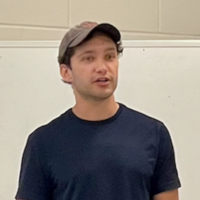
In the words of Damaris, a leader in Park Ridge: “We are getting results because we are united. We are so much stronger together than apart. We should not focus on the differences between us, but on the power that we build together.” Her message was met with enthusiastic applause from the crowd of 30 or so gathered in the complex’s community room recently—a combination of elders who had made time between medical appointments and visits from grandchildren or trips to the Social Security office, organizers, and allies who had come from around the state to support their cause.
They were echoed by the chapter’s co-vice president, Ellen: “The union is our power, the union is our communication. The union is what allows us to get stuff done. Our landlord wants to keep us divided, by language, by race, by age, by religion. He wants us to think that we don’t have time for this, that we have better things to do. They want that because we’re easier to deal with when we’re bickering with each other instead of focusing on them. Our power comes from staying united, staying together. And working for what’s good for all of us.”

And staying united is exactly what they’ve done—from the time the first leaders started knocking their neighbors’ doors through tense negotiations, landlord retaliation, long pickets, and loud press conferences. Their numbers have only grown, with more unions forming across the country with each month, the campaign presses on.
That campaign represents the sublimation of individual interests for the sake of collective good. It illustrates the possibility that people can, even in a country where the ruling class pushes naked self-interest as the highest moral value, work together in recognition that each of our individual positions have the best chance of being elevated if we work together to confront the systems that keep them down.
I believe that history is driven by material conditions, and our material conditions have driven us to a point of rupture and transformation—transformation that will lead to the extinction of our species over the next two centuries if not sooner, or transformation that will see us recultivate a harmonious relationship with our own planet, as we also reach the stars. It is up to us to chart a course towards the latter horizon if we hope to escape the former, and this is indicative of how that course should look.
Economics is the science of resource allocation. It is the essential question of life, from single cells all the way up: How do creatures exist, extract, exchange, and transform resources to meet their material needs in the context of their material conditions? The problem with our present moment is that our economics no longer compute with our material base. What emerged out of colonialism as a market-based competition to extract and exchange resources at a scale and range greater than ever before has now become a crippling surrender to profit above all else. Rather than allocating our resources to meet our material needs, our materials are metamorphosed and degraded by our labor to meet the need for investment returns. Our supply chains, retirement, housing, and healthcare all rely on it.
The unity shown by these organized tenants is the best answer I see to that situation. It is an insistence, across all number of lines of social difference, that we matter as human beings. That we matter not simply because of immaterial liberal appeals to human rights or the rule of law, but because both as workers and as consumers we are the engine that makes the economy run. And since we matter, since our participation is a necessary element in the continued production of profit, we can intervene. We can, if we see past the attempts to divide us, exert our own shared social power.
Just like large landlords can act together to continually increase the cost of rent despite deteriorating conditions and deplorable treatment, we can act in unison to insist on affordability, accountability, quality, safety, and control in our homes. We can be the agents of our own history, whether by working alongside our neighbors to win collectively-bargained leases that keep our rent reasonable and our units well-maintained, or by forging a movement to take housing out of the hands of slumlords and speculators and put into the hands of those who actually use it.
The brave tenants of Capital Realty Group across the country have taken a historic first step in showing us how to get there. We should back them, and we should follow suit.
As with all op-eds published by People’s World, the views reflected here are those of the author.
We hope you appreciated this article. At People’s World, we believe news and information should be free and accessible to all, but we need your help. Our journalism is free of corporate influence and paywalls because we are totally reader-supported. Only you, our readers and supporters, make this possible. If you enjoy reading People’s World and the stories we bring you, please support our work by donating or becoming a monthly sustainer today. Thank you!
CONTRIBUTOR