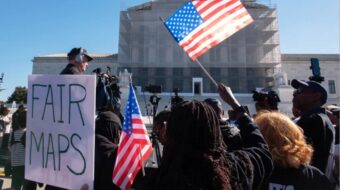
WASHINGTON—The make-up of Congress could shift permanently in favor of MAGA if the Supreme Court rules against the ability of states to use race as a factor in crafting electoral districts, giving Black voters a chance to elect representatives of their choice.
Oral arguments heard on Wednesday suggest that the right-wing majority may be poised to tear up the last remaining piece of the landmark Voting Rights Act of 1965. The 14th and 15th Amendments to the Constitution, which ended slavery and extended the vote to Black men, are often called the “Reconstruction Amendments.” Not until the passage of the Voting Rights Act, however, was there a legal structure in place to make those rights a reality.
Among the planks of that law was a rule that jurisdictions with a history of discrimination were required to get Justice Department approval of any changes to their voting rules or electoral maps. That provision has already been struck down by the Supreme Court. Republicans said at the time that this would not be a problem because victims of discrimination could still sue for fair district lines. Now, however, that provision too appears to be doomed.
Lawmakers in Louisiana, upset that the law was used to create a second district in their state where it is possible to elect a person of color, challenged its constitutionality.
Even the new electoral maps they are disputing already heavily favor white voters who, with just over half the voting population of the state, end up with 66% of the state’s congressional delegation. Before the new lines that the Louisiana Republicans challenged, the delegation sent by Louisiana was 75% white.
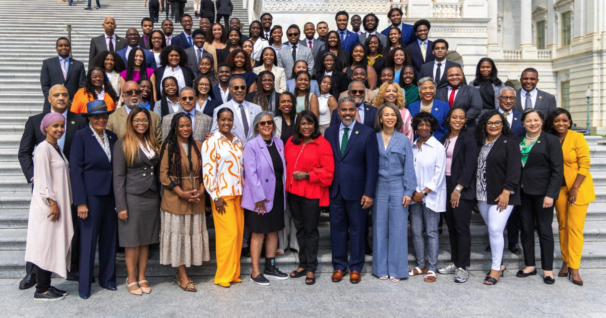
If the provision of the law at issue in this case is thrown out, almost every non-white representative across the South could lose their districts and their seats, creating almost an entirely white Congress in the states that constitute the former Confederacy.
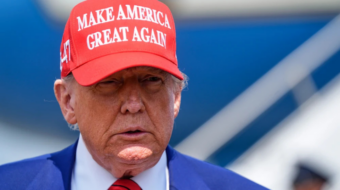
Estimates are that as many as 19 solid MAGA Republican districts could be created as a result of the ruling, possibly cementing indefinitely MAGA control of the U.S. Congress. Beyond that, the ruling can be used to redraw lines so that state legislatures, too, would fall under permanent MAGA control.
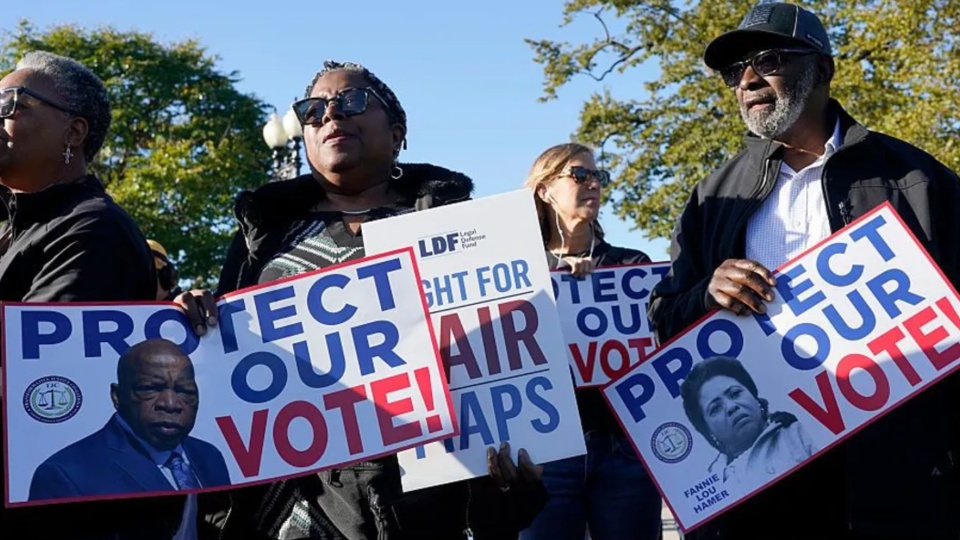
At issue in the argument before the justices was the future of Section 2 of the Voting Rights Act, the last path under the law for African Americans and other people of color to not only vote but to elect whom they want to the offices they desire.
In practical terms, supporters of the Voting Rights Act seek a U.S. House—and a state legislature, a county board, a city council, a school board, and so on—that looks like America.
The foes, a group of 12 unidentified “non-African-Americans” who challenged the law and Louisiana’s congressional map, don’t. They say the current map, which a federal judge forced Louisiana to draw, with two Black-held districts, violates the U.S. Constitution’s 14th Amendment and its equal protection clause. Louisiana, with six U.S. House seats, is 31% Black.
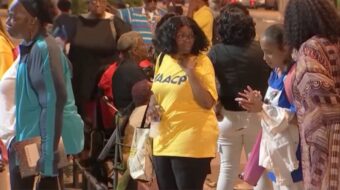
“The toxic effort to obliterate what remains of the Voting Rights Act threatens to disenfranchise millions of people,” House Minority Leader Hakeem Jeffries, D-N.Y., warned in August when he learned the justices were going to hear the Louisiana case. “It requires an immediate response.”
He called the case a part of a “nationwide effort to disenfranchise communities of color and rig the congressional map” on the part of Republicans.
The Louisiana situation is one among many cases where GOP-gerrymandered state legislatures have tried to “crack” Black communities to prevent the election of lawmakers who look like their constituents—such as in North Carolina, where a historically Black college campus was split right down the middle between two congressional districts, or Nashville, Tenn., where the city was split between three.
It’s also not counting the current surge, initiated by Trump in the map-redrawing. Most remaps are in red states, with Texas in the lead. It’s followed by Missouri—which just eliminated the Black-held seat in Kansas City—with North Carolina, Florida, and Ohio waiting in the wings.
Right-wing Justice Brett Kavanaugh admitted Wednesday during arguments heard by the court that consideration of race might sometimes have to be used to create fair districts, but said that this cannot continue without an expiration date and that, in the case of the Voting Rights Act, the time may have come to end this practice.
“The court’s cases, in a variety of contexts, have said that race-based remedies are permissible for a period of time, decades in some cases, but that they should not be indefinite and should have an endpoint,” he said.
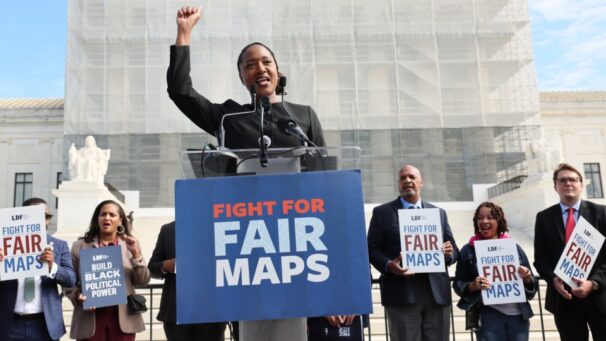
An end to racism and discrimination in the U.S. might signal such an endpoint, civil rights activists note, but the nation has certainly not achieved that goal.
In 1965, the vicious attacks on voting rights demonstrators on the Edmund Pettus Bridge in Selma, Alabama, helped galvanize the nation and the mass movements into pressuring President Lyndon Johnson to put forward the Voting Rights Act, which took only five months to become law.
Millions hoped that passage of that law, along with the passage of the Civil Rights Act of 1964 a year earlier, would lift the shadow Jim Crow had cast over America for generations. The destruction of the Voting Rights Act will usher in a new era of Jim Crow, many fear.
At issue here is how fast the Supreme Court rules on the matter. The hope among people fighting for voting rights is that the decision will come later rather than sooner. If it comes before the maps and processes are set for the mid-term elections next year, guaranteed MAGA control of Congress could be foisted upon the nation.
We hope you appreciated this article. At People’s World, we believe news and information should be free and accessible to all, but we need your help. Our journalism is free of corporate influence and paywalls because we are totally reader-supported. Only you, our readers and supporters, make this possible. If you enjoy reading People’s World and the stories we bring you, please support our work by donating or becoming a monthly sustainer today. Thank you!
CONTRIBUTOR