Another Thanksgiving, and I submit my yearly harangue against this infamous holiday (at least from my perspective and that of thousands of other Indigenous). Once again, the news media announces that this holiday “will see more people traveling than ever before,” with predictions of 82 million in transit by airplane and automobile. I keep wondering: Who are these people with all this money to travel when countless numbers are reportedly living paycheck to paycheck?
But, nevertheless, back to the subject of this discourse: Thanksgiving. There is a huge difference between last Thanksgiving and the upcoming holiday. This time around, we have a so-called president who is a convicted criminal (found guilty on 34 felony counts), a sexual predator, an outspoken racist, a warmonger, an inveterate liar, an archetypal imperialist, and pathological prevaricator. How’s that for a Thanksgiving platter?
I shall not delve into the genocidal origins of this observance, as I have done in previous offerings. Let’s just look at the historical development of this so-called holiday, which is quite interesting, to say the least. To begin with, in every year since the founding of the United States, each sitting president has assumed the cloak of “proclaiming” the national holiday on one date or another. Over time, it assumed the mantle of being part of mainstream American identity.
But, fascinatingly enough from a historical accounting, Thanksgiving was almost completely forgotten in one year by none other than the president from Tennessee, Andrew Johnson.
In Johnson’s defense, some historians point out that so many things were impacting 1865—the Civil War ended, the abolition of slavery, and the assassination of President Abraham Lincoln. These events produced a holiday season that was very quiescent; not a murmur of a proclamation, not the slightest gobble of a turkey. Must have been nice!
At this time, Thanksgiving had not been placed on any official calendar, but it was mostly celebrated sometime in November. So, when November came with no official proclamation, a church congregation, according to the Library of Congress, wrote a letter to Johnson asking him to remember Thanksgiving.
Prompted by the letter, Johnson set the holiday for Dec. 7, which was considered late, but better late than not at all. Johnson’s forgetting of the observance may seem surprising today, but prior to 1941, Thanksgiving was a floating holiday. From George Washington to Franklin Roosevelt, presidents moved the date around to accommodate wars, economic downturns, and other upheavals.
Washington was the first president to issue a declaration of Thanksgiving in 1789, marking Nov. 26 as the date of celebration. This was at a time when the United States was at war with various Indigenous nations east of the Mississippi. It must also be noted that Washington was an extensive speculator in Indigenous lands.
Fast forward, in the wake of the Union victory at the Battle of Gettysburg, Lincoln declared Nov. 26 as national Thanksgiving Day and directed that it was to be celebrated every year on the fourth Thursday of November.
Subsequently, this date has been changed only twice, both at the behest of President Franklin Roosevelt. In 1941, Congress passed a law establishing the fourth Thursday in November as the legal holiday date of Thanksgiving to preclude any confusion over the date occurring again.
As for the Indigenous peoples of the United States, at various stages of history we couldn’t have cared less as to when Thanksgiving Day was observed because from the late 18th century to the late 19th century, wars were being waged between the United States and Indigenous nations. But times have changed, and we will continue to demand that our voices be heard in the national conversation on the legitimacy of the heinous holiday.
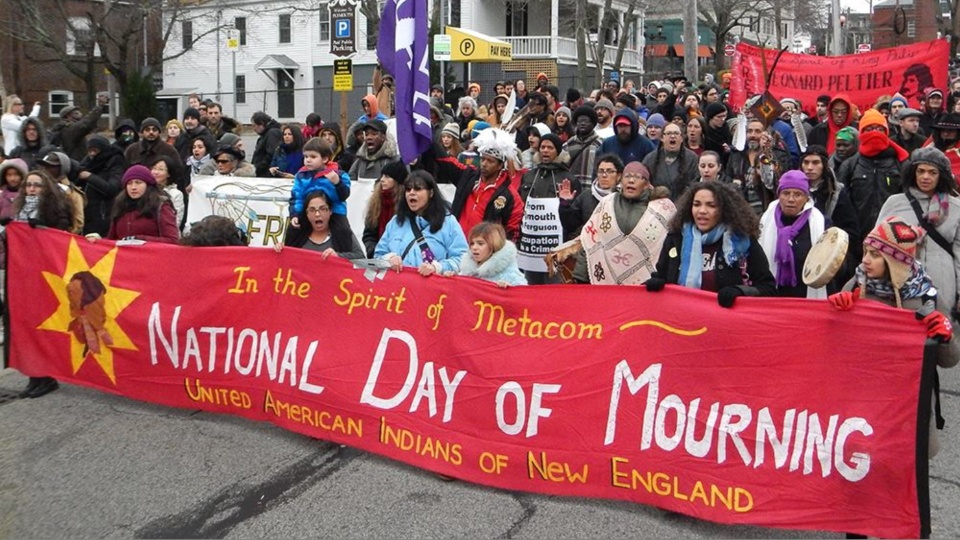
Lastly, over the years, the name of Thanksgiving has been changed in many Indigenous circles to “Thankstaking” and other unsavory appellations. Also, I would be remiss if I did not highlight the actions of the United American Indians of New England (UAINE) in proclaiming Thanksgiving as a National Day of Mourning (NDOM) and holding a commemoration at Cole’s Hill in Plymouth, Mass., every year since 1970.
The UAINE are the descendants of the Indigenous peoples who first met the Pilgrims with subsequent tragic history. The NDOM focuses on the centuries of genocide and resistance that followed in the wake of that first contact. On this Thanksgiving, I’ll be joining them in observing a day of mourning.
As with all op-eds and news analytical articles published by People’s World, the views reflected here are those of the author.
We hope you appreciated this article. At People’s World, we believe news and information should be free and accessible to all, but we need your help. Our journalism is free of corporate influence and paywalls because we are totally reader-supported. Only you, our readers and supporters, make this possible. If you enjoy reading People’s World and the stories we bring you, please support our work by donating or becoming a monthly sustainer today.
CONTRIBUTOR