CHICAGO—We’ve heard of bosses dodging discussions with their workers, but this episode may take the cake for corporate brazenness. Starbucks CEO Brian Niccol, in his haste to escape a conversation with a veteran Starbucks worker, Melissa Lee-Litowitz, about collective bargaining, almost caused a major accident on one of the nation’s main streets, Chicago’s North Michigan Avenue.
Starbucks workers in the Chicago area were conducting a two-day 24/7 picket line in front of one of the stores on the boulevard’s Magnificent Mile—Chicago’s high-class retail emporium—when a worker alerted Lee-Litowitz, a union activist and picket line co-captain, that Niccol was observing them.
What happened next would be hilarious if it weren’t so serious. He ran; she followed.
In an interview after the People’s World dinner Sunday on the South West Side, Lee-Litowitz—who attended with other Starbucks Workers United members—related her attempt to tell Niccol of conditions at the Chicago-area stores and elsewhere. And to have him pledge to restart bargaining for a fair and equitable contract that would benefit Starbucks, its workers, and its customers.
By contrast, conditions nationwide include low pay and ineligibility for benefits because of deliberately erratic scheduling. It prevents workers from toiling for the required 20-hour minimum to be eligible for benefits such as health care. And Starbucks’ latest offer, the New York Times reported, was no increase in the first year of a proposed contract and 1.5% yearly after that.

Other working conditions include sexual harassment on the job in New York–with the transfer of the harasser to another store—and mechanical breakdowns, lack of supplies, and filthy conditions in Chicago, and baristas everywhere who are overworked and underpaid.
There’s a need for training and “pay and compensation for risky situations,” such as “drunken customers threatening us—I had to call the police once—and crazy health problems, such as shards of metal in our ice bins,” says Lee-Litowitz. And the thermostats in food display cases often don’t work.
Some company discipline is petty. “One manager screamed at a partner for grinding the coffee too loudly. Another district manager sent a worker home because she wasn’t wearing a bra.”
Some workers who complain or become outspoken union supporters are informally “branded” by bosses “with a “scarlet ‘U,’” says Lee-Litowitz. That harkens back to Nathaniel Hawthorne’s novel The Scarlet Letter, where a colonial wife in New England was forced to wear a scarlet ‘A’ after she had a child out of wedlock from an affair with her minister.
“A district manager closed one of our stores in Glenview at 1 p.m., even though everyone showed up for work because everyone showed up wearing hats with union buttons on them,” says Lee-Litowitz. The National Labor Relations Board has ruled, in other cases, that disciplining workers for wearing union insignia is an unfair labor practice, the legal name for labor law-breaking.
Starbucks also forced its workers, whom it calls “partners,” to toil while sick, especially if they want to make the minimum-hours requirement. That exposes colleagues and customers to communicable illnesses. New York City’s Roastery store and emporium was infested with bedbugs.
“And if you’re injured, there’s no sick time. One 70-year-old woman” worker fell at work and injured herself. “Her manager told her not to report it,” but was overruled, Lee-Litowitz reported.
That corporate demand that workers not report on-the-job injuries is common, and not just in low-pay industries. Reports by non-partisan probers, including from Congress, comparing firms’ on-the-job injury reports with medical and hospital reports to state regulators for comp claims, show a huge gap.
Like millions of other low-wage workers nationwide, such as adjunct professors, port delivery drivers, retail workers, and Amazon workers, the Starbucks workers have had it up to here with corporate exploitation and repression in the name of profits. One route those oppressed workers take is to quit and find other jobs.
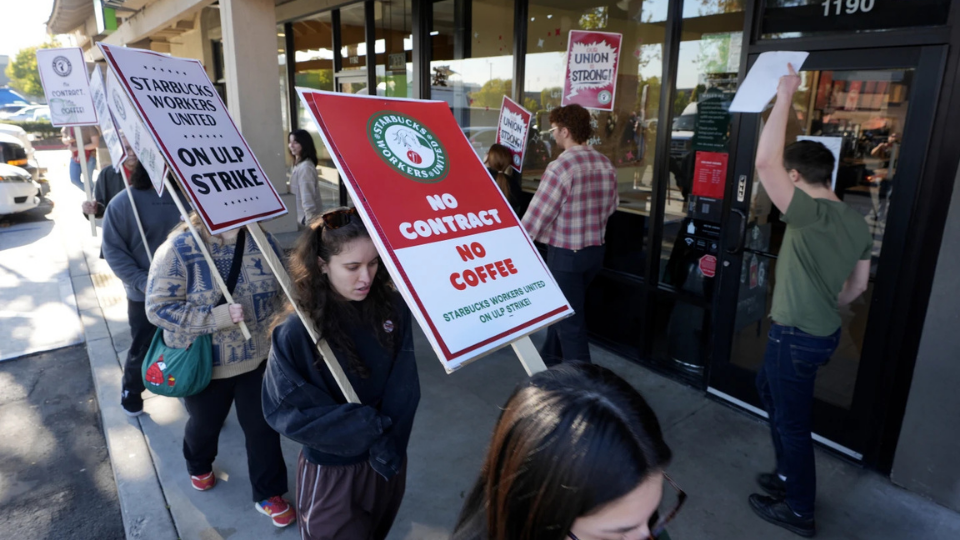
But the other, especially for young workers in a hostile economy, is to organize, mobilize, unionize and, if necessary, strike. That’s what Starbucks’ 12,500 unionized workers have been doing for more than a month. It’s the longest unfair labor practices strike in company history.
So Lee-Litowitz, a 10-year Starbucks veteran, approached Niccol in an attempt to talk with him, ask him to restart bargaining with the workers. The strike theme, directed to customers: “No contract, no coffee.” Talks between the two sides ground to a halt six months ago when Starbucks refused to budge from its low-ball-pay, no-benefit-eligibility offer.
“We kicked off a rally at 9 a.m. in snow and sleet and announced an active picket line” at different Chicago-area Starbucks sites, Lee-Litowitz explained. Everyone took six-hour shifts—on then off then on then off—to bring their cause to customers, the public, and, as it turned out, to try to bring it to Niccol.
“Niccol shows up at 10:30 a.m. on Day 2,” only to find the Starbucks store he went to had no supplies. The delivery drivers, members of Teamsters Local 710, refused to cross picket lines with their trucks. “It showed how we” in the labor movement “could flex the power of continued solidarity,” Lee-Litowitz said.
“I had completed my 6 a.m.-noon shift in subzero temperatures,” when she was tipped off about Niccol’s presence, Lee-Litowitz continued. “It was so cold that I developed chapped lips for the first time ever.”
Which didn’t stop her from trying to talk with Niccol, whose $94 million pay and benefits package for last year, on an annual basis, reflects Starbucks’s wealth, despite sales declines in both the U.S. and China. He still earned 6,666 times the median wage of a Starbucks worker, the AFL-CIO’s Paywatch reported, citing federal records.
The median is the point where half the workforce is above (including Niccol) and half below, including baristas. To equal his pay and perks package, a typical barista would have had to start working for Starbucks 2,000 years before the ancient Egyptians began building the Great Pyramid.
Niccol “had only been there maybe half an hour when I tried to approach him” to talk about conditions at the stores. Instead, “his security was blocking me out and rushing him out onto Michigan Avenue.”
That didn’t stop Lee-Litowitz. She took off in pursuit.
In desperation to avoid conversation, Niccol crossed Michigan against the red light for intersecting Erie Street. Somehow, he made it, against a background of screeching horns, squealing brakes, and cursing drivers. Luckily, nobody crashed into each other. “They laid on their horns” as they tried to turn left, Lee-Litowitz says, while “an entitled CEO” skedaddled across the six-lane avenue.
Lee-Litowitz, of course, didn’t follow him immediately. “I didn’t want to get hit,” she said. Lee-Litowitz is around five feet tall, and drivers would not have seen her. She waited until the light changed, then crossed and caught up to Niccol as he was about to enter his black limo.
Before, Lee-Litowitz had just identified herself as a long-time worker, interested in the future of the company and how cooperation, not confrontation with its workers, could better serve its customers. Now, she told Niccol of her identity as a Starbucks Workers United activist, too.
“I asked him to give us a fair and reasonable contract offer,” so bargaining could resume, she said. “He got in the car and slammed the door in my face.”
She also notes Niccol responded to sales losses in the U.S. and China by closing hundreds of stores in “reorganization” that shut stores, Starbucks claims don’t meet corporate profit expectations. While Niccol has closed 3% of what he says are “underperforming” stores nationwide, he’s closed 14% of the unionized stores. Starbucks Workers United says that’s not a coincidence.
Starbucks sales declines in the U.S. have resulted from bad publicity contrasting its conduct with its ideals. Niccol’s predecessor was ousted for admitting that. Starbucks’ unionized Chicago area stores included ones at Cherry Lane in the northwestern suburbs, where Lee-Litowitz worked, Ridge Avenue and Clark Street in Rogers Park, on South Halsted Street the edge of Greektown, at Bryn Mawr on the North Side, at Chicago Avenue and Main Street—right across from a Chicago El line stop—in Evanston and at East 55th Street and South Woodlawn Avenue in Hyde Park.
The Greektown store, the 55th Street store, and the Bryn Mawr store are close to major universities, whose students have been frequent Starbucks customers and sometimes off-campus work-study employees. Starbucks has closed Chicago and Main, Ridge and Clark, Greektown, and 55th Street.
The Times reported workers at a shorter strike last year at Bryn Mawr held up signs saying, “Please, Mr. Scrooge, give us a living wage,” and “Jingle bells, coffee sells, so why are we all broke?”
The company’s general response has been a non-response, in bargaining and to the strike. “It looks like they’re biding their time and trying to wait us out,” hoping workers will get discouraged and give up, says Lee-Litowitz. Dissidents at a handful of the 650 unionized stores have filed petitions with the National Labor Relations Board to decertify the union. The vicious, venal, and corporate-funded National Right to Work Committee is aiding the dissidents.
And four years after the first Starbucks unionized, in Buffalo, N.Y., none of the stores have a collective bargaining agreement, and all bargain jointly with the coffee giant—when it talks. Which it doesn’t.
Despite all that, Lee-Litowitz, like other Starbucks workers, is committed to the ideals of serving the customers and serving them well. “I sincerely think it’s in the best interest of Starbucks, our customers, and our union for them to get back to the bargaining table” and negotiate in good faith, she concludes.
We hope you appreciated this article. At People’s World, we believe news and information should be free and accessible to all, but we need your help. Our journalism is free of corporate influence and paywalls because we are totally reader-supported. Only you, our readers and supporters, make this possible. If you enjoy reading People’s World and the stories we bring you, please support our work by donating or becoming a monthly sustainer today. Thank you!
CONTRIBUTOR