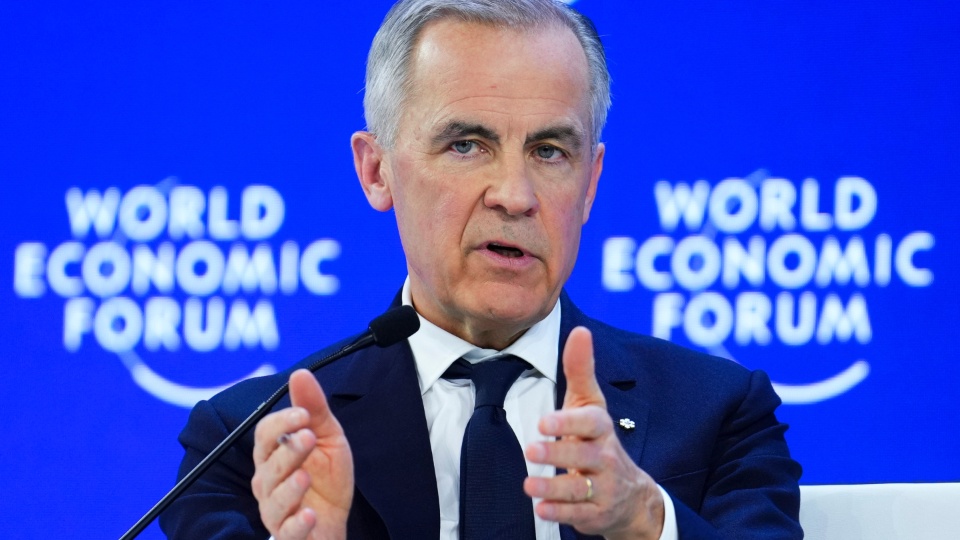
When Canadian Prime Minister Mark Carney offered his assessment of a “rupture” of the global order before an audience of statesmen and corporate CEOs at the World Economic Forum, he wasn’t giving the kind of diplomatic speech typically heard at these ruling class conclaves.
He was delivering a sober message from one segment of the international capitalist class to another: The old assumptions about U.S. leadership, predictability, and liberal multilateralism are dead—and they won’t be coming back.
Since 2016, much of the world’s ruling elite comforted itself with the notion that Donald Trump was a temporary deviation from the “normal” functioning of U.S. capitalism and imperial leadership. They were sure that he and his politics represented an aberration that would pass soon enough in an election or two. That illusion has collapsed, and Carney told everyone to face the facts.
The capitalist class and its partisan political representatives inside the United States have been divided for years over how to respond to the system’s prolonged crisis of profitability and the rise of challengers like China.
One faction favored a continuation of U.S.-led neoliberal globalization, anchored in free trade agreements like NAFTA, multilateral institutions such as the WTO and IMF, and the projection of U.S. power alongside partners through alliances like NATO.

Another faction—embracing nationalism and authoritarianism and more willing to discard any pretense of universal rules—advanced the view that U.S. dominance could only be saved by turning to economic warfare, tariffs, sanctions, and raw force. Guaranteeing U.S. corporate power wins out against its rivals, they argued, required a return to an imperial bloc strategy, the carving out an American-controlled “sphere of influence” as in the days of the Monroe Doctrine.
Trump did not invent this strategy, but he and the forces around him consolidated it, gave it political expression, and mobilized a mass electoral base around it. This faction has prevailed and succeeded in bringing to its side most of the major segments of the U.S. capitalist class.
Carney’s speech amounts to an acknowledgment that Trump and the faction of capital he represents decisively won this internal struggle within the U.S. ruling class and that their victory has consequences for the whole world.
Economic integration is now explicitly subordinated to geopolitical rivalry and domestic political calculation. Allies are treated as expendable, institutions as disposable, and agreements as binding only so long as they serve immediate U.S. advantage. This is not a policy glitch—it is the operating logic of the dominant wing of U.S. capital today.
Undoubtedly, the Canadian leader’s remarks will be remembered as the moment when U.S. imperialism’s junior partners woke up to a reality that the developing and colonized countries of the world have been living in for decades.
Far from the usual platitudes about the “rules-based order,” Carney plainly declared that the old architecture of U.S.-led multilateralism—once lauded by leaders like himself as the guarantor of stability—is being torn apart under the pressures of great-power rivalry, economic coercion, and unilateral aggression.
What makes Carney’s intervention in Davos so significant is that it reflects two major admissions:
First, waiting out Trumpism is no longer a viable strategy for the other advanced capitalist powers. Even if the individual personalities in Washington may change, the balance of forces has shifted within U.S. capitalism. The advantage now lies with those who see permanent economic conflict, increased militarization, and unilateral action as preferred tactics.

Second, the understanding of free trade globalization as a joint international project under U.S. leadership with win-win outcomes for all countries was never true—and leaders in places like Canada and Europe knew it all along. That was simply a “pleasant fiction,” as Carney called it.
The Canadian prime minister spoke with a frankness uncharacteristic of a Western leader:
“We knew the story of the international rules-based order was partially false, that the strongest would exempt themselves when convenient, that trade rules were enforced asymmetrically. And we knew that international law applied with varying rigor depending on the identity of the accused or the victim.”
But, he said, “this fiction was useful” for capitalists elsewhere. “American hegemony…helped provide public goods, open sea lanes, a stable financial system, collective security, and support for frameworks for resolving disputes.” Underpinning it all was the unspoken and only occasionally deployed threat of U.S. power, but the capitalists of the world kept the lie alive because they benefitted from it—their profits, prosperity, and security were guaranteed.
“We participated in the rituals,” Carney admitted, “and we largely avoided calling out the gaps between rhetoric and reality.” But with the shift of class forces in the U.S. and the pursuit of a new imperial strategy, Carney is telling capitalists elsewhere to open their eyes to what dependence on the U.S.-led system brought them: “You cannot live within the lie of mutual benefit through integration when integration becomes the source of your subordination.”
Carney’s rhetoric lays bare what Marxists and progressives have been saying for decades: The post-World War II order was always a fiction sustained by the domination of U.S. capitalism, not a genuine egalitarian system of global governance. The closest the world ever came to that was the wartime anti-fascist cooperation between the U.S., the Soviet Union, Britain, and the Allies, but that was scuttled in exchange for the Cold War. What came afterward was an arrangement that locked in advantages for U.S. corporations and banks while still leaving plenty of opportunities for the capitalists of other countries to also reap benefits. However, “this bargain no longer works,” Carney said.

His speech reflects the dilemma facing an elite trapped between loyalty to a collapsing framework and the need to adapt to a world in which U.S. capitalism no longer offers predictable leadership, only demands for alignment and obedience.
For the working class—in the U.S. and around the world—the significance of this moment lies in what Carney has revealed about the system itself. It is workers, along with poor and developing countries, who bore the costs of economic shocks, privatization, austerity, and wars during the era of globalization. They knew it, and now a representative of the ruling class is admitting it.
Carney’s speech is an overdue confession that financial and military power, not abstract principles of freedom or democracy, have always been the foundations of international relations under capitalism. It shows that the old stabilizing myths peddled by mainstream politicians and the corporate media no longer hold. “Nostalgia is not a strategy,” as he said.
The future will be shaped not by a return to a mythical order but by struggles over how power, resources, and sovereignty are distributed—struggles in which the working class must insist on their own interests rather than trailing the delusions of elite consensus. This is the corollary that Carney doesn’t touch; his speech never confronts the system that concentrated power in corporate hands long before Trump came on the scene.
His honesty, however, unintended though it may be, still strips away the myths that sustained capitalist globalization. The question now is not whether the old order can be restored, but whether working people will organize to fight for a new one—built not on imperial dominance and capitalist competition, but on solidarity, peace, and democratic control of the economy.
We hope you appreciated this article. At People’s World, we believe news and information should be free and accessible to all, but we need your help. Our journalism is free of corporate influence and paywalls because we are totally reader-supported. Only you, our readers and supporters, make this possible. If you enjoy reading People’s World and the stories we bring you, please support our work by donating or becoming a monthly sustainer today. Thank you!
CONTRIBUTOR