Right on cue, as the mad wannabe-pharaoh unleashes yet another cataclysmic war in the Middle East, LA Opera’s first operatic production of 2026 is about upheaval and regime change in that part of the world. Innovative minimalist composer Philip Glass’ Akhnaten is a lavish aural luau and visual feast that reimagines ancient Egypt. Like his 1976 Einstein on the Beach and 1980 Satyagraha (about Gandhi), Akhnaten is a “portrait opera” about a transformative figure who possesses “the power of inner vision.”
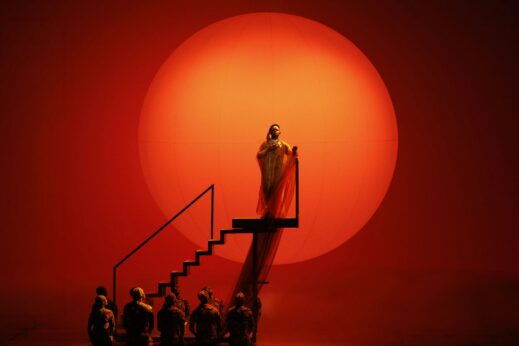
The freewheeling story (Glass co-wrote the libretto with four others, including Jerome Robbins) opens with the death of Amenhotep III (Florida bass-baritone Zachary James, who has a double role as The Scribe) on the bottom level of a staggering three-level stage concocted by English scenic designer Tom Pye. According to Thomas May in Performances Magazine, which serves as the opera’s program, Glass’ “reliance on the number three, from the architecture of trilogies to the triadic core of his harmonic language, played a decisive role in conceiving Akhnaten.”
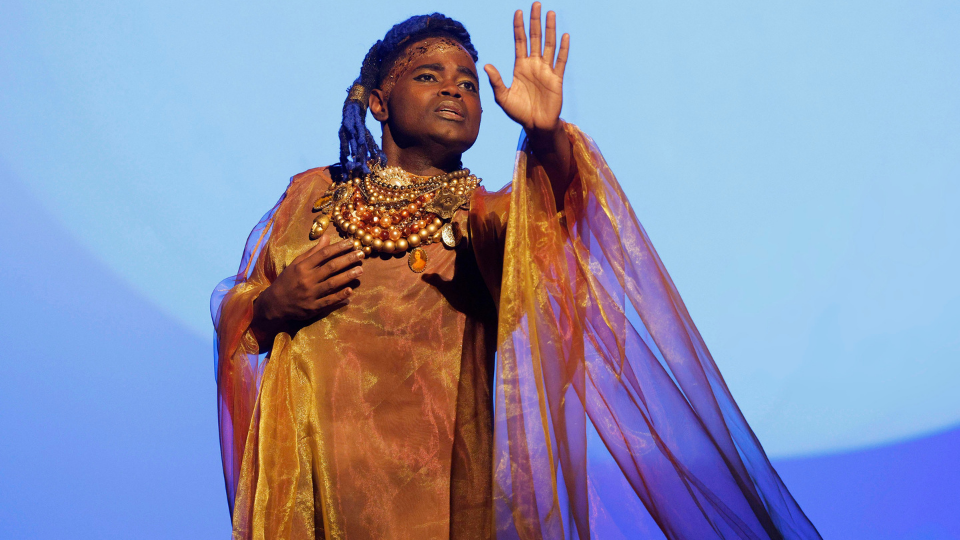
It appeared to me that modern dress characters, perhaps archaeologists, were studying the pharaoh’s mummy on the bottom tier of the boards. In any case, Amenhotep III’s son, who goes on to take the name Akhnaten (Texas countertenor John Holiday, who has a preternaturally high-pitched voice), ascends to the throne in a spectacularly eye-popping, ritualistic coronation ceremony.
While this opera’s eponymous character, the 18th-Dynasty pharaoh who reigned from about 1353-1336 BCE, is probably unfamiliar to most Westerners, two of the other historical personages depicted in Glass’ pharaoh-palooza are among the best known today from Egyptian annals. They are Nefertiti (New York mezzosoprano Sun-Ly Pierce), the wife of Akhnaten, and the latter’s son, who has been celebrated in American pop culture, Tutankhamun (Schroeder Shelby-Szyszko, in a non-singing role), aka King Tut, who became pharaoh while still a child, reigning until his untimely death at age 19, yet famously buried rather opulently.
In the opera, Akhnaten discombobulates the Egyptian theocracy by imposing monotheism centered around a sun god upon the polytheistic, highly hierarchical society. After his religious revolution, Akhnaten, Nefertiti, and their six daughters relocate to a new capital city, Akhetaten, and are cut off from the currents of Egyptian daily life at this primordial Mar-a-Lago. The High Priest of Amon (tenor Yuntong Han plays this leader of the religion displaced by Akhnaten) joins forces with General Horemhab (baritone Hyungjin Son) and Nefertiti’s father, Aye (bass Vinicius Costa), to topple the upstart Akhnaten. Will they succeed in their quest for regime change?
Aye’s attire curiously includes a bowler hat (with a death’s head affixed to it), an umbrella, and a suit, and he looks as if he stepped out of Monty Python’s motley crew. Other members of the cast are garbed in approximations of period dress—as well as undress—as there is nudity and the wearing of sheer, see-through. A number of cast members are clad in outfits that, to me, resemble mummy wrappings or camouflage. Liverpudlian costume designer Kevin Pollard also has the keen eye of a painter, and hiseye-catching apparel, from the ancient to the 20th century, including regal robes and headdresses, are sumptuous highlights of this stunning spectacle.
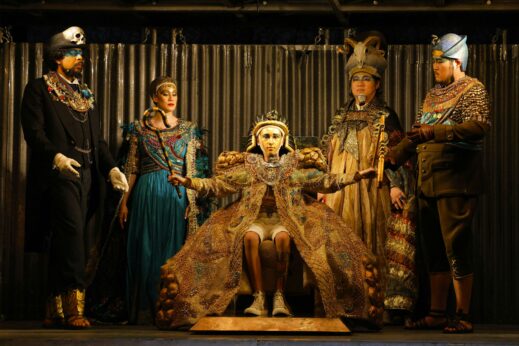
So are the multi-layered sets by Pye, which cleverly feature visual references to hieroglyphics, those ancient emojis. The original and revival lighting designed by, respectively, England’s Bruno Poet and New York’s John Froelich, heighten the ambiance. English opera and theater director Phelim McDermott masterfully helms the extravagant extravaganza. The intricate opera’s endless moving parts include a slew of jugglers, played by performers from the opera’s juggling choreographer Sean Gandini’s troupe, who bestow a Cirque du Soleil-like vibe on this really big show.
The frequent skilled tossing of balls is among the many head-scratching features of Akhnaten, although the extremely helpful Performances Magazine explains that juggling was indeed practiced in the Egypt of antiquity. (Who knew?) Reprising his role from LA Opera’s likewise stellar 2016 presentation of Akhnaten, Zachary James helps us make sense of the strange, mind-boggling proceedings onstage. Although, as noted above, Amenhotep III’s funeral opens the show, he remains a spectral presence throughout, commenting on the action. With his stentorian voice, James comments upon the action, offering some explanations in spoken English in his dual roles as Akhnaten’s father, Amenhotep III, and also as The Scribe, a 20th-century lecturer, perhaps at a university, on archaeology.
Glass’ three-hour pharaoh-palooza (with two intermissions) that goes back and forth in time is all rather overwhelmingly magisterial and magnificent in its immensity, enhanced by the LA Opera debut of Kyiv-born conductor Dalia Stasevska, who adds glory to Ukraine with the twirling of her baton.
The fact that Akhnaten, about violent turmoil in the Middle East, returns to the stage at the precise moment that the man who would be pharaoh launches unprovoked warfare in that region is yet another example of how art and life imitate one another. It remains to be seen if the one who inhabits that latter-day Tell el-Amarna at Palm Beach and the White House will meet the same fate as Akhnaten. Stay tuned—and what a portrait opera that will be for Glass or another composer to create.
I can’t presume to speak for Glass as to what he thinks about this contemporary violent fury and folly in the Middle East, but amidst the recent uproar at the Kennedy Center which President Donald Trump has illegally annexed his name to, the 89-year-old Glass canceled the premiere of his latest work there in January, declaring: “After thoughtful consideration, I have decided to withdraw my Symphony No. 15 ‘Lincoln’ from the John F. Kennedy Center for the Performing Arts. Symphony No. 15 is a portrait of Abraham Lincoln, and the values of the Kennedy Center today are in direct conflict with the message of the symphony. Therefore, I feel an obligation to withdraw this symphony premiere from the Kennedy Center under its current leadership.”
Bravo for your integrity, Maestro Glass—and for your majestic masterpiece, the must-see—and hear!—Akhnaten.
For tickets and info, go here.
We hope you appreciated this article. At People’s World, we believe news and information should be free and accessible to all, but we need your help. Our journalism is free of corporate influence and paywalls because we are totally reader-supported. Only you, our readers and supporters, make this possible. If you enjoy reading People’s World and the stories we bring you, please support our work by donating or becoming a monthly sustainer today. Thank you!
CONTRIBUTOR