For most of Jay Ozier’s decades as a trade union activist in St. Louis, May Day came and went just like any other workday. A small fundraising breakfast for People’s World here, a few comrades and likeminded fellow workers gathered there—but nothing like the international working-class holiday celebrated in countries all over the world.
But this year, that’s changing. Now, there are plans for over a thousand rallies in cities across the country—with many led by organized labor, including dozens of central labor councils, state labor federations, and now even the national AFL-CIO itself signing on.
“In the last few years, the May Day demonstrations have been growing,” Ozier told People’s World in a recent sit-down interview. “It got going for real in 2006 for the immigrant rights movement, and probably started getting more popular during Trump’s first term. But certainly, after the murder of George Floyd, people began to understand that we need to be in the streets.”
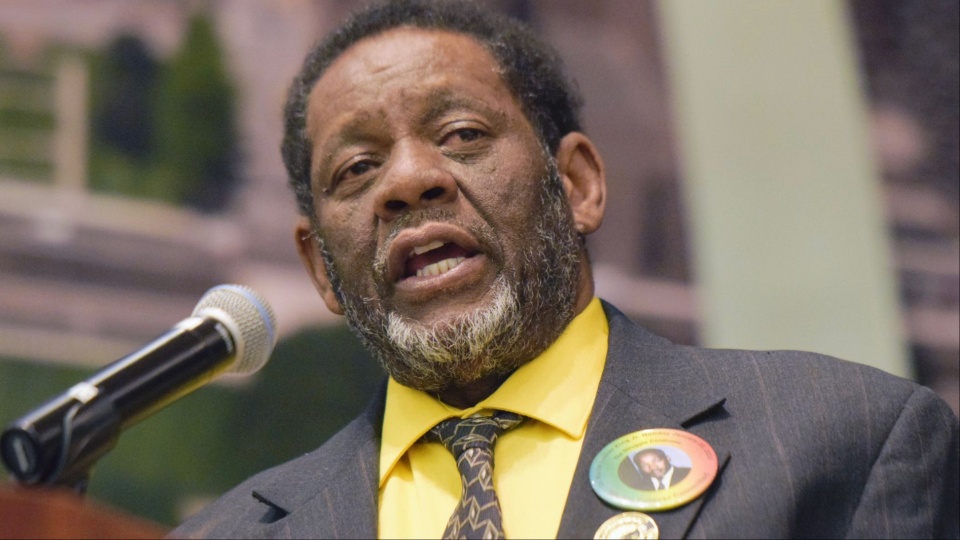
Ozier isn’t one to rush into the spotlight when it comes to taking credit for the militant spirit spreading across organized labor lately, but he’s played no small role in helping it along. He’s one of the lead advocates behind the Coalition of Black Trade Unionists’ resolution calling on the AFL-CIO to organize a national union day of solidarity to protest the Trump administration’s anti-worker policies.
It’s a proposal modeled on the “Solidarity Day 1981” march in response to Ronald Reagan’s firing of air traffic controllers and the breaking of their union, PATCO. Support for the CBTU’s call is picking up steam. Earlier this month, the Federal Unionists Network, which has been battling the mass layoffs of government workers, signaled its support.
This year, with the billionaire-backed Trump regime creating havoc and chaos for working people both here and abroad, Ozier says mobilizing for May Day isn’t just important—it’s essential. And for Black workers in particular, May Day 2026 carries a special urgency that connects the unfinished business of the Civil Rights Movement to the fight against billionaire rule.
From the Black Consciousness Movement to the union hall
Ozier’s political education began long before he picked up a hammer. In high school, he was part of the Black Consciousness Movement, pushing to get Black history taught in St. Louis classrooms and forming Black student unions across the city. But it all really started when his sister urged him to read The Autobiography of Malcolm X.
“I first heard of Malcolm X the day he was assassinated,” Ozier recalls. “I didn’t know anything about him or the Nation of Islam.” Reading Malcolm’s words changed everything—his speeches “The Ballot and the Bullet” and “Message from the Grassroots,” his clear opposition to the Vietnam War, his recognition that newly independent African and Asian nations were moving toward national sovereignty and even socialism.

Before joining the Carpenters Union Local 92, Ozier threw himself into the Free Angela Davis campaign, where he met trade unionists and even communists for the first time. He then started attending classes at St. Louis’s W.E.B. Du Bois bookstore. By the time he entered the building trades, he already understood a fundamental truth: “The only way to beat an organization [of bosses] is if you have a better organization.”
That understanding would prove crucial. Ozier entered the Carpenters Union apprenticeship through an Urban League remedial program—established only after Percy Green and another activist, Richard Daly, climbed the Gateway Arch to protest the absence of Black workers on the construction site.
‘Black Workers need May Day’
So why should Black workers, and indeed all working people, take to the streets this May Day?
“Black workers, and really all workers, are natural allies because we work for the same people,” Ozier says. The billionaires, he explains, have a simple strategy: “Keep us divided, keep us fighting against each other, and that keeps the capitalist cash registers ringing.”
Drawing on the foundational labor principle that “an injury to one is an injury to all,” Ozier argues that unity across racial lines isn’t just morally right—it’s the only path to winning. “The more we unite, the more we can extract from the billionaires we work for and ultimately change society.”

He then pointed to the reality of how production works: “Whether we’re making the steel, whether we string an electrical wire, even for what they call parts suppliers—which are still billion-dollar businesses—we’re working for them to supply the big [corporations].”
Capitalist production is socialized, Ozier said, with countless workers contributing to every product. But the profits? “Those are privately appropriated by those who own the land, factories, and machinery which we use on the job.”
“But without us, the workers, they cannot produce anything,” Ozier said.
On the necessity of unity of the multi-racial working class, he invoked Karl Marx’s observation about the U.S. Civil War: “Labor in white skin can never be free so long as labor in Black skin is held in bondage.”
The same principle holds today, he said. “A union that excludes immigrant workers, that allows divisions based on skin color or language, weakens itself. A working class that fights itself strengthens the only enemy that matters—the billionaire class.”
The demands of May Day 2026
This year’s May Day mobilizations center on four demands, and Ozier sees each one through the lens of Black working-class struggle.
No War: “War is not in our interests,” Ozier firmly stated. “It’s in the interests of multinational corporations that manufacture armaments and profit from conflict.” From war in Vietnam—which Malcolm X opposed in the 1960s—to today’s endless wars, working people’s children die while weapons manufacturers get rich. Black communities, disproportionately represented in the military and disproportionately suffering the economic consequences of militarism, have every reason to fight against war.
No ICE: “All of us are immigrants,” Ozier said—though he quickly adds the crucial distinction that “Black workers were the only ones forced by chains over here into slavery.” That history makes it particularly contradictory for Black workers to turn against immigrants seeking a better life. “Everyone crossing the border is looking for a better life. We shouldn’t be divided based on origin, based on union status, based on any of that.”
No Billionaires: “Billionaires keep us divided based on gender, based on color, based on language, any way they can,” Ozier explained. “While we’re fighting among ourselves, they’re benefiting.” The only answer is multiracial, multigender working-class unity, he said.
Protect the Right to Vote: “This is primary,” Ozier emphasized. “That’s the only chance that we as workers have a voice in this specific system of government.” Without the vote, workers cannot make or change laws for their benefit. Without the vote, workers cannot elect other workers to represent their interests. “Right now, the laws are bent in terms of the owners,” he says. “Billionaires do not want us to have any other right than the right to go to work for them.”
The attack on voting rights is not a minor thing, he said. It’s aimed directly at Black voters, immigrant communities, and working people of all races. The MAGA agenda’s systematic voter suppression is an attack on a crucial democratic right that working people still possess.
May Day’s forgotten history
There’s a “bitter irony” that Ozier pointed out: May Day commemorates the Haymarket affair in Chicago, where workers were killed and executed for fighting for the eight-hour day in 1886. The entire world celebrates May Day in honor of that struggle—except the country where it happened.
“We didn’t really celebrate it here,” Ozier said. “We had Labor Day instead.” In his opinion, the labor movement must take up the fight to make May Day a paid holiday. “After all, it’s about respecting workers as full human beings who deserve a say on the job and in the conditions of their work.”

But on this May Day, Ozier will be in the streets with his union siblings and comrades, joining the mass movement growing before our eyes. He’s seen May Day demonstrations grow from small affairs to real mobilizations of masses of people, and he believes the momentum can continue.
“Workers standing up and wanting to be respected as full human beings,” he says—that’s what May Day means. “To have a say on the job and the conditions of work. To be in solidarity with all workers wherever and whoever they are. To fight for community control of our school boards and police departments. For women to have control over their own bodies.”
For Black workers, who have had to fight steadfastly to have any say over anything in this country, that demand carries special weight, Ozier said. And for all workers facing a real fascist danger, a regime that serves billionaires at every turn, May Day 2026 is an opportunity to declare: “Workers over billionaires!”
People’s World is in the midst of its annual fund drive, trying to raise $140,000 by May Day. To support working-class journalism, please consider make a donation or become a monthly sustainer. Thank you.
CONTRIBUTOR