NEW YORK—In the face of an escalating U.S. campaign to strangle the Cuban economy through a total oil blockade, the World Federation of Trade Unions (WFTU) has issued an urgent appeal for international solidarity. They are calling for an International Week of Action from April 6 to 12 in support of the Cuban people.
In the U.S., National Nurses United (NNU) joined the international labor movement in condemning the Trump regime’s blockade of Cuba, saying: “Depriving the Cuban people of essential resources needed to sustain life and health is an unconscionable violation of human rights and international law.
“What is now widely reported is a calamity with an especially harmful effect on pregnant women and children. As nurses, we will not be silent when our nation’s policies cause immense suffering for any people, whether at home or abroad,” said NNU President Mary Turner.
The WFTU’s announcement of the week of action, following a joint meeting between the WFTU Secretariat, the leadership of the Central de Trabajadores de Cuba (CTC), which is the trade union federation there, and the WFTU Regional Office for Latin America, comes as the Trump administration intensifies its extraterritorial assault on the island nation’s sovereignty and indeed all of Latin America.
“Under the ridiculous pretext that Cuba is a country that supports terrorism, they are imposing a total blockade on oil supplies and condemning the Cuban people to conditions of absolute energy poverty, with all the harsh consequences that this has on the living and working conditions of Cuban workers,” the WFTU said.
The labor federation is calling on its 105 million members across 133 countries to “move beyond statements of condemnation toward practical, material support.” The federation has outlined two primary objectives for the solidarity campaign.
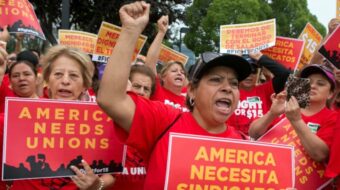
 First, affiliated WFTU unions and supporters of Cuba are urged to organize events and demonstrations during the week of April 6-12, with actions targeted, where possible, outside U.S. embassies worldwide. Second, the federation has launched an international campaign to collect money, medicines, and medical supplies to be channeled through the CTC to Cuban workers in businesses and workplaces hardest hit by fuel and electricity shortages.
“The working class and the people of Cuba face with pride and dignity the economic strangulation and unbearable challenges, refusing to submit to the will of the imperialists,” the statement emphasized. “They refuse to abandon the revolutionary path they have freely chosen.”
The effects of the intensified U.S. pressure campaign are palpable across Cuban daily life. Following the January kidnapping of Venezuelan President Nicolás Maduro—a key oil supplier to Cuba—the Trump administration, led by anti-Cuba hawks like Secretary of State Marco Rubio, has tightened the screws on the Caribbean socialist nation.
According to People’s World correspondents in Havana, Cubans are enduring long gas lines, severe power outages, delays in trash collection, and scarcity of medical supplies. Public institutions remain operational but with reduced hours, and workers face transit difficulties as fuel shortages limit transportation options.
Yet despite these hardships, Cuba is far from the passive, collapsing state depicted in corporate media narratives. The Cuban government and people are actively implementing creative measures to not only mitigate the crisis but build toward a more independent, sustainable future.
Dependence on imported petroleum has made Cuba vulnerable to precisely the kind of attack Trump and Rubio are now waging. In response, the national focus has shifted dramatically toward building an autonomous energy grid sustained by renewable sources and nationally produced oil.
The WFTU’s call for material aid reflects a sophisticated understanding that effective solidarity must empower Cuba’s long-term development, not merely provide temporary relief. As recent People’s World reporting from Havana notes, humanitarian aid alone will not solve the larger economic issues Cuba faces as a result of the blockade that shackles its capacity for autonomous development and international trade.
The WFTU is urging affiliates to coordinate with the CTC to direct assistance where it will have maximum impact. The organization’s central offices stand ready to assist member organizations with practical coordination.
While material aid is crucial, the WFTU and Cuban solidarity movement recognize that the blockade itself can only be lifted through political action in the United States. U.S.-based activists must exert pressure on Congress to support legislation repealing the blockade, joining the coalition led by Rep. Jim McGovern, D-Mass., who introduced H.R. 7521 in February. Sens. Ron Wyden, D-Ore., and Jeff Merkley, D-Ore., have introduced similar legislation in the Senate.
NNU urged members of Congress to support legislative proposals to finally end the blockade. “It’s time to throw away the failed policies of the past. Let’s focus on the people of Cuba—and let’s treat them like human beings who want to live their lives in dignity and freedom. The Cuban people—not politicians in Washington—ought to decide their own leaders and their own future,” the union said.
Ed Ott, retired Executive Director and Political Director of the NYC Central Labor Council, told People’s World that the latest attempts to destroy the Cuban government is “deeply rooted in the Cold War” where they “painted Cuba as a threat to us—which is not true.
“There’s a long history here of trying to destroy the Cuban process,” Ott told People’s World. “I think all American trade unionists should reject this and support the call to action. Regardless of our own political orientations, there is no reason we should buy into the Trump regime’s threats against Cuba.”
The struggle to maintain Cuba’s sovereignty is fundamentally linked to working-class struggles in the U.S, Ott said. The same foreign policy apparatus that chokes Cuba and the rest of the world through military intervention and bullying diverts vast resources from social programs at home, promotes offshoring of jobs, and undermines international cooperation on public health and other working-class issues.
“It is long past time for a complete reversal in the regime-change policies of the U.S. in Cuba,” said Turner of NNU. “The U.S. has carried out a blockade against Cuba since 1962 that has been condemned in overwhelming votes by the United Nations for 33 consecutive years.”
Cuba’s situation, while severe, is not insurmountable. The nation’s daily peak power demand of approximately 3,500 megawatts is modest compared to the United States’ 400,000 to 500,000 megawatts of continuous demand. Cuba’s rationally organized distribution system and prioritization of essential human needs mean it can achieve energy sovereignty with moderate investment—precisely the kind of investment international solidarity can help facilitate.
“By linking an end to the embargo with a general call to build a peace economy rather than a war economy, activists can articulate a working-class vision of international relations,” People’s World’s Havana correspondent reported. The demand must be to leave Cuba in peace and instead invest resources in domestic social services and economic development.
The labor federation’s call echoes the sentiments of the Jan. 16 march in Havana, where half-a-million Cubans demonstrated along the Malecón past the U.S. embassy, defending their sovereignty and honoring 32 Cuban combatants killed while serving in Venezuela.
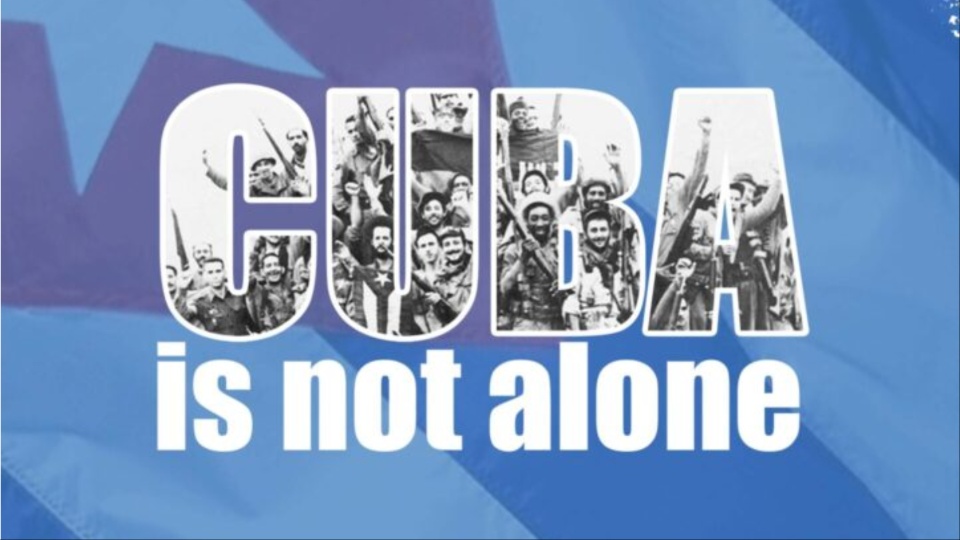
“Cuba is not alone!” the WFTU declares. The International Week of Action from April 6-12 offers trade unionists and progressives worldwide the opportunity to transform solidarity from rhetoric into concrete support for a people whose only crime is refusing to submit to imperial domination.
For practical issues regarding participation in the solidarity campaign, WFTU members and friends can contact the WFTU Central Offices for coordination and assistance.
We hope you appreciated this article. At People’s World, we believe news and information should be free and accessible to all, but we need your help. Our journalism is free of corporate influence and paywalls because we are totally reader-supported. Only you, our readers and supporters, make this possible. If you enjoy reading People’s World and the stories we bring you, please support our work by donating or becoming a monthly sustainer today. Thank you!
CONTRIBUTOR