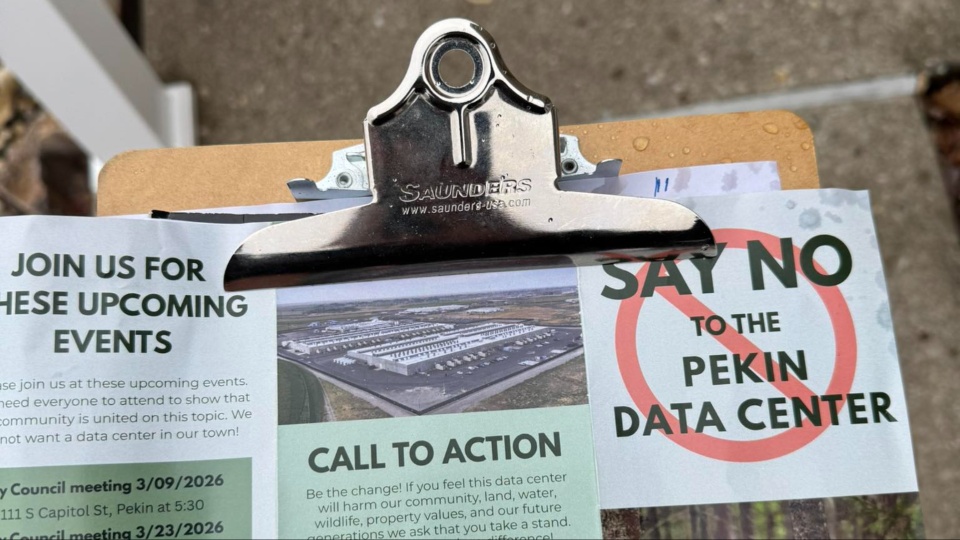
PEKIN, Ill.—Residents celebrated a victory Tuesday night as Mayor Mary Burress announced that Pekin City Council does not plan to move forward with approval for a proposed AI data center.
Burress was greeted with applause by those in attendance as she read off her statement indicating the council was nixing the facility.
“When a project creates this level of uncertainty and division, it is important for us to step back to consider whether moving forward is truly the right path,” Buress told the crowd.
Zoey Carter, who is running for the Illinois State House in District 93, expressed gratitude for the decision, highlighting the various reasons the community opposed the data center. “From an environmental standpoint, it was a terrible deal,” Carter said, also pointing to the fact that people “are dealing with rising utility costs.”
Even with the victory, activists with the Central Illinois Data Center Opposition remain cautious. “There are still ordinances and resolutions on the books, contracts, and land option agreements. There needs to be more city action to finally put this to rest,” said Mark Stevens, spokesperson for the group. “We are pushing the city to rescind all of that. Pull data centers out of city code.”
Prior to the Tuesday council meeting, the opposition group had distributed over 1,100 signs opposing the project. Thousands had signed up on their private Facebook group to receive updates and show support. Stevens emphasized that since January the group has packed the council chambers, with standing room only being a common site.
“I think that the council was shocked. They were shocked at how well-informed we were and how fast we organized. It caught them off guard,” he said.
Stevens emphasized the need for lawmakers at the state capitol in Springfield to do more to protect communities from the negative impacts of data centers. “If data centers are so good then don’t give them any tax breaks,” he said.
“Data centers are looking for a free handout. They should not be allowed to participate in power purchase agreements, they should invest money to create more supply, and it should be more environmentally friendly, like solar, nuclear, and wind.”
Ultimately, the data center fight showed how rapidly the Pekin community could organize and mobilize across political divides and across the region. Stevens explained, “This was a ‘Hey, this isn’t good for our community and this isn’t good for the community around us’ kind of moment.”
We hope you appreciated this article. At People’s World, we believe news and information should be free and accessible to all, but we need your help. Our journalism is free of corporate influence and paywalls because we are totally reader-supported. Only you, our readers and supporters, make this possible. If you enjoy reading People’s World and the stories we bring you, please support our work by donating or becoming a monthly sustainer today. Thank you!
CONTRIBUTOR