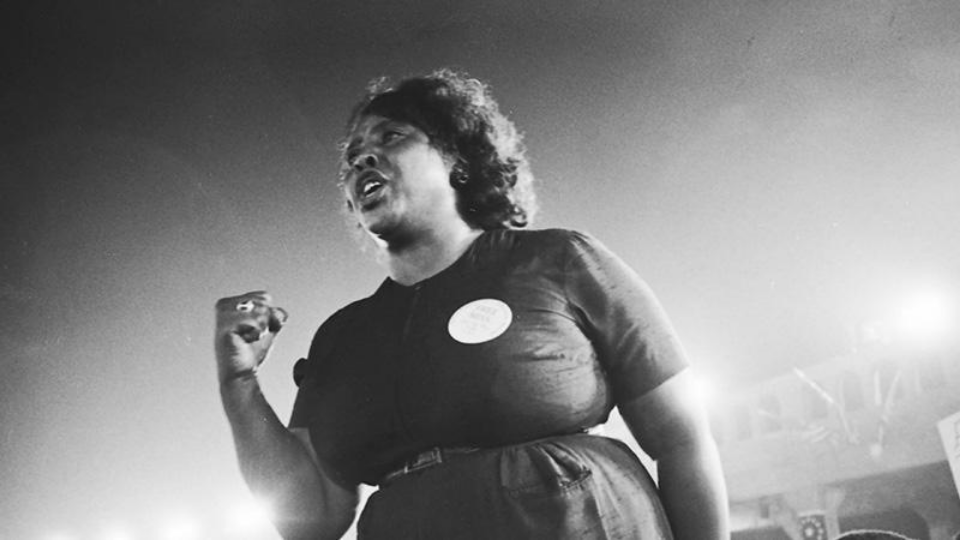
Fannie Lou Townsend Hamer rose from humble beginnings in the Mississippi Delta to become one of the most important, passionate, and powerful voices of the civil and voting rights movements and a leader in the efforts for greater economic opportunities for African Americans.
Hamer was born on October 6, 1917, in Montgomery County, Mississippi, the 20th and last child of sharecroppers Lou Ella and James Townsend. She grew up in poverty, and at age six Hamer joined her family picking cotton. By age 12, she left school to work. In 1944, she married Perry Hamer and the couple toiled on the Mississippi plantation owned by W.D. Marlow until 1962. Because Hamer was the only worker who could read and write, she also served as plantation timekeeper.
Hamer and her husband wanted very much to start a family, but in 1961, a white doctor subjected Hamer to a hysterectomy without her consent while she was undergoing surgery to remove a uterine tumor. Forced sterilization was a common method of population control in Mississippi that targeted poor, African-American women. Members of the Black community called the procedure a “Mississippi appendectomy”. The Hamers later raised two girls they adopted, eventually adopting two more. One, Dorothy Jean, died at age 22 of internal hemorrhaging after she was denied admission to the local hospital because of her mother’s activism.
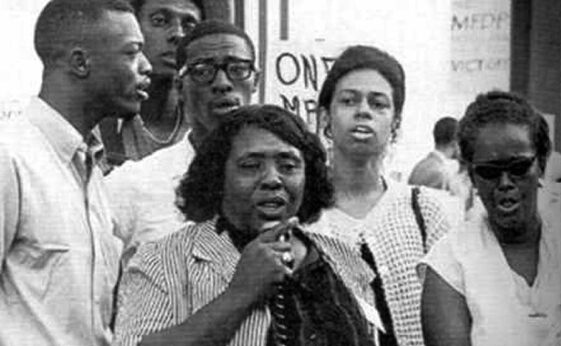
On June 9, 1963, Hamer was returning from a voter registration workshop by the Southern Christian Leadership Conference (SCLC) in Charleston, South Carolina. Traveling by bus with co-activists, they stopped for a break in Winona, Mississippi. Some of the activists went inside a local cafe, but were refused service by the waitress. Shortly after, a Mississippi State highway patrolman took out his billy club and intimidated the activists into leaving. One of the group decided to take down the officer’s license plate number; while doing so the patrolman and a police chief entered the cafe and arrested the party. Hamer left the bus and inquired if they could continue their journey back to Greenwood, Mississippi. At that point the officers arrested her as well.
Once in county jail, Hamer’s colleagues were beaten by the police in the booking room (including 15-year-old June Johnson, for not addressing officers as “sir”). Hamer was then taken to a cell where two inmates were ordered, by the state trooper, to beat her using a baton. The police ensured she was held down during the almost fatal beating, and when she started to scream, beat her further. Hamer was also groped repeatedly by officers during the assault. When she attempted to resist, she stated an officer, “walked over, took my dress, pulled it up over my shoulders, leaving my body exposed to five men”. Another in her group was beaten until she was unable to talk; a third, a teenager, was beaten, stomped on, and stripped. An activist from SNCC came the next day to see if he could help but was beaten until his eyes were swollen shut when he did not address an officer in the expected deferential manner.
Hamer was released on June 12, 1963. She needed more than a month to recuperate from the beatings and never fully recovered. Though the incident left profound physical and psychological effects, including a blood clot over her left eye and permanent damage of one of her kidneys, Hamer returned to Mississippi to organize voter registration drives, including the 1963 Freedom Ballot, a mock election, and the Freedom Summer initiative the following year.
Freedom Summer brought hundreds of college students, Black and white, to help with African American voter registration in the segregated South. In 1964, Hamer announced her candidacy for the Mississippi House of Representatives but was barred from the ballot. A year later, Hamer, Victoria Gray, and Annie Devine became the first Black women to stand in the U.S. Congress when they unsuccessfully protested the Mississippi House election of 1964. Hamer also traveled extensively, giving powerful speeches on behalf of civil rights. In 1971, she helped to found the National Women’s Political Caucus.
In 1968, she began a “pig bank” to provide free pigs for Black farmers to breed, raise, and slaughter. A year later she launched the Freedom Farm Cooperative (FFC), buying up land that Blacks could own and farm collectively. With the assistance of donors (including famed singer Harry Belafonte), she purchased 640 acres and launched a co-op store, boutique, and sewing enterprise. She single-handedly ensured that 200 units of low-income housing were built—many still exist in Ruleville, Mississippi, today. The FFC lasted until the mid-1970s; at its heyday, it was among the largest employers in Sunflower County.
Hamer died of breast cancer at age 59 in 1977. Forty-eight years after her death, President Joe Biden awarded the Presidential Medal of Freedom, the Nation’s highest civilian honor, to Hamer. CLUW honors Fannie Lou Hamer and her incredible spirit and determination.
We hope you appreciated this article. At People’s World, we believe news and information should be free and accessible to all, but we need your help. Our journalism is free of corporate influence and paywalls because we are totally reader-supported. Only you, our readers and supporters, make this possible. If you enjoy reading People’s World and the stories we bring you, please support our work by donating or becoming a monthly sustainer today. Thank you!
CONTRIBUTOR