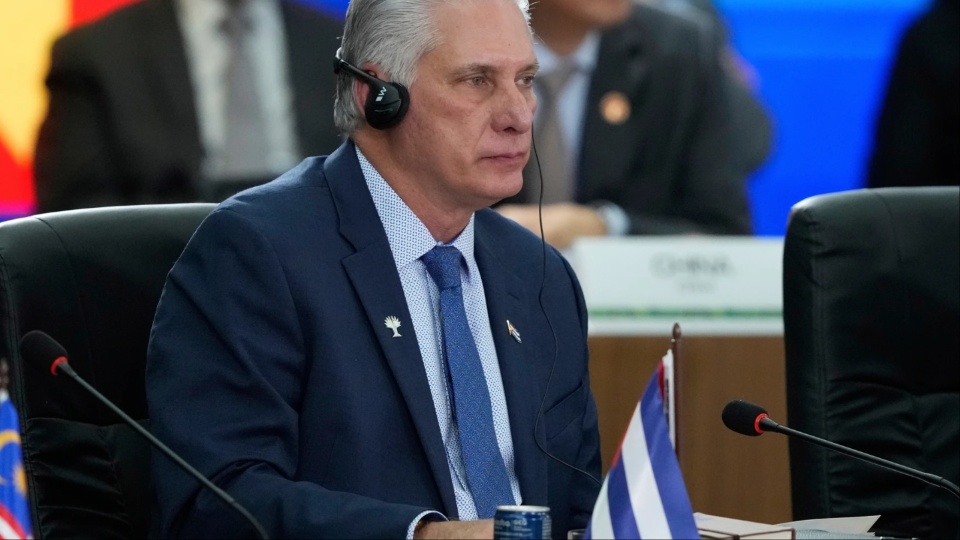
At a press conference with Cuban reporters on March 13, President Miguel Díaz-Canel reviewed his government’s analyses, actions, and plans as Cuba copes with the recently-imposed U.S. oil blockade. President Donald Trump on Jan. 29 announced that tariffs would be applied to nations exporting oil to Cuba. Díaz-Canel’s press conference reflects adjustments and new realities showing up since his earlier one on Feb. 6.
What follows is a selection of the Díaz-Canel’s remarks showing the government’s rationale for new policies, the growing impact of the energy blockade on Cuban society, and the bind put on Cuba’s revolutionary government. Just a few days after this press conference, another nationwide blackout hit the whole of the country. As of press time, power has been partially restored to select areas.
The information provided by Cuba’s president may be useful to solidarity activists on Cuba’s side within the United States and elsewhere.
Díaz-Canel opened his press conference by noting that government leaders “have expanded upon the information we provided [at the earlier press conference] to build consensus.” He stated that, “Today we can confirm that no fuel tankers have entered our country for more than three months and that we are working under extremely difficult conditions, which are having an immeasurable impact on the lives of our entire population.”
Question: Now that it has been announced that exchanges [with the U.S. government] are taking place, and if we are talking about a process of sustained dialogue, what would be the topics or the agenda…and the principles for that dialogue with the U.S. government?
President Miguel Díaz-Canel: “These are processes that are conducted with great discretion…long-term processes that must begin by establishing contacts, ensuring there are avenues for dialogue, and fostering a willingness to engage…. Cuban officials recently held talks with representatives of the United States Government….[and] these exchanges have been facilitated by international actors…. [O]bjectives are: “to identify the bilateral issues that need to be resolved…determine the avenues for resolving those issues…and ascertain whether there is a willingness on both sides to take concrete actions.”
Question: What impact is the U.S. decision to tighten the energy blockade having on our economy and our society? How are we addressing this?
MDC: “We had been preparing for the situation in advance, and…we have outlined a whole set of proposals, actions, and measures that we are currently implementing.… [W]e are generating electricity during the daytime using domestic crude oil and our thermal power plants, as well as the contribution from renewable energy sources.” The latter is contributing “between 49% and 51% on a daily basis.” Díaz-Canel mentioned the use of natural gas, a “byproduct of crude oil production,” and, “at night, we’re generating power solely through thermal power plants and Energas.”

The president stated that the remaining supplies of fuel oil and diesel had run out a week previous and that power could no longer be generated for peak hours and at night. He indicated “a lack of fuel in the island generators to send the signals needed to start up the thermoelectric plants, synchronize them, and even synchronize the photovoltaic [solar power] farms.” Because of instability, “we cannot take full advantage of all the power or energy generated by the solar farms during the day.” The instability “affects our water supply and water pumping…all at once.”
He noted that 1,000 megawatts of solar power produced daily account for approximately half of the electrical power generated during daytime hours for the entire island. Also, “The new photovoltaic park capacities being added will supply more than 100 megawatts to the national power grid…by the end of March.”
He praised the unionized electrical workers: “They are true titans…[often] working for more than 40 hours without rest” and then going home where “their families have experienced a 30- or 40-hour power outage.”
Production of domestic crude oil is increasing. “This year, 185 megawatts of thermal power generation capacity have been restored.” Use of natural gas is expanding, for which “we have to lay pipes, dig trenches for the pipes, and make all the connections.”
He indicated that nearly 1,000 photovoltaic systems have been installed in isolated homes, community centers, polyclinics, maternity homes, nursing homes, and ATM areas, also that, “[A]lready 2,247 private entities…[and] more than 900 state-owned enterprises have photovoltaic systems”
Díaz-Canel reported that, “[W]e are promoting electric mobility and the creation of electric charging stations.” He mentioned “21,600 electric motorcycles [and] 2,665 electric vehicles” with 400 more having been ordered.
He claimed that mounting hardship is adversely affecting the medical, transportation, and education systems. The president cited “tens of thousands of people in the country waiting for surgery that cannot be performed due to the lack of electricity,” many of them children.
Question: What more can executives and business leaders do…to prevent massive work stoppages?
MDC: “Productive activity has declined; without energy, no country can produce at normal levels.… There are changes in work assignments…[and] job relocations…. A principle we must all share…is that of defending the job security and wage protection of our workers. And I continue to insist…that rather than resorting to layoffs, we should try to adapt and seek job relocation or job changes, because there is much work needing to be done.”
Díaz-Canel made reference to “work needed in the communities,” such as “strengthening local production, particularly community-level food production, care for the vulnerable, solid waste collection, educational projects now centered in the community…[and] creative activities appropriate to the population.”
Additionally, “Our labor legislation includes a set of special provisions.” Employees of idle stated-owned entities “who have not been reassigned to another position are paid 100% of their salary, and after a month are paid 60%.” As regards the private sector, he called for “the union to be present not just in the factory, but in those spaces where workers have been relocated. The companies must advocate for fair working conditions and wages.”
Question: Cuban universities have had to adapt to complete their academic year—has the country’s leadership assessed this issue and what plans are in place?
MDC: “How does a school function, how does a university function with power outages, without fuel for transportation, with food shortages, and without being able to fully utilize the potential of information technology? This energy blockade affects all of this.”

Díaz-Canel recalled that “the curriculum design for educational activities, both in general education and in higher education, has been redesigned.” He referred to “blended learning models” for higher education and “a shift to a community-based setting.” He would “identify the potential within each community” and would have professors “go out into the community more.”
Díaz-Canel highlighted another March 13. That was the day in 1957 when student revolutionaries attempting to overthrow dictator Fulgencio Batista attacked the Presidential Palace. Student leader José Antonio Echeverría was killed. The president stated that, “I believe that reaffirming this, at a time like now, means that for the Cuban Revolution and in our process of socialist construction, education and higher education are priorities, and we will continue to maintain them as such.”
Question: What role does the Cuban government recognize for Cubans living abroad, in regard to providing financial support to their families and in promoting a more objective view of Cuba in the face of political campaigns aimed at isolating the country?
MDC: “The number of Cubans living abroad or extending their stay abroad at this time has been growing; it’s our responsibility as a government to welcome them, listen to them, attend to them, and provide them with space to participate in the economic and social development of our country…. Many of them are professionals or technicians; they are a fundamental component of the skilled workforce that the Revolution has built through our educational system… They are people who maintain their cultural roots, their identity with Cuban culture and the Cuban nation.”
He added that “Deputy Prime Minister Oscar [Perez-Oliva Fraga], who also serves as Minister of Foreign Trade, will explain in detail on Monday [March 16], during a press conference…everything we are going to implement.”
(According to a Reuters report, “Cuba on Monday extended an invitation to Cuban Americans and other exiles living abroad to invest in and own businesses on the island.”)
Question: Cuba has recently received aid in solidarity and is still receiving it. We would like to know what the Cuban government’s strategy is for distributing these resources and the control mechanisms to ensure they reach their intended destinations.”
MDC: The president lauded Mexico and Mexican President Claudia Sheinbaum for “tremendous steadfastness in defending Cuba.” He denounced “media disinformation regarding the use and destination of the donations “with implications of mismanagement.” He countered by recalling the “Revolution’s high ethical standards” and Cuba’s well-established “system of planning, distribution, and control, and long experience in how to process these donations.” Díaz-Canel detailed procedures and control mechanisms.
Question: What is the current status of investigations into the attempted terrorist incident, and are Cuba and the United States collaborating to explain the incident?” (On Feb. 25, Cuba’s Coast Guard engaged with a speedboat proceeding from Florida with ten Cuban- Americans and a large store of arms abroad. Gunfire resulted in the deaths of five crewmembers and the wounding of five more. The captain of the Cuban vessel was wounded.)
MDC: “The incident itself is exactly as reported: an armed infiltration for terrorist purposes, an infiltration financed and organized from U.S. territory. They [allegedly] came to pick up families.… Is it really necessary to come to Cuba to pick up families armed with explosives, assault rifles, and all the military equipment they brought? A criminal proceeding has been initiated with all the guarantees of due process.… As for the wounded, they have received full medical care, have expressed gratitude for the medical care, and their families have been able to interact with them. All have admitted their involvement…. Two of the detainees are listed on our country’s national list of persons and entities designated as terrorists.… Our counterparts in the United States have been informed and have expressed their gratitude for the information provided.… They have expressed their willingness to collaborate in clarifying the facts, and we are awaiting a possible visit….
“Since we are talking about infiltrations and enemy plans, ten Panamanian citizens have also been detained, as announced, and are being prosecuted in a trial with all due process guarantees.”
Question: The government of Ecuador recently declared the staff of our embassy in that country ‘persona non grata.’ There was a summit that clearly seeks to revive the policy of the United States and the OAS to isolate Cuba (Shield of the Americas summit, March 7, 2026). What is the position of the Revolutionary Government regarding this new aggression by the U.S. government?
MDC: “What does Cuba offer the world? A broad, active, friendly bond of cooperation and solidarity. That is what defines Cuba’s relations with the rest of the world. We are a country that maintains diplomatic relations with most countries in the world. But beyond that, we have a broad network of people-to-people ties, with friends all over the world.
“Cuba has cooperated in the development of countries through government programs. Wherever Cubans have carried out missions, there is immense recognition of the role they have played; there are many stories of our medical, educational, construction, and labor missions.”
Diaz Canel spoke of solidarity with Mexico and Angola, of Cuban medical missions to Honduras and Caribbean countries that will no longer be providing care “recognized as vital to their health systems.”
Despite Cuba’s diplomatic mission having been expelled from Ecuador, “the friendship between the Cuban people and the Ecuadorian people is historic and indestructible, just as the relationship between the Cuban people and the peoples of the Americas is indestructible.”
Díaz-Canel stated that, as regards the summit, “U.S. administrations…have consistently sought to isolate our country.… We remember events at the OAS (Organization of American States) and remember how Mexico maintained its relations with our country with dignity.… It seems history is repeating itself: They are once more weaving a campaign to isolate Cuba. There are those who do not yield, and once again, a supportive and brotherly Mexico stands by Cuba’s side.
Question: In the spirit of goodwill and close, fluid relations between the Cuban state and the Vatican, the government of Cuba has decided to release 51 individuals sentenced to imprisonment in the coming days. What can you tell us about this? We know that this is standard practice in our criminal justice system.
MDC: “It is a sovereign decision; we are doing this now for the reasons explained in the statement, and it simply reflects our humanistic values and the way the Revolution deals with such cases fairly. Note that it acknowledges that these are people who have maintained good behavior, and our legal regulations provide for benefits for individuals serving sentences for specific offenses.”
The transcript of this press conference appears on Cubadebate.cu. The author edited the machine-translated remarks of conference participants.
We hope you appreciated this article. At People’s World, we believe news and information should be free and accessible to all, but we need your help. Our journalism is free of corporate influence and paywalls because we are totally reader-supported. Only you, our readers and supporters, make this possible. If you enjoy reading People’s World and the stories we bring you, please support our work by donating or becoming a monthly sustainer today. Thank you!
CONTRIBUTOR