HAVANA―Earlier this month, the Young Communist Union (Unión de Jóvenes Comunistas, or UJC) and the José Martí Pioneers of Cuba celebrated their 64th and 65th anniversaries respectively. In the face of heightened U.S. aggression, the UJC is launching a national campaign of youth mobilization against imperialist intervention.
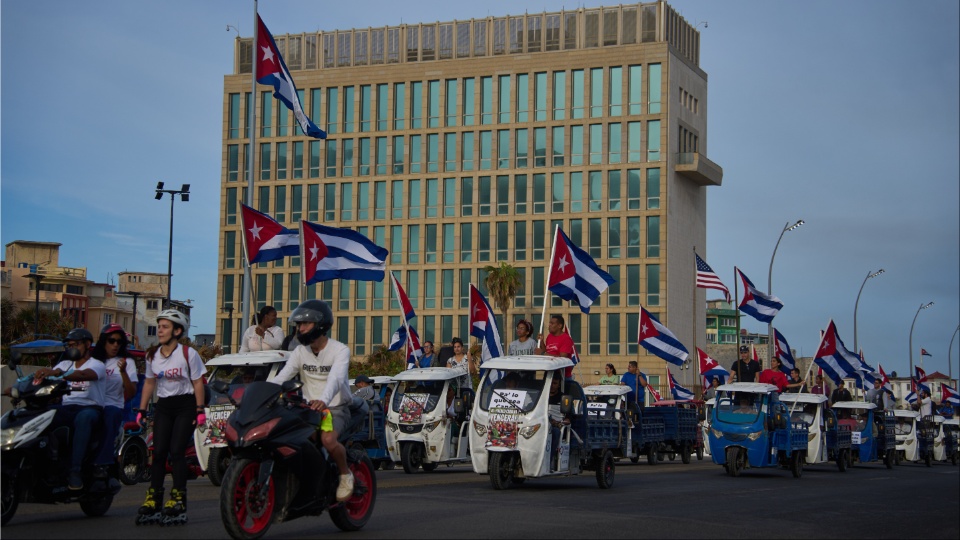
On April 2, the two revolutionary youth organizations kicked off the effort with an anti-imperialist march in Havana along the Malecón, led by a caravan of bikers and motorcyclists.
In an interview with the UJC’s newspaper, Juventud Rebelde, Cuban President and Communist Party First Secretary Miguel Díaz-Canel Bermúdez explained the significance of bikes for the youth during the economic crisis of the 1990s: “We got to the university, to activities, and to work on bikes. With bikes we did volunteer work and mixed with different sectors [of society].”
With the arrival of the COVID-19 pandemic, Cuba entered its worst economic crisis since the fall of the Soviet Union, so comparisons naturally arise between the generations.

Especially since the Trump administration began its total oil blockade of the country in January, freedom of mobility within the urban sprawl of Havana has been severely compromised, as gasoline is rationed and prices surge. Bikes are one of the most reliable modes of transportation for young people and provide a much-needed escape from extended blackouts at home.
A new Special Period
In early February, a few weeks after the oil blockade was put in place, the University of Havana shut down its operations indefinitely. While medical students and some science departments were able to continue in-person instruction out of necessity, most students now take asynchronous classes.
Many government workplaces, cultural centers, museums, and social spaces—important places of employment and public life for young people—can only operate for a few hours a day, three to four times a week.
Primary and secondary schools are also running on reduced schedules. Access to education, one of the core tenets of the Revolution, is being compromised in a way that it never has before, even during the so-called “Special Period” of the 1990s.
Some young people now have a surplus of free time on their hands. Others fill their days with the daily grind of survival. The process of procuring basic necessities like food, water, and medication, as well as keeping up with household chores like cooking and laundry, becomes a full-time job thanks to the limited transportation and periodic blackouts.
The social and mental effect of both of these lifestyles is similar, though. Discourses within the UJC revolve around trying to find ways to renew revolutionary vigor among young people who only associate socialism with slogans and economic hardship.
Organizers with the UJC have thus characterized the current economic crisis as an ideological one as well—the phrase “Homeland or death!” and memories of Fidel don’t carry the same weight with the newer generations.

Much like in the United States, many people intrinsically believe in the need for a more just and equitable society, and they reject the impoverishment and alienation offered by the free market. But they don’t necessarily use the term “socialist” to describe their beliefs due to preconceived notions of what socialism is or what it means in practice.
Private sector jobs are becoming much more common, at least in Havana, but they don’t come with the same organizing structures or community involvement offered by many public sector workplaces.
Young people are also leaving the country in large numbers, leading to a shortage of educated workers, artists, and caretakers for an aging population. The reasoning behind this mass migration is more economic than ideological—there simply aren’t enough job opportunities. For example, artists are severely limited by the impositions of the blockade unless they have connections abroad. Public sector wages are also unable to keep up with the inflation of recent years.
Mobilizing the Cuban youth
But the UJC remains committed to educating and engaging young people in the cause of a more just and healthy socialist society.
Amalia Díaz-Pérez, an organizer with the University of Havana’s chapter of the UJC and the Federation of University Students (Federación Estudiantil Universitaria, or FEU), describes the task of young Cuban militants as providing a communal solution in the face of the individualism that arises out of need and desperate circumstances.
“When you’re hungry, the solution is to eat. You can’t pass judgement on someone for that, but every time we can provide a solution to that shortage, we need to provide it in a manner that is collective, less individualistic,” she explained to People’s World.
Individual solutions, as Díaz-Pérez calls them—such as starting up a business in the private sector or leaving the country in search of better opportunities—are inevitable results of the economic crisis. But the UJC seeks to plug Cuba’s youth back into their communities and to give back to the neighborhoods they grew up in.
Much of the UJC’s day-to-day activities take the form of cultural and community work within the context of one’s neighborhood, school, or workplace—organizing festivals and group outings, hosting workshops, checking in on the welfare of neighbors, delivering food to schools, or doing street cleanups where the municipalities’ trash pick-up has suffered.

Work is distributed among members based on where they live or what they study; medical students distribute medicine within their neighborhoods while engineering students help install batteries and solar panels in homes and schools.
It may seem like grunt work, but the strategies of the UJC and student organizations tackle a fundamental task of communist organizing that is often overlooked—the development of personal connections, a community focus, and hands-on experience.
“The idea is that those neighborly relationships fortify us to see this crisis through, to resist it in some way,” Díaz-Pérez said. “The act of thinking about these problems collectively is something to enjoy, something to share. For me, it’s part of my day-to-day life.”
Structures to learn from
Most UJC hubs consist of between three and 15 people, organized within the context of workplaces, schools, neighborhoods, or departments within the university. Unlike the FEU, the UJC does not function as a mass organization which anyone can join.
UJC members identify prospective recruits by their level of political consciousness and organizing potential. Membership is determined after getting to know the candidate on a personal level, through inviting them to excursions and activities organized by the UJC.
Building that sense of community is integral to making prospective members feel committed and connected to the work they will eventually do within the organization. This commitment is fortified through the more formal initiation process of interviews and evaluations.
Through this process, which may take up to several months, the UJC works to maintain its function as the vanguard of the Cuban youth, putting into action what it sees as the Leninist concept of the “professional revolutionary.” It provides its members with a sense of belonging and purpose.
The FEU works closely with the UJC on many activities, but it serves a different function in student life. Every student at the University of Havana is automatically a member of whichever branch of the FEU corresponds to their department of study.
The FEU, although still a political body with a storied revolutionary history, engages students more on a recreational and educational level, putting together cultural and sporting events, helping students with career and educational development, and serving as a bridge between students, professors, and the administration.
Many a UJC militant is born out of the experience of organizing first with the FEU or its high school counterpart (Federación de Estudiantes de Enseñanza Media, FEEM), as was Díaz-Pérez’s trajectory.
In school and the workplace, faculty or co-workers who are members of the Communist Party (PCC, or Partido Comunista de Cuba) often mentor rising UJC militants, identifying prospective members and aiding in the process of initiation. UJC members are inducted not based on tests of moral purity but rather on their willingness to learn and get involved.
Many times, when there is a PCC hub established in a particular locality, a UJC is soon to follow, and vice versa. The party understands the importance of building the consciousness and the practical skills of its younger cadre to ensure the longevity of the Revolution.
Connected struggles
Despite having their distinct history and being a socialist country, Cuba shows that communist organizing is necessarily local, personal, and intergenerational. As the Communist Party USA is in the process of building out a national structure for its youth affiliate, its members may want to look to the experiences of organizing among young people in Cuba.
The work of the Cuban youth organizations also show that the Cuban people are not helpless victims by any means, as reporters on all sides of the political spectrum in the U.S. media often make them out to be.
Cuba solidarity movements in the U.S. and in the global north more broadly should be wary of perpetuating paternalistic models of aid or spreading misinformation about the actual effects of the blockade.
Aid should be organized around the work that Cubans are already doing, aimed at the government’s stated goals of energy self-sufficiency starting with the sectors of society that need it most—key centers of production, schools, hospitals, workplaces, etc.
It is important to remember just how many ways Cuban society remains adaptable, dynamic, and lively—this, too, is resistance. When a blackout hits, people go about their daily routines or find new ones. Even with the University of Havana shut down and social spaces limited, young people find places to congregate and organize.
In the face of so much uncertainty and fear among the population at large and youth in particular, Díaz-Pérez told People’s World: “I think that to inform oneself about everything that’s happening in the world, to exchange ideas with the movements in other countries, is always important, to give us perspective on Cuba’s future. We don’t live alone in the world.”
The gains of working-class struggle are hard-won, and can never be taken for granted—especially for Cuba, whose institutions and ways of living are constantly under attack by powerful international capitalist forces.
The next generation, Cuban Communists believe, cannot realize its full potential without the guidance of the party, but the PCC cannot rest on its laurels as long as the international class struggle continues. The dialectical relationship between the youth and community, YCL and party, strengthens both.
Díaz-Canel said that his memories of the UJC during his youth in the ’90s were “filled with sweat, toil, but also music, song, dance, and, above all else, heavy with ideas, creation, a desire to save the homeland, the Revolution, and socialism.”
This strategy of community-building, recreation, and militancy within revolutionary youth movements is one that we can take with us in our own struggles at home.
All quotes are translated by the author.
As with all op-eds and news-analysis articles published by People’s World, the views represented above are those of the author.
We hope you appreciated this article. At People’s World, we believe news and information should be free and accessible to all, but we need your help. Our journalism is free of corporate influence and paywalls because we are totally reader-supported. Only you, our readers and supporters, make this possible. If you enjoy reading People’s World and the stories we bring you, please support our work by donating or becoming a monthly sustainer today. Thank you!
CONTRIBUTOR