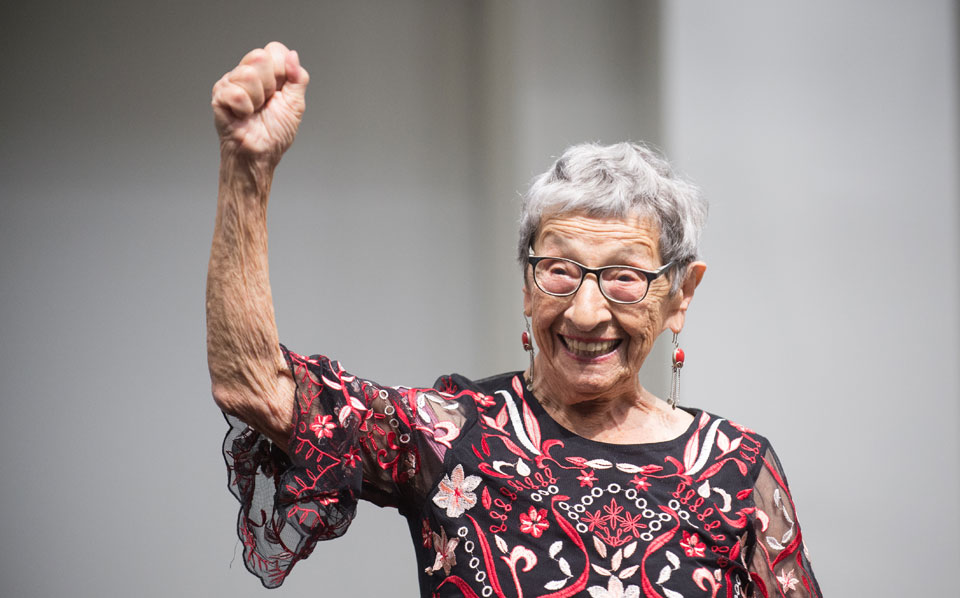
Beatrice Shapiro Lumpkin came roaring into the world on Aug. 3, 1918, and she went out of it just after midnight on June 14, 2026, hailed by labor and progressive leaders around the country as a “matriarch of the movement.” Dying just weeks shy of her 108th birthday, she was an activist, organizer, and teacher who had an impact on countless people and struggles across the 20th and 21st centuries.
Bea no doubt inherited her fiery spirit from her parents, who were Jewish revolutionaries in Russia before they emigrated to the United States in 1905. Bea’s father, Avrom Hirshenhorn, was arrested after returning fire on the Czar’s Cossack troops when they attacked the synagogue in Odessa where the Jewish Labor Bund was meeting. The Bund decided to spring Avrom from jail. Bea’s mother, Dora Chernin, then Avrom’s fiancée, baked and delivered a cake that contained instructions on the proposed jail escape. With a passport in the new name of Morris Shapiro, Avrom made his way to New York City. A year later, Dora joined him.

In 1927, Bea’s family moved to the mostly Jewish working-class Bronx neighborhood of Hunts Point. Eager to escape the oppressive conditions in the garment industry, Dora and Morris had opened a small laundry shop. Bea spent her early years in the laundry watching her mother iron clothing all day. As she grew older, she learned how to sort the laundry and use the mangle machine (an ironer). Earning less than the unionized factory workers that patronized their shop, Bea’s parents retained their socialist outlook, and Bea says she was born “knowing which side I was on.”
At age 9, Bea took her first train ride to Passaic, N.J., to support striking textile workers there.
Bea was editor of the school newspaper and a member of the Arista Honor Society but was stripped of all honors after May 1, 1931, because she had skipped school to attend the International Workers’ Day march.
Student leader
A free speech fight at Monroe High School in 1933 led 15-year-old Bea into the National Student League and soon after, the Young Communist League. Since that time, Bea often said, she “never had a moment when I had nothing to do. There were always picket lines for workers on strike, demonstrations to demand food for a hungry family, knocking on doors to sell the Daily Worker, or bring people out to vote.”
She made speeches on street corners denouncing Hitler and the rising wave of fascism. Her involvement in the “Free the Scottsboro Nine” campaign helped her understand the need for multiracial unity.
When she graduated from high school in 1934, Bea enrolled at Hunter College, a city college with free tuition (by this time her family was on relief, as the laundry business folded due to the Great Depression). She always remembered the injustice of not being allowed to major in physics because the all-women’s school did not have a full physics program.
At a very young age Bea had developed a feminist consciousness, a sensibility she attributed to her mother. During the 1905 Russian Revolution, a young Dora Chernin had brought ammunition hidden in her long skirts to the soldiers on the frontlines, all the while dodging bullets from the Cossack troops. Dora Shapiro would take her daughter out with her when she went canvassing and ringing doorbells to recruit new members to the International Workers Order.
Bea remembered that her mother found time for such activities even though she was “always working,” first in the needle trades and later in the family’s laundry shop. Bea recalled that Chernin Shapiro was the first woman in her neighborhood to cut her hair short and shorten her dresses. It was her mother, she said, who taught her to think for herself.

At Hunter College, when the school threatened to raise the price of a half pint of milk from five to six cents, a not insignificant amount of money for the mostly working-class students, Bea and other members of the Young Communist League organized a boycott and convinced the school to keep the price at five cents. If the milk protest wasn’t enough, Bea and other student activists had also gotten themselves on the dean’s blacklist due to a protest they organized against a visit of the ambassador from Nazi Germany. A few weeks later, the dean suspended Bea after she led a group of classmates to join the National Student Strike for Peace.
Bea was also active in many of the labor struggles that were transforming New York and other cities across the nation in the 1930s. In 1935, on a picket line in front of Ohrbach’s Department Store on 14th Street, she was arrested for the first time. She was picked up a while later in front of the New York Public Library for “peddling” the Daily Worker on park property.
‘Hey CIO girl!’
Not yet 20, Bea was among the 30 organizers to be hired by the CIO in 1937 to organize New York City’s more than 30,000 laundry workers under the newly-formed Congress of Industrial Organizations (CIO).
Conditions in the laundries—where many of the workers were African American women—were among the worst in the city. Bea remembered that as word spread that the organizers were on their way to a plant, workers would run out and shout at her: “Hey, CIO girl! We want a union too!” Bea helped the workers establish shop committees that included a worker from each department.

She won the trust of the workers by answering their questions honestly. When some of the workers conveyed fears to her that the union might sell them out, she replied: “Well, that depends on you. If you go to the meetings, and you’re active and on top of them, then they can’t sell you out.” Over the next few months, Bea was among the organizers who were able to sign up close to 20,000 workers in the Laundry Workers Industrial Union.
A quick succession of jobs followed her time in the laundry. She operated a drill press and a milling machine in Queens and worked briefly at Emerson Radio in Manhattan. Eager to spread her wings, in 1942 she moved to Buffalo and got a job checking electronics equipment for Sylvania Radio.
In the 1940s, Bea was blessed with two wonderful children, Carl and Jeanleah. After an amicable divorce from her first husband in 1946, Bea met her soulmate, Frank Lumpkin. Bea met Frank through his remarkable family, in particular his mother, Hattie Lumpkin. Bea described Hattie as her mentor for community work. Deeply rooted in the community, Hattie was a force within Buffalo’s Communist Party and a community activist. Bea became fast friends with Hattie and her daughter Jonnie. The three women spent their evenings knocking on doors campaigning against Nazism and racism.

The Lumpkins—an impressive team
Bea and Frank married on Oct. 22, 1949, in Chicago. They spent their early married years living in Gary, Ind., while Bea worked at Allied Radio until she was fired for being pregnant and Frank worked as a chipper at Wisconsin Steel in South Chicago. Bea and Frank were blessed by two more wonderful children, Paul and John. Bea worked long distance writing copy for an electronics company in Chicago.

Together, the Lumpkins were an impressive team. It was the McCarthy era, and neighbors soon reported that FBI agents were asking about the interracial couple. Undeterred, Frank and Bea threw themselves into community organizing.
When they discovered that the septic tanks were leaking into the water wells, they organized their neighbors and launched a ten-year battle that ended with the city providing sewers. The city could not give them clean drinking water, however, because the water was apparently privately owned.
The Lumpkins would also join the many civil rights battles that would culminate in the passage of the Civil Rights and Voting Rights Acts in 1964 and 1965.
Pioneer of multi-cultural education
Bea began her career in education at the age of 47 when she became a Chicago Public School teacher. She went on to become a tenured associate professor of math at Malcolm X College.
As Bea explained, her life experiences—motherhood, her job as a writer of instructions for electronic kits, and above all else, civil rights and labor activism—prepared her well for her career in teaching. As a professor, Bea welcomed her students’ demands for African American Studies, Latino Studies, and Women’s Studies. Since textbooks largely omitted this information, Bea became a researcher, an author, and an advocate for multicultural education.

She published groundbreaking books and essays on the multicultural roots of mathematics and science including: African and African-American Contributions to Mathematics, Mathematics in Ancient Egypt, Math: A Rich Heritage, as well as articles in leading social science and scientific journals. Her pioneering work helped establish the centrality of African contributions to the development of mathematics knowledge. Bea developed curriculum and teaching resources and served as a consultant to public school systems in Portland, Ore., Chicago, Detroit, and Milwaukee.
Through all of this important educational work, she continued her organizing and political action. Bea was present at the 1974 founding of the Coalition of Labor Union Women. She served on CLUW’s National Executive Board and for 20 years was on the executive of the Chicago chapter of CLUW. She continued to act as a mentor to younger trade union sisters.
In 1979, she and Frank moved to Chicago’s South Shore neighborhood. From there, they supported the successful 1983 mayoral campaign of African-American Harold Washington.
Bea’s book Always Bring a Crowd chronicled Frank’s 17-year battle to hold Wisconsin Steel accountable. The company manipulated bankruptcy laws to steal millions of dollars in wages and pensions when it closed in 1980. With Bea at his side and represented by labor lawyer Tom Geoghegan, Frank launched a Save our Jobs Committee. While the plant never reopened, the Save Our Jobs Committee forced the company to pay its former workers $19 million.

The couple remained deeply in love, united by their shared belief that only through social change would racism, sexism, poverty, and war be eradicated. Frank died in 2010.
In 2013, Bea published her autobiography Joy in the Struggle: My Life and Love, documenting her remarkable life of activism, work, family, and friends. In addition to her extended family of friends and comrades and four children, Bea had several grandchildren, great-grandchildren, and great-great-grandchildren.

In her 90s, she took on Southwest Airlines for age discrimination, while in her 100s, Bea continued to walk picket lines in her hometown of Chicago and campaign for pro-labor candidates. She said that she believed women’s rights and civil rights can “best advance when labor’s rights advance.” She worked hard on the election and re-election of President Barack Obama, watching with amazement and contentment as young people crowded into tiny offices working the phones for the candidate of hope.
Tireless retiree
Bea never slowed down even in her most senior of senior years. She sat on the Executive Board of the Illinois Alliance for Retired Americans and the South Chicago chapter of the Steelworkers Organization for Active Retirees. As a member of the Chicago Teachers’ Union Retirees, she supported the 2012 Chicago teachers’ strike marching alongside community members demanding fair treatment of teachers and better services for students. They were also challenging the closing of 50 public schools in African American and Latino communities.

In 2017, Bea helped found INTERGEN, a coalition of retirees from the Illinois Alliance for Retired Americans and young activists from the labor movement, the United Steelworkers Next Gen, Chicago Young Workers, and Chicago Student Action. The intergenerational and multiracial group supported initiatives such as the “Fight for $15” minimum wage, Free Tuition Illinois, and broader struggles to win affordable health care and preserve Social Security.
In 2020, amid the lockdowns of the COVID-19 pandemic, Bea appeared on television screens and newspaper front pages around the world when she hit the streets in a full-body hazmat suit to cast her ballot in the pivotal election that year.
Then aged 102, she couldn’t take a chance of catching coronavirus, but she said, “I think democracy is on the line, and if we ever want to have another election,” then Donald Trump had to be defeated. She told People’s World at the time that the American people “do not want to see fascism in the USA…. It’s something so serious—whatever it takes, I’m going to make sure that my ballot is counted.”

After the global health crisis passed, Bea once again became a familiar face at demonstrations, peace vigils, and rallies to save Social Security and oppose privatization. She joined countless picket lines in Chicago in front of restaurants, hotels, and even laundries.
In 2022, the Chicago labor movement honored Bea by making her the Grand Marshal of the Labor Day Parade. At 104, she showed up to support Starbucks strikers in the West Loop, offering tales from her decades of labor movement experiences to rally the young people fighting to win a union at the coffee giant. “No matter how big the company is, we workers are stronger—when we’re united!” she told them.
Her last article for People’s World, published in September 2023, provided guidance on “How to prevent a fascist takeover in the U.S.,” where she encouraged a united front to defeat the right in the 2024 elections.
Legacy of struggle
After Bea died in June 2026, the proof of her decades of tireless work and commitment was evident in the statements and condolences expressed by movement leaders.

The AFL-CIO, the country’s largest labor federation, called her a “giant of the labor movement” and a woman who “embodied solidarity.” The labor body’s president, Liz Shuler, said, “Bea Lumpkin dedicated her life to proving that when working people stand together, we can change the world.”
Chicago Mayor Brandon Johnson issued a statement saying that Bea’s life “was a testament to the power of principled activism and the enduring belief that ordinary people, working together, can change the world.”
The Chicago Teachers Union, which awards a scholarship named for Bea, said, “She never met a struggle she was willing to leave to someone else and accepted the challenges faced by organized labor without reservation or condition.”
Joe Sims, co-chair of the Communist Party USA—of which Bea was a member for over 90 years—said, “With the passing of Comrade Bea Lumpkin, we lost a great fighter for peace and social justice…. We pause to dip our banner in her memory.”
Through example, Bea demonstrated how one person’s integrity and passion for social justice can transform individual lives, families, and communities. For almost 108 years, she devoted herself to the cause of the working class, whether they be exploited laundry workers trying to organize during the Depression in New York City; African Americans challenging Jim Crow segregation and state-sanctioned racial violence; unemployed steel workers in Chicago bearing the brunt of deindustrialization and corporate capitalism; union women fighting for equality in the workplace; teachers committed to preserving public education; seniors demanding affordable health care; or young people who dare to believe that another world is possible.

| Till Mayer / Der Spiegel, courtesy of Bea Lumpkin
It is impossible to feel cynical about our potential to shape history when one thinks about the indelible mark that Beatrice Lumpkin had on the lives of so many. Her passion for and commitment to social justice inspires us to feel hopeful for the future, even during the darkest hours.
SELECTED WRITINGS BY BEA LUMPKIN
- How to prevent a fascist takeover in the U.S.
- Juneteenth and the power of Black History
- Hidden history: The truth about Reconstruction
- Black women laundry workers finally get their due as organizers and leaders
- Communist teacher turned health minister leads pandemic fight in India
- Justice for fossil fuel workers—Pass the Green New Deal
- 65 years after Brown vs. Board: What happened to multicultural education?
- Needed: A shorter work week
- The Russian Revolutions: 1905 and 1917
- Socialism or capitalism: A life-or-death difference
- Getting racism out of school curricula
- Do we need public education?
- WOMENS HISTORY MONTH: I helped organize the CIO
Read more of Bea Lumpkin’s writings here.
This short biography of Bea Lumpkin was originally written by labor historian Jenny Carson for Lumpkin’s 100th birthday. It was updated and expanded by People’s World editor C.J. Atkins.
We hope you appreciated this article. At People’s World, we believe news and information should be free and accessible to all, but we need your help. Our journalism is free of corporate influence and paywalls because we are totally reader-supported. Only you, our readers and supporters, make this possible. If you enjoy reading People’s World and the stories we bring you, please support our work by donating or becoming a monthly sustainer today. Thank you!
CONTRIBUTOR