LOS ANGELES—Not even Paramount’s announcement of the return of horror icon Freddy Krueger from the popular Nightmare on Elm Street film franchise could eclipse the news that unions and over a dozen states are suing to block the studio’s monster of a merger with Warner Bros. this week.
On July 13, California led a coalition of states to court to stop what they consider a disastrous move for workers in the entertainment industry and consumers. They were joined a day later by the Writers Guild of America West and the Writers Guild of America East, alleging the merger violates federal antitrust law and would cause specific harm to writers.
Since late 2025, the public has watched closely to see what would be the fate of Warner Bros., a company that had become one of the “Big 5” remaining major film studios, which include Walt Disney Studios, Universal Filmed Entertainment Group, Sony Pictures, and Paramount Skydance Studios.
Last December, it seemed as though the streaming media giant Netflix would acquire Warner Bros. Discovery (WBD), as they had entered into a definitive agreement. Yet, months later, this deal would fall through as the David Ellison-led Paramount won out with a hostile $110 billion bid, which, if it goes through, will create one of the largest media conglomerates in corporate history.
Since the bidding wars over Warner Bros. began, unions were outspoken against any type of megamerger.
 The Writers Guild of America asserted that it wasn’t about who bought Warner Bros. but rather that “the problem is the acquisition and pending consolidation of two media giants,” and that “these companies should be focused on investing in their own businesses, rather than wasting tens of billions to buy up the competition.”
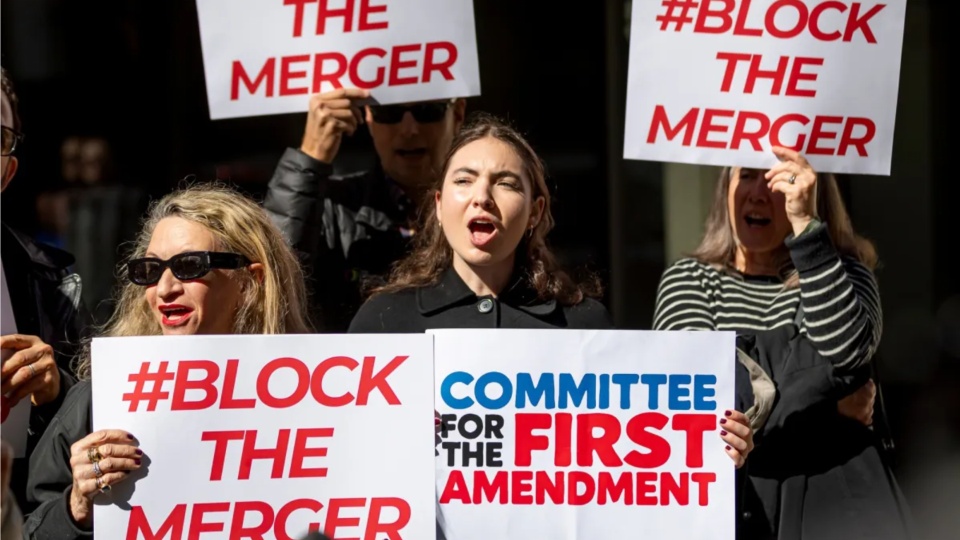
The Block The Merger coalition, which includes hundreds of culture workers and their allies and is led by longtime political activist and movie star Jane Fonda, issued a public anti-deal letter condemning the Paramount-Warner Bros. merger.
They noted that “media consolidation has accelerated the disappearance of the mid-budget film, the erosion of independent distribution, the collapse of the international sales market, the elimination of meaningful profit participation, and the weakening of screen credit integrity.” Signatories to the letter said they were “deeply concerned by indications of support for this merger that prioritize the interests of a small group of powerful stakeholders over the broader public good.”
But these outcries of concern seemingly fell on deaf ears, as the U.S. Department of Justice’s Antitrust Division greenlit the transaction in mid-June, claiming that it found the merger unlikely to harm competition. This swift approval has also come under scrutiny, as critics note the close relationship between President Donald Trump and the father-son duo of Larry and David Ellison.
Under Ellison, the once-revered news broadcast 60 Minutes has been accused by viewers and former employees of bowing to Trump and his administration. 60 Minutes, which is under CBS and thus owned by Paramount, is seen by many as a telltale sign of what the fate of CNN (which is owned by Warner Bros.) would be if the Ellison family were put in charge.
Trump’s head of the Department of War, Pete Hegeseth, hinted as much when mentioning the news channel in a press conference, stating, “the sooner David Ellison takes over that network [CNN], the better.”
Yet, in the face of this consolidation of media power into even fewer wealthy hands, a dozen attorneys general from across the country are stepping up, saying “no deal.”
The coalition of states filed a lawsuit asking the court to block the proposed merger, arguing that it would substantially lessen competition in violation of federal antitrust law. California Attorney General Rob Bonta filed an emergency motion in the U.S. District Court for the Northern District of California seeking a temporary restraining order and preliminary injunction to immediately block the merger from closing. The lawsuit asserts that the Paramount-Warner Bros. pair-up violates Section 7 of the Clayton Act, which prohibits mergers that may substantially lessen competition or tend to create a monopoly.

Along with California, Arizona, Colorado, Connecticut, Massachusetts, Minnesota, Nevada, New Jersey, New Mexico, New York, Oregon, and Washington make up the coalition. In a guest column in Variety on the day the lawsuit was filed, Bonta went further in explaining what is at stake if the merger is allowed to proceed. One major concern he expressed is related to news journalism.
“Combining cable news channels would mean fewer journalists informing our electorate and fewer opportunities for Americans to hear the full breadth of information and opinions on a subject,” Bonta wrote. “Consolidation would mean fewer voices speaking truth to power and fewer documentarians, filmmakers, showrunners, producers, writers, and artists shedding light on important stories that too often go untold.”
And Bonta doesn’t seem to be the only one worried about freedom of the press under a White House administration that has repeatedly infringed on it. On the heels of the attorneys generals’ lawsuit, a Paramount shareholder is also taking the Ellisons to court, claiming that they made an “illegal” side deal with Trump to secure approval for the Warner Bros. takeover.
The shareholder’s complaint alleges that the Ellison-Trump side deal included “the opportunity to improperly funnel cash” to the president through the settlement of his legal claims against CNN, along with promises to fire CNN anchors Trump dislikes after the Warner Bros. takeover.
Caught in the middle of this merger are the culture workers who may face fewer opportunities to practice their craft and be paid for it. On July 14, the Writers Guild of America West and the Writers Guild of America East filed their complaint in the U.S. District Court for the Northern District of California, asserting that the proposed merger “threatens the economic and creative health of the American entertainment industry.”
The suit notes that less competition would result in lower compensation to writers, “reshape what gets made, and silence underrepresented voices.” The unions warn that the merger would “forge a cultural monolith and shrink the marketplace of ideas through corporate concentration.”
Many have come out praising the lawsuits, noting the need to challenge the seemingly unstoppable merger.
“This illegal merger would mean layoffs for artists and workers, higher prices for consumers, and the death of Hollywood,” said Matt Stoller, research director of the American Economic Liberties Project.
Neera Tanden, president and CEO of the Center for American Progress, called the Paramount-Warner Bros. merger “emblematic of the corruption of the Trump administration.”
“President Trump and his cronies are waving this anti-competitive deal through because David Ellison has demonstrated time and again that he will leverage his media empire to silence Trump’s critics and amplify MAGA propaganda. That’s corruption, plain and simple,” asserted Free Press Co-CEO Jessica J. González.
And while the Ellisons and representatives of Paramount-Skydance have continued to deny allegations of corruption and bias, critics see a different story unfolding. As Alvaro Bedoya, senior advisor at American Economic Liberties Project, who recently completed town halls on the merger in Los Angeles, New York, and Atlanta, put it:
“The rich guys who run Paramount can say what they want, but the people who actually work for them know that this will kill jobs and screw over the small businesses that are the lifeblood of this [entertainment] industry. I hope the states win and win fast, because these people need it.”
We hope you appreciated this article. At People’s World, we believe news and information should be free and accessible to all, but we need your help. Our journalism is free of corporate influence and paywalls because we are totally reader-supported. Only you, our readers and supporters, make this possible. If you enjoy reading People’s World and the stories we bring you, please support our work by donating or becoming a monthly sustainer today. Thank you!
CONTRIBUTOR