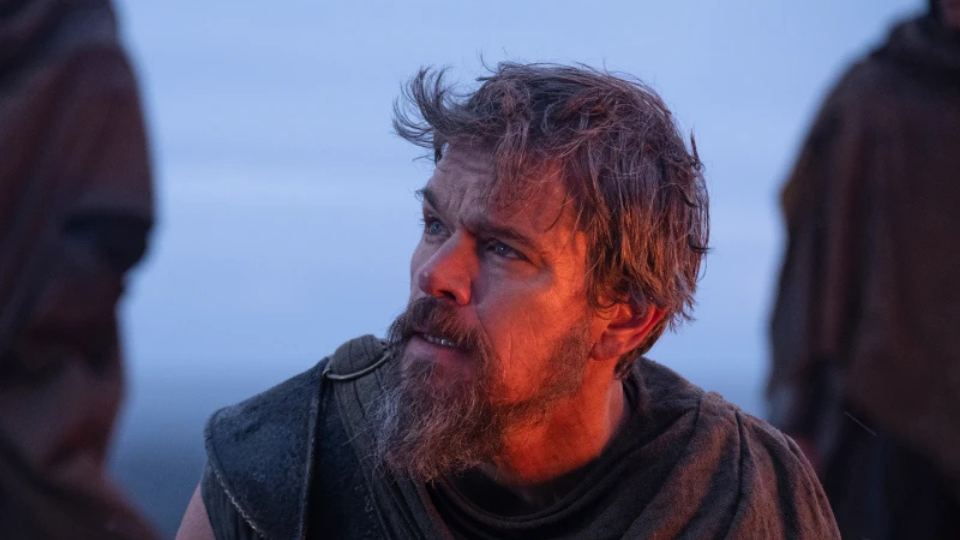
With The Odyssey, writer-director Christopher Nolan and his collaborators (wife and producer Emma Thomas, cinematographer Hoyte van Hoytema, editor Jennifer Lame, composer Ludwig Göransson, and the incredibly pedigreed ensemble led by Matt Damon, Anne Hathaway, and Tom Holland) have exceeded expectations by leaning into their strengths in combining scale and sentimentality. As soon as it finished, I wanted to watch it again. It’s a tale nearly as old as our understanding of time, communicating themes of dedication and sacrifice, and, moreover, the foibles of overreliance on premonition and prophecy when you have a choice in your fate. It is a film that asks where duty and fidelity lie, and why we create rules and structures that house within them the cores of their undoing.
The film follows Odysseus (Matt Damon), the warrior-trickster king of Ithaca, on his long journey home from the war led by Agamemnon (Benny Safdie) for his brother Menelaus’s (Jon Bernthal) wife, Helen (Lupita Nyong’o). Decades after Odysseus’s departure, his wife, Penelope (Anne Hathaway), and son, Telemachus (Tom Holland), have their hands full at home with greedy suitors (led by Robert Pattinson’s Antinous and Corey Hawkins’s Polybus) who want his wife and home for themselves. Eumaeus (John Leguizamo) and Mentor (Ryan Hurst) help guide and protect Telemachus. Eurylochus (Himesh Patel) tries to do the same for Odysseus as his second-in-command. Elliot Page is pivotal as Sinon, an Ithacan soldier whose memory haunts Odysseus. Samantha Morton, Zendaya, and Charlize Theron also appear amid Odysseus’s guides and tormentors.
Nolan, Van Hoytema, Lame, and Göransson (the expert at epic themes, though I’m not sure yet this one equals Oppenheimer) brilliantly convey chaos, danger, and fear. The journey home’s gravity immerses, the danger tangible through monstrous encounters and the constant wrath of wordless gods speaking through the natural world. Everything translated or reimagined from the epic shows up with gusto, including gusts of wind and thunderstorms captured on IMAX cameras, expressing the wrath of the gods of sea and sky, reminding me of a mythic extrapolation of Tenet’s sailing scene.
The slickest of the well-choreographed, intentionally chaotic action sequences are revisited to focus on their brutality, their mercilessness; the means giving the characters and the audience further reason to question the ends. The blocking and lighting of the sacking of Troy allows the moment to feel poetic and tragic.
The performances are earnest, fleeting moments of comic relief earned and authentic to the desperation and exasperation that bring them about. The love between Odysseus and Penelope is palpable, as is her resilience as she sits in a tenuous position as a queen with the will to lead in a system that wants her to follow.
The Odyssey is a modern interpretation of a story already hundreds of years old when it was written down over 2000 years ago. This story has become foundational to the “Western” tradition, anachronistic and imprecise as it is to apply that term to the people and period out of which The Odyssey emerged. Mycenaean Greece’s very alienness to us is conveyed by its vastness through a variety of shooting locations (Greece, Morocco, Italy, Iceland, Scotland, and the U.S.) and cast diversity, complicating modern preconceptions about ancient identity, themselves premised on 18th-19th century Euro-American politics. It almost goes without saying that fascists and liberals will see much to draw on for their own political projects; it is worth considering what the left can learn and use from such imagery and imagination.
The diverse cast contributes to the film’s bit of a play-act quality, its metatextual communication of timelessness, and its adaptation of the ancient story to modern times. This is otherwise communicated in dialogue about “the age of bronze” and the greatness of their “civilization,” and foreknowledge that civilization is closing.
Drawing primarily on Emily Wilson’s translation of the poem (the first full-length English translation by a woman, in 2017; done in iambic pentameter), the dialogue strives for legibility and comprehensibility. By not relying on approximations of Early Modern English, this further fuses the ancient and the modern, much as combining predominantly ancient and occasionally medieval aesthetic helps convey continuity of mythopoetic and myth-history from the ancient past to the present.
Towards its end, the film has powerful emotional and intellectual payoffs for long-sown seeds of mystery and threat. Simultaneously, it doesn’t over-explain the origins of everything that beset Odysseus and his men. The cyclops who eats soldiers in the cave scene with the eeriest music and sound design, the witch who turns them into pigs in the film’s flirtation with body horror, and the creeping monstrosities that pluck them from their boat. They are supernatural and abnormal traumas to gild the earthly traumas already experienced. Taken less generously, this film could be seen as simply another paean to the grief of soldiers after they have invaded a foreign land and murdered its people. There’s some of that, but if we are to draw the lesson into modernity, it is more about the inhumanity of such wars in the first place.
NOTE: Parts of the film were shot in the Western Sahara, which the Kingdom of Morocco has occupied since 1975 despite an International Court of Justice verdict in 1975 that the territory has a right to self-determination. The Sahrawi independence movement (Polisario) has maintained the Sahrawi Arab Democratic Republic exists across the easternmost fifth of the country. A ceasefire between the Polisario and Morocco came into effect in 1991. Since 2007, Morocco has proposed a plan for limited autonomy based on the Spanish regional autonomy model. In December 2020, under President Donald Trump, the U.S. recognized Moroccan sovereignty over the Western Sahara in exchange for Morocco normalizing relations with Israel. In December 2025, the U.N. Security Council voted for a U.S.-authored proposal of autonomy under Moroccan sovereignty, ignoring the previous verdict of a right of self-determination.
We hope you appreciated this article. At People’s World, we believe news and information should be free and accessible to all, but we need your help. Our journalism is free of corporate influence and paywalls because we are totally reader-supported. Only you, our readers and supporters, make this possible. If you enjoy reading People’s World and the stories we bring you, please support our work by donating or becoming a monthly sustainer today. Thank you!
CONTRIBUTOR