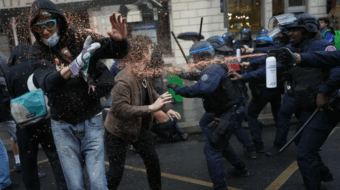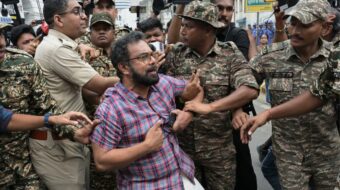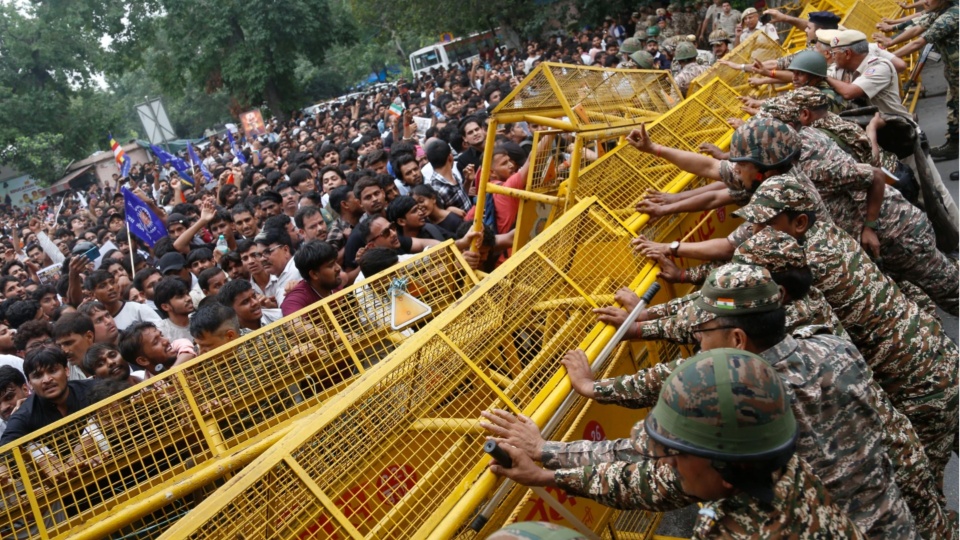
Baton-wielding riot police fired tear gas and charged into crowds of student and youth demonstrators in New Delhi Monday as more than 10,000 supporters of India’s “Cockroach” movement tried to march on Parliament, in the largest and bloodiest confrontation yet between the right-wing Narendra Modi government and a protest movement that has grown into the most serious challenge to his ruling Bharatiya Janata Party (BJP) in years.
The demonstrators, marching under the banner of the Cockroach Janta Party (CJP)—or Cockroach People Party—were demanding the resignation of Education Minister Dharmendra Pradhan over a scandal involving leaked national entrance exam papers, a full overhaul of the exam system, and compensation for families of students who took their own lives after the scandal-ridden tests.
The controversy began in May, when questions for the National Eligibility cum Entrance Test (NEET)—India’s high-stakes, once-a-year exam that decides which of roughly 2.2 million applicants win medical school seats—leaked in advance, forcing every one of those students to retake it. More than a dozen are reported to have died by suicide in the fallout, and the government briefly banned the messaging app Telegram in a bid to stop further leaks.
Police sealed metro stations, threw up barricades around the Jantar Mantar protest grounds where protesters have been camped out, and invoked emergency prohibition orders to keep the crowd from reaching the parliament building as lawmakers convened for the “monsoon session,” the mid-year sitting of India’s parliament that opens each summer during the country’s rainy season and runs for several weeks.
Protesters pushed through barricades near Parliament Street anyway, and police responded with tear gas and what’s known in India as a “lathi charge,” a baton charge in which officers wade into a crowd swinging long bamboo canes called lathis to beat demonstrators and disperse them. Both protesters and officers were injured, and 10 to 15 protesters were detained, according to the Press Trust of India.

The movement traces its name to a remark by Indian Supreme Court Chief Justice Surya Kant, who in May compared unemployed young people appearing before the Supreme Court to “cockroaches.” Organized within days by 30-year-old communications strategist Abhijeet Dipke, the satirical “party” turned the insult into a rallying cry, amassing more than 20 million Instagram followers and chapters across a dozen states.
The Cockroach Janta Party name was deliberately chosen to mock the initials of the ruling BJP. What began as an online meme campaign has since become a mass youth movement, channeling years of anger over an economy that leaves nearly 40% of graduates without jobs even as a predatory coaching industry and repeated exam scandals mock the tests meant to decide their futures.
On June 20, the CJP and allied student groups turned that online energy into a physical protest camp at Jantar Mantar, a historic public square near parliament that is one of the few sites in New Delhi where demonstrators are legally permitted to gather. Students, teachers, and supporters have held an around-the-clock sit-in there ever since, sleeping under tarps and tents through the summer heat and monsoon rains.
Anger boiled over further after Delhi police forcibly removed 59-year-old engineer and climate activist Sonam Wangchuk from his three-week hunger strike at Jantar Mantar on Saturday, hauling him to a government hospital over his objections. Some officers dressed to appear as medical staff during the operation, and Wangchuk has said from his hospital bed that he considers himself under “illegal detention” and intends to continue his fast.

The Communist Party of India (Marxist) placed direct blame on the Modi government for Monday’s violence. “The Polit Bureau strongly condemns the brutal lathi charge and teargassing of peaceful protesters gathered in and around Delhi’s Jantar Mantar today,” the party said in a statement, noting that police also used force near the CPI(M)’s own Delhi headquarters.
The party said the “paranoid government,” rather than address the “growing mess in education and the pathetic situation of unemployment,” had chosen repression, and demanded Pradhan’s resignation, the dissolution of the National Testing Agency (the body that administers NEET and other national exams), and the release of all those arrested.
The protests have drawn backing well beyond the students at their core, including from India’s organized labor movement.
In Nashik, in the western state of Maharashtra, members of the Centre of Indian Trade Unions (CITU) and the All-India Trade Union Congress (AITUC) joined a solidarity demonstration outside the district collector’s office on Monday alongside sanitation workers, lawyers, and other civic groups, condemning Wangchuk’s forced hospitalization as “an attack on democratic rights guaranteed under the Constitution” and demanding that peaceful protest be allowed without police interference.
Student federations aligned with India’s left trade union movement, including the Students’ Federation of India and the All-India Students Association, have served as an organizing backbone of the encampment since it began four weeks ago.
With Wangchuk vowing to continue his fast and CJP leaders promising more mobilizations, the standoff with the Modi government shows no sign of easing as the monsoon session gets underway.
We hope you appreciated this article. At People’s World, we believe news and information should be free and accessible to all, but we need your help. Our journalism is free of corporate influence and paywalls because we are totally reader-supported. Only you, our readers and supporters, make this possible. If you enjoy reading People’s World and the stories we bring you, please support our work by donating or becoming a monthly sustainer today. Thank you!
CONTRIBUTOR