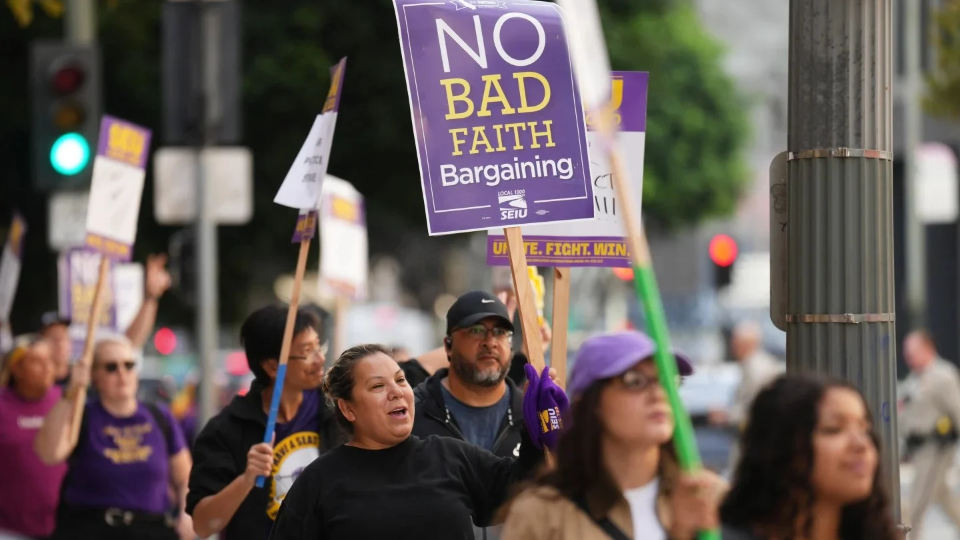
SACRAMENTO—From San Diego to San Francisco and north, almost 100,000 California state workers struck for a day on October 21 to protest Democratic Gov. Gavin Newsom’s unfair labor practices, specifically his failure to bargain in good faith for a new contract.
“We are going on strike because we know the Newsom administration can and must do better,” said Anica Wells, president of Service Employees Local 1000. Essential workers didn’t walk. Others did.
“They must return to the table and bargain in good faith toward a contract that allows state workers to afford groceries, childcare, rent and other necessities.”
The strike wasn’t longer, Local 1000 said, because even a day without pay hurts workers in high-cost California. But it held out the possibility of further action, depending on what Newsom does.
Local 1000’s strike could have national political implications, too. But neither the union nor Newsom mentioned that.
Newsom is term-limited, and he leaves office in early January 2027. As governor of the nation’s most populous state, he’s considered a contender for the 2028 Democratic presidential nomination, and he’s done nothing to discourage the speculation.
But he’s also had an up-and-down relationship with California’s unions, including SEIU, in a state with more union members than any other in the U.S. and a relatively high union density. The unions’ weight could play a key role in the 2028 race.
The Local 1000 statewide strike was easily the largest in the U.S. since the United Auto Workers undertook their rolling strike against the Detroit 3 automakers—Ford, GM and Stellantis—starting in September 2023. The UAW is gearing up for another round of tough bargaining in 2028, newly re-elected President Shawn Fain recently said.
The California walkout began at 7 a.m. on September 21 and lasted for 24 hours. It didn’t last longer, Local 1000 said in a Q&A with its members, because the union knew they would all lose a day’s pay—and that’s important in high-cost California.
But the union said developments at the bargaining table, or lack of them, may force further action.
In response to the strike, the first by the union in 44 years, the Newsom administration asked the state Public Employment Relations Board—California’s equivalent of the NLRB for state workers—for an injunction to stop the walkout. Local 1000 opposed that move in its filing with the board.
Bad faith bargaining is the key issue, with pay running second, for now.
Bargaining began in April, but Local 1000 told the state board that state officials delayed responding and rejected all of its proposals on June 30, the last day of the old contract. Local 1000 quoted the state bargainers as saying rejection “was not necessarily based on the merits of the request.” The state offered no counterproposals.
The union adds the state is running a large surplus and can afford the raises the workers seek and need. The old contract expired June 30, and Newsom waited until after the strike authorization vote—it passed 96.2%-3.8% in early October—to brusquely reject the union’s proposal.
That’s after a July 2025 side letter to the old contract postponed a 3% general raise for all the workers from July 1, 2026, to July 1, 2027, the union’s response to the state board reveals. The state responded that the side letter meant it didn’t have to bargain over economic issues. California froze benefit fund contributions through next June 30, too.
And Newsom still demands all the workers return to their offices at least four days a week, rather than continuing more-flexible—and more productive—telework arrangements, as Local 1000 demands.
The state “engaged in bargaining with a predetermined position that it would not agree to any economic proposals,” the union told the board. And state bargainers “lacked authority and/or willingness to bargain.”
The state bargainers also said California had no money for raises, even though the union presented evidence to the board—and in its q-and-a for members who answer the public’s questions—that California had a $20 billion increase in general fund spending in fiscal 2026-27 compared to 2024-25, and added $6.4 billion into its surplus temporary holding account.
California also garnered $1.3 billion more in revenues in May and June 2026 than it projected and saved $240 million “in two custodial and healthcare-service outsourcing arrangements,” the union told the board.
Local 1000 said workers seek a 20% increase over three years, higher state healthcare contributions and flexible telework. Newsom wants workers in the office four days a week. The union argues for keeping current flexibility for telework. Studies show that arrangement actually increases productivity.
On October 21, picket lines went up at three sites in the state capital of Sacramento, which also saw workers march and rally from 11 a.m. to 3 p.m., Pacific Time, taking time out to listen to supportive speakers and eat lunch.
Other picket lines were scheduled for Oakland, San Francisco, Los Angeles, Norwalk, San Diego, San Bernardino, Redding, Eureka, Crescent City, El Centro, Blythe, Porterville and San Luis Obispo.
“Any strike will be historic. California has never seen a strike this large involving the workers who keep the state running. The Newsom administration can prevent this by coming to the table and bargaining in good faith. Administrations may change, but our demand will not: bargain fairly with the workers who keep California running,” Local 1000 added in its q-&-a for the workers.
“October 21 is our strike day, but it won’t be the last time we show the state our collective power. If the state continues to refuse to bargain fairly, we’re prepared to escalate and hold the line,” Local 1000 said.
“But we also know that missing even one day of pay is a huge sacrifice for members who are already struggling, and we don’t take that lightly. We’re going to be strategic about how we use our collective power and what we ask of our members.”
No paywalls at People’s World
We hope you appreciated this article. At People’s World, we believe news and information should be free and accessible to all, but we need your help. Our journalism is free of corporate influence and paywalls because we are totally reader-supported. Only you, our readers and supporters, make this possible. If you enjoy reading People’s World and the stories we bring you, please support our work by donating or becoming a monthly sustainer today. Thank you!
CONTRIBUTOR