

DILI, EAST TIMOR—Out of my love for the Portuguese language, I’ve tried to visit Portuguese-speaking countries so I can practice it, and also learn something about the way the language sounds in different places. On a recent trip to Indonesia, I realized that Timor-Leste, a former Portuguese colony, sits amidst the Indonesian archipelago, and without too much trouble I could fly in and check things out. “Leste” means East in Portuguese; the western half of the island is part of Indonesia.
Upon arrival from Bali, a Timorese driver held up a placard for a David Webster headed for the same hotel where I was booked, so we shared the ride into town. How fortuitous! David is a Canadian historian who has studied East Timor for well over two decades. He had come to participate in an academic conference sponsored by UNESCO concerning the establishment of a history department at the local university. So as a fellow historian by training, we had much to talk about on the short taxi ride, and then over dinner. He shared with me a comprehensive article he had written back in 2017 on the 15th anniversary of Timor-Leste’s independence.
In one quick paragraph, with due credit to David’s much deeper analysis, here’s a summary of recent Timor-Leste history:
After the 1974 April Revolution in Portugal, which shortly granted independence to its colonies (Angola, Mozambique, Cape Verde, etc.), Timor-Leste declared its independence in 1975. Days later, Indonesian armed forces invaded and claimed it as part of their country. But Timorese resistance, for years deemed a “lost cause,” outlasted the rule of Indonesia’s General Suharto, who fell from power in 1998. In a referendum run by the United Nations in 1999, 78% of the population voted for independence. Following a wave of violence by pro-Indonesia forces, the UN stepped in and supervised a transition to Timorese self-government in 2002. The flag proclaimed in 1975 is the flag today.
Timor-Leste is the poorest country in East Asia. The Portuguese colonists exported sandalwood and spices from its territory. Now it depends on oil found in the strait between its territory and Australia, and on investment income from its sovereign wealth fund based on oil revenues. The great hope of the donor-funded sector is to diversify the economy away from the dominance of oil and invest in small-scale, local development programs, many of them women-led (such as the hotel we stayed in), and in areas far from the capital city. Though its attractions are modest, the beginnings of a tourist market can be found. The country struggles to keep up with today’s world. The year 2017 saw the country’s first LGBTQI Pride parade.
Comprising 5794 square miles, Timor-Leste is slightly larger than Connecticut. The national capital, Dili, sits toward its western end. From there it’s only 186 miles to the far eastern tip. The estimated 2026 population is 1,434,991, with a lowering but still relatively high fertility rate.
Although the language of primary and secondary education in much of the country has been Portuguese, that does not necessarily translate into widespread fluency. Still, it qualifies as a member of the Community of Portuguese Language Countries (CPLP). Between 2021 and 2025, Zacarias da Costa, a former East Timorese Minister of Foreign Affairs, served as its Executive Secretary. In 2014, the 10th “Summit” (Conference of Heads of State and Government of the CPLP) met in Dili.
Portuguese is designated as one of the two official languages of the country, but in my admittedly limited experience—only in Dili—I encountered many people, even some employed in museums or hotels, for example, unable to maintain a conversation in Portuguese. The CPLP asserts that in many of its constituent member nations, young people would benefit from a higher fluency in the language, as such familiarity with a world language would surely add to their success in later life.
The most commonly spoken language is Tetun (or Tetum), a Malay-based tongue (as is Indonesian). It serves as a lingua franca, but is not everyone’s first language: Some 20-odd other local languages are spoken in Timor-Leste. A cursory glance at written Tetun shows that thousands of words clearly derive from Portuguese. A brochure about the Max Stahl Audio-Visual Center, for example, defines its mission in Tetun: “Peskiza, Produs, Prezerva Audiovisual Arquivo [elsewhere in that same publication rendered as “arkivu”] Historiku Timor-Leste”; i.e., Researches, Produces, Preserves the Historical Audiovisual Archive of East Timor.
The impact of English as a global language is surely felt here: I could often be understood more easily in English than Portuguese. American and Australian influence is strong: A flight between Dili and Darwin, in northern Australia, takes about 80 minutes, and there are anywhere between 10 and 19 flights per week. Politically and economically, however, East Timor also recognizes that the Asian balance of power obliges the small country to have good relations not only with Indonesia, but also China. It is the newest member, since 2025, of the 11-member Association of Southeast Asian Nations (ASEAN).
Speaking of the American influence, the U.S. dollar is the official currency of East Timor, even though few merchants will accept an actual U.S. dollar bill—only higher denominations, please. Timor-Leste has its own coinage, however, in centavos, for smaller change.
Who was Max Stahl?
Max Stahl (1954-2021), documentarian of the Timor-Leste independence movement, was quite a magnetic person. Born Christopher Max Wenner as the son of a British diplomat, he spent much of his early life in Latin America, his father serving as ambassador to El Salvador. In his early 20s, he was impressed by the Timorese Resistance to the Indonesian invasion and occupation, and resolved to tell its story. He entered the struggle personally and soon became well connected to its leaders. His videos circulated around the world and helped spread the word about this obscure movement in a place few people had ever heard of. The 1991 massacre at the Santa Cruz Cemetery in particular shocked the conscience of the world. It’s estimated that Timor-Leste lost about one-quarter of its population in the war of liberation. With Indonesia’s prior history of massacre (the Suharto dictatorship murdered anywhere from half a million to a million hypothetical “Communists” in 1965-66), East Timor simply looked like dessert.
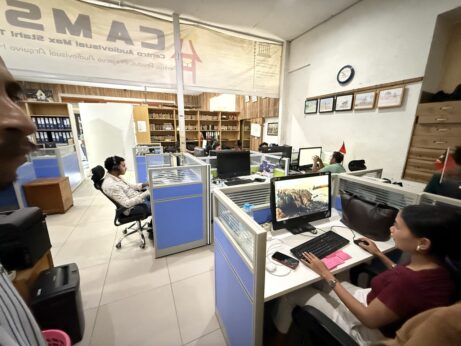
After the referendum on national autonomy on August 30, 1999, the Indonesians destroyed as much as they possibly could before packing up to leave. Stahl recorded some 5,000 hours of footage and took thousands of still photos, including the 2002 ceremonies marking the recognition of East Timor’s “second” independence, which included former U.S. President Bill Clinton. In subsequent years, Stahl devoted himself to organizing his vast documentation and preserving it with technical support from UNESCO. In 2020, a year before he died, Stahl received Timor-Leste citizenship. José Monteiro was my helpful guide through the modest building which houses Stahl’s uniquely comprehensive audio-visual center. I saw half a dozen or so young students sitting at computers actively using its invaluable resources.
The text of “Pátria (Fatherland)” the national anthem, reflects East Timor’s emergent spirit—at least at the time it was adopted:
Glory to our people and the heroes of our liberation…
We vanquish colonialism, we cry: Down with imperialism!
Free land, free people, no, no, no to exploitation!
Let us go forward, united, firm, determined in the struggle against imperialism,
the enemy of the people, until final victory, onward to revolution!
Xanana Gusmão tosses coconuts
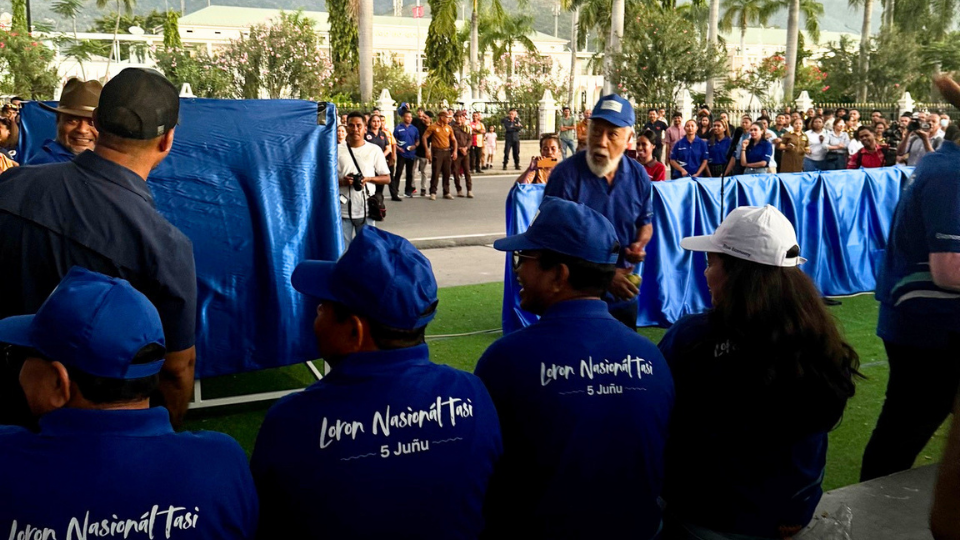
June 3 was World Ocean Day in East Timor, although globally the official date is June 8th. As an island nation, it’s obvious why its people would be concerned for the health and continued bounty of the world’s waters. Residents began gathering on the oceanfront promenade with the official government buildings behind them. Displays of ocean scenes constituted the main decor. At least as long as I was there, no special event, like a speech, dedication, or march, took place.
The main attraction was the presence of Xanana Gusmão, 79 then (now 80), Prime Minister and one of the principal leaders of the “1975 Generation” and the Resistance movement. I was standing about eight feet away from where he sat waiting to cut the strings on the mantle over the big Ocean Day display, and observed him closely for a good half hour. He radiated a Will Rogers-like charm, playing on the love and respect he commanded from his people. He had no self-consciousness about removing his shirt and displaying his naked torso when the official t-shirt of the occasion was presented to him to wear. He openly mugged for the cameras, pulling constantly on his cigarette, flashing his toothy smile, greeting people he knew personally—which in such a small country might be a sizable percentage of the population. He motioned to a pair of fruit sellers, and started tossing coconuts out to the cheering crowd, then switched to fresh oranges. He has a strong throwing arm, and people several rows back eagerly reached out to catch one. It was the humblest yet most convincing demonstration of a political leader’s populist appeal.
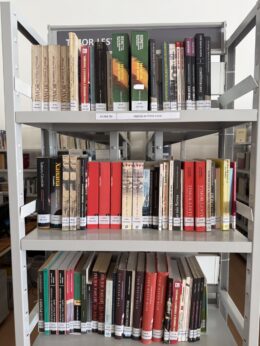
A number of countries have embassies in Dili, but as one might imagine, the Portuguese embassy is a large one, perhaps the largest in town. It handles consular functions and international relations, but also sponsors a library and classes. For about ten minutes I sat in on a Portuguese language class in progress, and then carefully perused the library holdings. The collection contains numerous reference books, such as dictionaries and encyclopedias, as well as general studies. Its shelves feature a small selection of Portuguese literature. I was disappointed to see nothing, neither theoretical and historical works nor fiction, by the longtime Portuguese Communist Party leader Álvaro Cunhal, whose novels and short stories I have translated into English. It would seem as though the contributions of the PCP toward overthrowing the fascist regime in Portugal have been quietly passed over. Still, the work of the embassy in promoting Portuguese—in step with the CPLP—is all-important: to help the Timorese become functionally conversant in a European language spoken on several continents.
Another cultural institution I visited was the Fundação Oriente, perhaps best rendered as the Foundation for the East. It features art exhibitions, classes, performances, a library, and support for research and publishing. I strolled through a gallery of original drawings, many based on native folklore and rendered in a contemporary style mixing ethnography with fantasy and invention. Several sported the universally recognized red dot on the wall, indicating that they had been purchased, giving evidence of a culture-consuming class eager to support artists and acquire significant Timorese work.
A museum documents the resistance
The resistance movement from 1975 to 1999, and culminating in the island nation’s “second” and real independence on May 20, 2002, gradually came to the attention of global anti-colonialists and leftists. Support groups for Fretilin (Revolutionary Front for Independent Timor-Leste), the main party leading the struggle, cropped up in various countries.
Armed freedom fighters have adopted any number of strategies for success. The Chinese Communists had their presence in the main cities, but are renowned for their command of huge rural areas from which they expanded to eventually gain victory over the Kuomintang throughout the land. Similarly, in the 1950s, perhaps observing the example of China, the Cuban Revolution established a foothold—a foco, or focus—in the Sierra Maestra, making forays into urban areas to strike against the Batista regime.
Che Guevara—an Argentine who became Cuban—tried to duplicate this model in Quechua- and Aymará-speaking Bolivia.
But given the geography of East Timor, this was in large part the approach of Fretilin, to hold out in the central mountains that they knew well, and that were less accessible to the Indonesian invaders. As noted, the losses were terrifying. But over time, with the world’s attention becoming increasingly aroused, as the U.S., starting under Gerald Ford and continuing through several presidencies, supplied arms and diplomatic support to the staunchly anti-Communist Indonesians, the tide started turning against the decades-long rape of Timor-Leste.
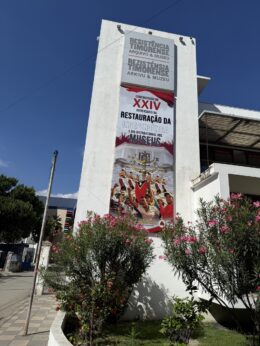
The Timorese Resistance Archive and Museum, founded in 2005 and located right in the center of town, highlights this monumental struggle. It is perhaps the single “must-see” destination in the country, a splendidly designed chronological flow of the course of the 25-year struggle for independence. Aside from what the visitor sees, the archive contains documents, artifacts, eyewitness testimonies, videos, photographs, etc. Names are named, such as Henry Kissinger and Gerald Ford. The insidious hand of the CIA is everywhere. Didactic panels appear in three languages—Tetun, Portuguese, and English.
My M.O. in a detailed, comprehensive museum such as this is normally to take photos of some of these texts that I can study more carefully when I get home. But the museum strictly forbids photos—perhaps to steer visitors toward purchasing the heavy, expensive catalog featuring all the displays and texts. In any case, if you want to learn about the organizational structures and methods of the different political groups (not just Fretilin) that led the Resistance, this is the place.
Not far from the center of town are the library and reading room of Xanana Gusmão, who is among his country’s most prolific and honored writers. Most of his work concerns the struggle for independence and the challenges of the new country. He has written an autobiography (To Resist is to Win!) and is also a poet and painter. He has won honors from Brazil, New Zealand, Portugal, the UK, and even Indonesia (First Class Adipurna of the Star of the Republic of Indonesia) in 2014.
Gusmão is a close colleague of José Ramos-Horta, a fellow Resistance leader who currently serves as Timor’s President. His name is familiar to the world as the recipient of the 1996 Nobel Peace Prize, which he shared with Timorese Bishop Ximenes Belo, for their efforts on behalf of their people’s right to self-determination.
Because I’d been nearly flattened by a raging cold, I couldn’t do all I’d wanted in Timor-Leste. I was unable to arrange any excursions outside the capital city. But on my last day in Dili, Sunday, June 7, I was fortunate enough to witness the celebration of the Feast of Corpus Christi (also known as the Solemnity of the Most Holy Body and Blood of Christ).
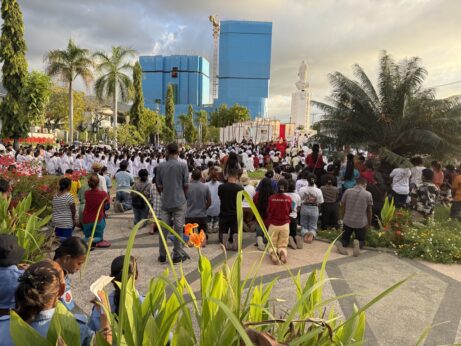
East Timor is 98% Roman Catholic, with meager smatterings of other faiths, thanks to centuries of Portuguese colonization. In rural areas of the country, however, many local and tribal practices continue to be observed, resulting in a marked degree of syncretism.
In the capital, every Catholic school, church and society sent its adherents out onto the street for a long procession, decked out in their colorful uniforms, with banners and flags flying, and culminating at a plaza featuring a prominent statue of the Virgin Mary for a mass prayer ritual with not a syncretism in sight. Thousands dropped to their knees at a signal from the pulpit. And everyone seemed to know the language of the prayers and songs.
I’m glad I was able to catch this mass demonstration of faith, if only for the pageantry of it all. Yes, it is possible to celebrate such noble principles as freedom, independence and autonomy while holding fast to a compelling religious discipline.
Timor-Leste would not be at the top of most tourists’ bucket list—and maybe not on anyone’s. But for me it held a certain attraction, and I gave in to it. Now that I’m back home, I expect my ears to perk up when I hear news of the country. Perhaps my readers will understand why.
We hope you appreciated this article. At People’s World, we believe news and information should be free and accessible to all, but we need your help. Our journalism is free of corporate influence and paywalls because we are totally reader-supported. Only you, our readers and supporters, make this possible. If you enjoy reading People’s World and the stories we bring you, please support our work by donating or becoming a monthly sustainer today. Thank you!
CONTRIBUTOR
MOST POPULAR TODAY
Warnings sound: Trump ready to stage what amounts to a full-fledged coup
Workers walk: Almost 100K California employees struck for a day

The question of violence: Protests in France, riot or rebellion?
Grenada marks 40 years since the assassination of revolutionary leader Maurice Bishop
In spring 1894, the jobless marched on Washington from every direction