

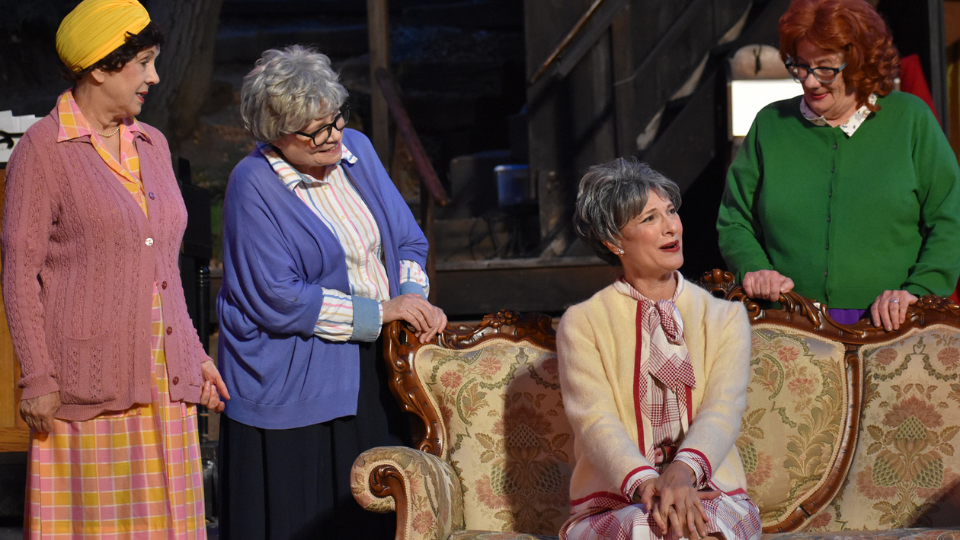
The multi-talented London-born actor/playwright/composer Sir Noël Coward was renowned as the very soul of sophisticated Brit wit. However, when the chips were down, and Hitler’s bombs were falling during the Battle of Britain, Coward courageously turned his talents to the war effort, writing, co-directing (with David Lean) and co-starring as a Naval captain aboard a British destroyer in the 1942 morale booster In Which We Serve, for which he won an Honorary Academy Award and was Oscar-nominated in a screenwriting category.
Almost two decades later, Coward took aim at a mortal threat even more implacable than the Nazis, who after all could be prevailed over and eventually were beaten in World War II. But in his 1960 play Waiting in the Wings, Coward bravely took aim at the one foe no human can overcome: Death. In addition, the bold British bard dared to tackle another thing avoided like the plague by our youth-obsessed culture, but which anyone who lives out his/her natural life span must also face: old age. And to top it all off, in the male-dominated field of the stage, most of Wings’ dramatis personae are not only female—but “women of a certain age.”
Waiting in the Wings is set during the 1950s at a retirement home located near Maidenhead for “over the hill,” mostly English ex-actresses who subsist off of charity.
During the two-act, almost three-hour Wings’ retired thespians are confronted not only with the vicissitudes of aging and impending death, but by feuds, score-settling, familial discord, conflict versus the need for harmony, forming bonds and community, gotcha gossip tabloid media, living—or at least existing—outside of the limelight that once shone on them when they had trod the boards in their younger days, and more. Simply filling one’s time from day to day can be a daunting task in this version of a sort of assisted living home in the country. How does one deal with declining mental and physical abilities and capacities as the proverbial sun sets slowly in the West?
The aging process can be extremely dramatic—and traumatic—but is rarely dealt with as the main storyline of Hollywood movies. Martin Scorsese’s 2019 The Irishman, which followed the lead character played by Robert De Niro to what we’ve called “an old age home,” is a notable recent exception to the rule in a youth-obsessed industry that eschews wrinkles and graying hair (or lack of) in favor of young good looks. It is to Coward’s and to Will Geer Theatricum Botanicum’s credit for reviving one of Sir Noël’s productions that is much less known than some of his other more celebrated plays, such as 1925’s Easy Virtue, 1930’s Private Lives, 1932’s Design for Living, 1941’s Blithe Spirit, 1946’s Peace in Our Time, plus the acclaimed 1945 movie Brief Encounter.
Susan Angelo, who co-stars as Lotta Bainbridge, must confront the bane of her existence for the first time in years when, due to her reduced circumstances, she reluctantly joins the retirement home where her longtime nemesis May Davenport (Jan Wikstrom) also lives. I had thought that competition for a stage role was the source of their age-old Hatfields and McCoys squabble, but the real derivation of their enduring tensions leads to an even greater confrontation for Lotta to deal with in Act II. Will she be able to come to terms with either or both or none of the rifts in her life as a touring actress, which set Lotta on her path to this retirement home near Maidenhead? Will Bainbridge bridge the banes of her life?
Ms. Angelo does a convincing job portraying a character older than she actually is, and is herself a mainstay at Will Geer Theatricum Botanicum as both a thesp and helmer.
The English actress Miranda Heath has a commanding stage presence as one of the cast’s younger characters, Miss Archie, an administrator of the retirement home. Jane Macfie and Katherine Griffith have faces that may be familiar to many theatergoers, and are droll as song-and-dance entertainers who still have panache.
Isabel Stallings is striking as the tabloid journalist Zelda Fenwick through whom one suspects Coward is commenting on the press. (Her zany moniker seems like a mashup of the names of F. Scott Fitzgerald’s wife and the world’s tiniest nation, the Duchy of Grand Fenwick, where the 1959 Peter Sellers comedy The Mouse That Roared largely takes place.)
The scene-stealing Ellen Geer spryly plays Sarita Myrtle, who has seen better days as she loses her faculties—and in the process almost destroys the facility the thesps reside in. WGTB’s Co-Producing Artistic Director gets to display her finely honed acting chops and her mischievous side as someone who is “not of her right mind,” as the expression goes.
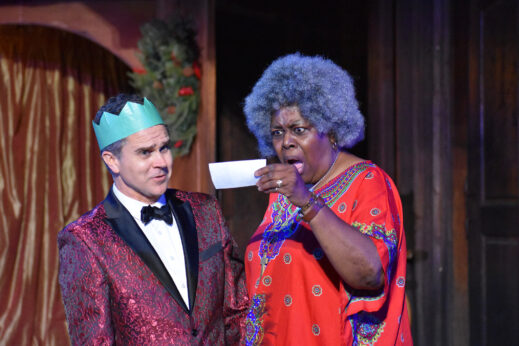
Earnestine Phillips portrays Dierdre O’Malley, one of those grouchy grumps who are only happy when they’re miserable or inflicting misery upon others. [PLOT SPOILER ALERT:] In fact, she meets her fate in the only moment of sheer joy Dierdre lets her guard down to enjoy.
Ms. Phillips, who is also a WGTB stalwart, told me that Dierdre was originally written by Coward as an Irish character (the world premiere of Waiting in the Wings was in Dublin in 1960), but WGTB won approval from the Coward estate to transform her into an African American for its adaptation of Wings after WGTB presented documentation to said estate about the many Black performers from America who went on tour in Europe. Some, like the acclaimed Josephine Baker, even made their homes in Europe. In her depiction of Dierdre, Ms. Phillips does an interesting twist on the trope of “the angry Black woman.”
The entire production is expertly, nimbly (but never numbly!) helmed by WGTB’s Co-Producing Artistic Director Willow Geer, who elicits poignant, nuanced, finely etched portraits from her cast. Ms. Geer may be too young to have suffered the slings and arrows of outrageous aging yet herself, but as a charter member of a showbiz dynasty who is herself a gifted thespian, Willow intimately knows the ins and outs of the acting life, which is another one of Sir Noël Coward’s themes in Waiting in the Wings, which is also a paean to the theater.
The title Waiting in the Wings is a double entendre and may also reference Samuel Beckett’s 1953 masterpiece Waiting for Godot. When Wings opened at Ireland’s Olympia Theatre, and then at London’s West End in 1960, the Theatre of the Absurd and British Kitchen Sink angry young man dramas were the theatrical rage. Coward’s look at old woman, with dark and lighthearted moments, seemed outdated to some, and to only have a wing and a prayer of finding an audience. But Coward showed courage going against the grain with a woman-centered play about those ultimate taboos: Death and old age, especially afflicting those whom Simone de Beauvoir dubbed “The Second Sex.”
This is a theatrical experience about fading stars presented outdoors under the stars for those interested in the subjects of aging, death, acting, reconciliation, getting along, and sticking together. I quite enjoyed Waiting in the Wings and found it to be very moving about truths we’d really rather not face, but likely eventually will—if we’re lucky enough to live that long.
Will Geer Theatricum Botanicum is presenting Waiting in the Wings through October 3 in repertory with Romeo & Juliet, A Midsummer Night’s Dream, Treasure Island, and The People of Pompeii, which premieres August 1 at 1419 North Topanga Canyon Blvd., Topanga, California 90290. For info and tickets, go here or call (310)455-3723.
We hope you appreciated this article. At People’s World, we believe news and information should be free and accessible to all, but we need your help. Our journalism is free of corporate influence and paywalls because we are totally reader-supported. Only you, our readers and supporters, make this possible. If you enjoy reading People’s World and the stories we bring you, please support our work by donating or becoming a monthly sustainer today. Thank you!
CONTRIBUTOR



MOST POPULAR TODAY

Warnings sound: Trump ready to stage what amounts to a full-fledged coup

Workers walk: Almost 100K California employees struck for a day

The question of violence: Protests in France, riot or rebellion?

Grenada marks 40 years since the assassination of revolutionary leader Maurice Bishop

Thousands of No Kings rallies across nation shout ‘vote out MAGA’