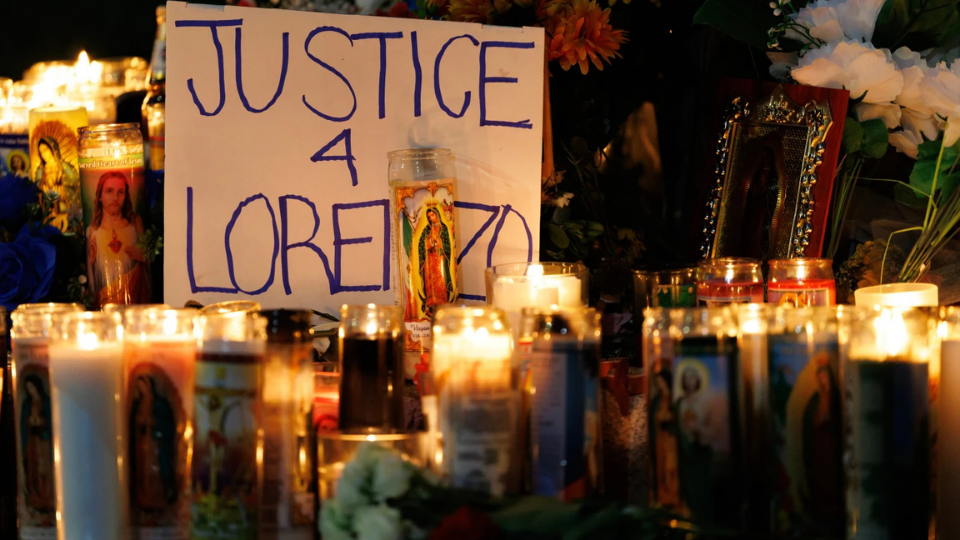
WASHINGTON—In a somber ceremony outside a Northeast D.C. Roman Catholic church, almost 100 people around the metro area gathered to light memorial candles for the two latest victims of President Donald Trump’s ICE agents.
And at the rite, one of 110 “Disappeared in America” observances nationwide the weekend of July 25-26, they vowed to continue to battle for the rights of migrants—and everyone else—against Trump’s troops from the Immigration and Customs Enforcement Service, the Border Patrol and the National Guard.
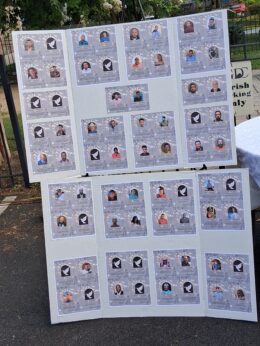
The D.C. ceremony centered on a collage of photographs of what the group says are 70 victims of ICE since Trump returned to power a year and a half ago and turned the agency loose to round up, detain and deport hundreds of thousands of people. The prime characteristic of the deportees: They’re not white.
Most of the ICE victims, like the two—Lorenzo Salgado Araujo of Houston and Johan Sebastián Durán Guerrero of Maine—whose deaths set off the latest round of anti-ICE protests, have Hispanic names.
“We gather to honor the fathers, and mothers and neighbors and friends whose lives have been taken by ICE,” said Yeselyn Iraheta, the 17-year-old emcee of the D.C. ceremony and a member of the League of United Latin American Citizens, or LULAC. Iraheta’s mother helped Iraheta light the memorial candles on the ground in front of the collage of photos.
“No family should have to wonder if their loved one can never come home safely from work,” Iraheta added.
Two of the exceptions were Alex Pretti, the Veterans Administration nurse and union (AFGE) member, and Renee Nicole Good, a mother and activist. Federal agents shot both to death during the massive Operation Metro Surge in Minneapolis.
Speakers at the D.C. ceremony noted the mainstream media erupted in outrage over the killings of Pretti and Good—but not over ICE killings, either on the streets or in detention, of people with Hispanic names.
“This system is inherently un-American,” said Dr. Ray Serrano, LULAC’s director of research and policy. “The immigrants are somebody” many people in the U.S. “inherently don’t see.”
That includes the ICE agents themselves, he added. To prevent their own accountability in Salgado Araujo’s killing, “they removed all identification from his body and held it for two days” until Salgado Araujo’s family, through LULAC, put pressure on for identification and release.
“I’m disappointed at how routine this is becoming,” both by ICE and as part of the evening news, said the only local legislator to speak, Oye Owolewa, a progressive D.C. city councilmember-elect. Both Sebastián Guerrero and Salgado Araujo were regular residents who never were in trouble with the law and “who paid their taxes to a government that later killed them.”
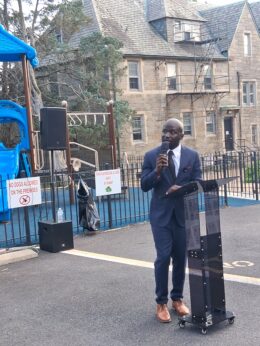
“They and dozens of others have been killed by a domestic terrorist organization…They were killed for what they look like, what they sound like.”
Several speakers made the point that the repression has roots in wider structures. One pointed out the area’s leading contractor, Clark Construction, has a contract to erect a new $300 million ICE headquarters on the campus of a now-closed city institution—virtually an infamous warehouse—for the mentally ill. The D.C. Council should review all its contracts with Clark, unless Clark abandons the ICE project, that speaker said.
Left unsaid is that ICE has been buying empty factories and warehouses nationwide and hiring contractors to rehab them into prisons for the thousands of migrants it arrests and detains, usually without hearings or trials. And it hires private prison firms, infamous for their mistreatment of inmates, for large sums to run the facilities.
Some cities, even in red states, such as Oklahoma, have rejected such deals. But in others, ICE already owned the buildings involved and converted them for detention, despite widespread local protests. The political heat has gotten so bad that one notorious human pen, “Alligator Alley” near Florida’s Everglades, is in the process of being shut down—maybe—said one D.C. participant in regular contact with protesting colleagues in the Sunshine State.
But ICE hasn’t stopped its pursuit of people who are non-white, having been freed to do so explicitly by a sentence in a U.S. Supreme Court decision. Its killings of Pretti and Good, and its assaults and wounding of journalists in L.A. and Chicago who were reporting on its roundups show ICE goes after witnesses and supporters of the migrants, too.
Recent investigations have disclosed that more than three-fourths of the people ICE has rounded up have no criminal records at all. And almost half of those arrested and detained have had their cases thrown out by federal judges due to sheer lack of evidence or justification, a recent New York Times investigation shows.
Still, the prime ICE victims are migrants, legal or not. And the pain and trauma will linger for years. To take the most obvious case, Sebastián Guerrero was shot to death while driving, with his wife and three-year-old son in the car.
“I can’t imagine not being able to go home to your kids after a hard day’s work,” said Iraheta, briefly pausing for composure. “Or not being able to go outside for a walk.”
Gesturing to the chart, Iraheta added, “And that’s what these people felt—until they lost their lives.”
We hope you appreciated this article. At People’s World, we believe news and information should be free and accessible to all, but we need your help. Our journalism is free of corporate influence and paywalls because we are totally reader-supported. Only you, our readers and supporters, make this possible. If you enjoy reading People’s World and the stories we bring you, please support our work by donating or becoming a monthly sustainer today. Thank you!
CONTRIBUTOR