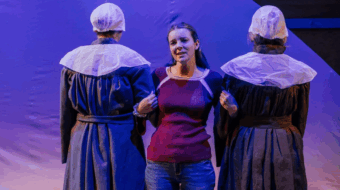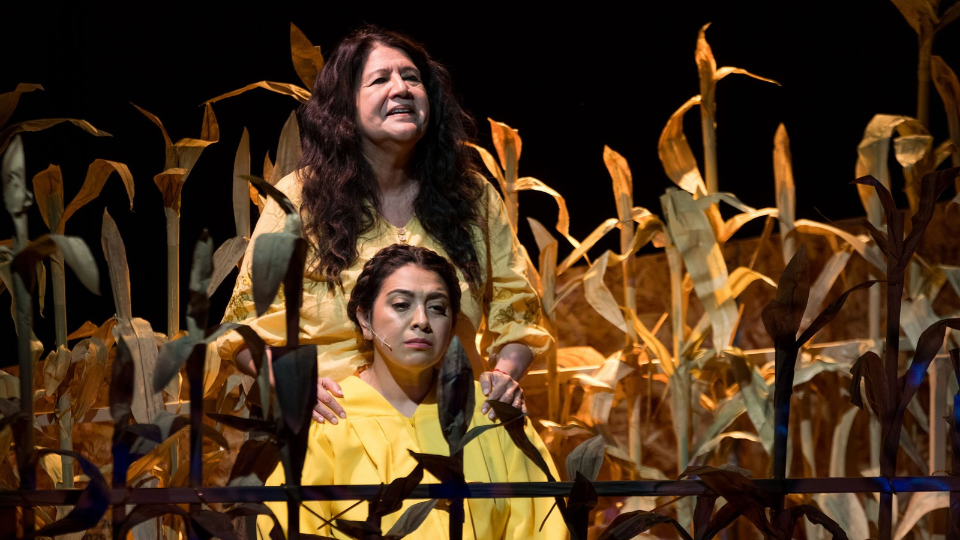
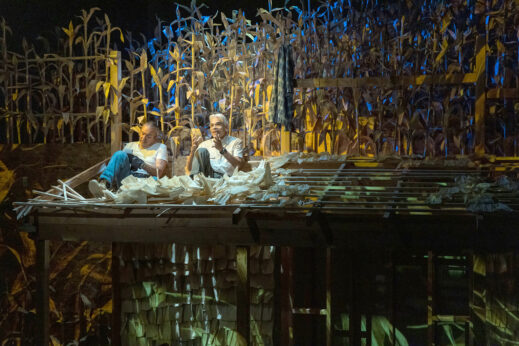
Award-winning bard Luis Alfaro’s Speaking in Tongues takes place in a small town called Early March near Delano, in California’s Central Valley, where L.A.-born Alfaro traces his farmworker legacy. The play concerns a Pentecostal congregation, and is set presumably in the present day at a church beside a cornfield (the imaginative, awards-worthy multi-level set is by scenic designer Prairie T. Trivuth).
Alfaro’s one-act production is not easy to understand, which is probably as intended, since it deals with some mystical subject matter, as the title suggests. At times, I thought I was watching a comedy, as there was some funny dialogue, but serious subjects were also being addressed. In a brief video about his play, Alfaro discusses what Tongues is supposed to mean—but I didn’t glean any of that from the 90-minute or so show, probably because I’m a dense heathen.
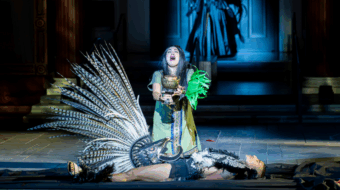
Speaking in Tongues prompted this critic to ruminate on the theater’s function since antiquity. Alfaro’s oeuvre includes his “Greek Trilogy,” which reimagines plays by Sophocles and Euripides through a Latino lens, such as Oedipus El Rey, which was performed at Manhattan’s prestigious Public Theater in 2017. In a similar vein, in September the Latino Theater Company presented at Getty Villa playwright Evelina Fernández’s adaptation of Sophocles’ Antigone, resetting it from ancient Thebes to pre-Columbian Tenochtitlan, capital of the pre-contact Aztec Empire in Mexico. Subtitled In the Language of Kings, it was directed by José Luis Valenzuela, who also helms Tongues, which co-stars Sal López—who portrayed Tetzahuitl in Antigone—as Hermano Mando, while writer Evelina Fernández displays her acting talent as Hermana Romie in Tongues.
What I appreciated about Speaking in Tongues as a theatrical experience is that it dramatizes something I’ve witnessed in my life: Religious and sometimes political cults and/or sects, how they brainwash and punish members, imposing often improbable dogma upon adherents (the gullible and unwilling alike). The unnecessary suffering and struggles this inflicts upon believers and doubters, from Tehran to the South Seas, is definitely something worthy of dramatization. Interestingly, Rogue Machine currently has on its boards a similarly-themed one-act entitled Saint Megan, about the truly despicable, utterly reprehensible Westboro Baptist Church.
Somewhere in the South Pacific I got dragged into a religious service by a relative to some godforsaken Holy Roller sect – I can’t even remember what denomination this abomination was? – of neo-colonial “Christianized” Islanders, some of whom were literally speaking in tongues during the church service. Not wanting to be disrespectful, I, of course, held my tongue.
This was at the time of the Iraq War, and, of course, it never even crossed the minds of any of these self-anointed apostles of the Prince of Peace to protest the unjust invasion of Iraq, on the grounds that, like, you know, “Thou shalt not kill.”
So, as with Saint Megan, this pagan found the dramatizing of a religious cult or sect to be illuminating and intriguing. There are tensions within the quintet of characters. At one point, Brother Mando muses out loud: “Jesus was a radical. There have been over a thousand farmworkers arrested in the Valley by ICE. What have we done about it? Jesus would have been protesting and asking us to help. It’s not enough to just pray. We’ve forgotten what it means to be a Christian. Like a real Christian.” Preach brother!
Mando’s tongue-lashing of the congregation’s passivity in the face of massive injustice evokes a Liberation Theology conception of the Social Gospel, as opposed to a mumbo jumbo Biblical interpretation. Sal Lopez, who drolly and movingly plays Hermano Mando, is a founding member of the Latino Theater Company and has 163 screen acting credits at IMDb.com, including Stanley Kubrick’s 1987 Vietnam War drama, Full Metal Jacket.
Another character, Sister Tiri (depicted by East L.A.-born Esperanza America, who played Antikona in LTC’s Antigone), even expresses out loud a desire to quit the Pentecostal church. She is the daughter of Speaking in Tongues’ most enigmatic character, Hermana Romie, from whom I presume Alfaro drew the title for his play. Sometimes when she opens her mouth, instead of dialogue, Romie emits supernatural sounds (sound design by Robert J. Revell). Along with projections by Yee Eun Nam and lighting designed by Xinjuan Li (Lee) (who both worked on LTC’s Antigone), the audio-visual special FX accompanying Romie’s tongue speaking (so to speak) enhance the play’s underlying otherworldly sensibility that informs the narrative written by Alfaro, who was raised Pentecostal.
The esteemed Valenzuela ably directs his ensemble through laughter and doubts and up and down with a challenging multi-level mise-en-scène that requires some nimble mountain-climbing skills by cast members.
According to press notes, Tongues was “Commissioned by Latino Theater Company and developed in its Circle of Imaginistas playwriting group… [T]he son of farmworkers from the San Joaquin Valley[,] Alfaro was formerly associate artistic director of Center Theatre Group at the Music Center of Los Angeles County and is currently an associate professor at the University of Southern California. He has received a fellowship from the John D. and Catherine T. MacArthur Foundation, popularly known as a “genius grant,” awarded to people who have demonstrated expertise and exceptional creativity in their respective fields. His plays, including The Travelers, which was produced by Latino Theater Company in 2023, Electricidad, Oedipus El Rey, Mojada, The Labours, Lady Killer, Aztlan, Delano, Body of Faith, Alleluia the Road, Black Butterfly, Bruja and Straight as a Line, have been seen at regional theaters throughout the United States, Latin America, Canada and Europe.”
The cast includes Geoffrey Rivas as Hermano Tico, who amusingly likes to sleep on the church’s rooftop like a Christian fiddler on the roof, and Lucy Rodriguez as Hermana Cubby; both are founding members of the Latino Theater Company.
Speaking in Tongues is for serious theatergoers who enjoy thought-provoking plays and productions with a spiritual subject and bent.
Speaking in Tongues runs through November 15 on Thursdays, Fridays, and Saturdays at 8:00 p.m. and Sundays at 2:00 p.m. at the Los Angeles Theatre Center, 514 S. Spring Street, Los Angeles, CA 90013. For info and tickets: (213)489-0994; https://www.latinotheaterco.org/.
No paywalls at People’s World
We hope you appreciated this article. At People’s World, we believe news and information should be free and accessible to all, but we need your help. Our journalism is free of corporate influence and paywalls because we are totally reader-supported. Only you, our readers and supporters, make this possible. If you enjoy reading People’s World and the stories we bring you, please support our work by donating or becoming a monthly sustainer today. Thank you!
CONTRIBUTOR