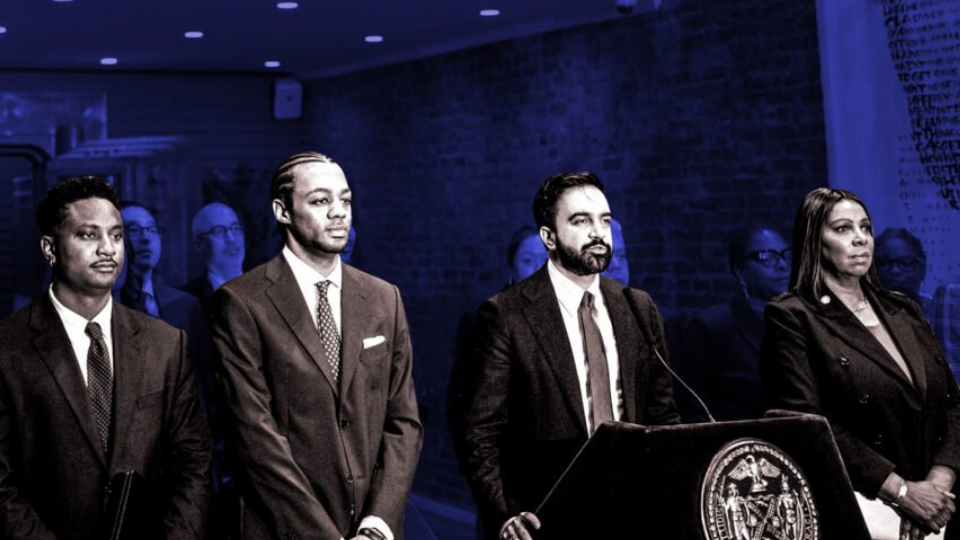
NEW YORK—The prospect of having a family home and building generational wealth for decades only to discover that the name on the deed was conspicuously changed is a nightmare scenario most could never fathom. However, this problem, known as deed theft, has become a reality for many New Yorkers, including Carmella Charrington, a longtime Bedford-Stuyvesant resident in Brooklyn, New York.
For many years activists in the movement for housing have seen massive construction of low income public housing as a major long-term part of the solution to the housing crisis. In the Bedford Stuyvesant neighborhood of Broolyn, however, people are now fighting not just for low income public housing but against deed theft which is contributing to a sharp and immediate worsening of the city’s housing crisis.
Deed theft is a particularly pernicious and predatory housing problem. It occurs when “a thief takes the title to a home without the homeowner’s knowledge or approval.” It typically takes place in the form of forgery or fraud.
Charrington’s father, who at the time lived in Georgia, appeared on the deed. Though he was diagnosed with Alzheimer’s in 2021, his conservator allowed him to sign away the rights to the home in 2024.
In April of 2026, community members and organizations gathered to protest the eviction order, among them the self-identified democratic socialist city council member, Chi Ossé. Not long after the police arrived and Ossé was slammed to the ground and arrested.
While in jail his office stated, “Black displacement is happening right now in Bed-Stuy, and Carmella is one of many Black homeowners battling deed theft in Brooklyn. For months, our office has pushed for an eviction moratorium for homeowners facing deed theft.
“These protections are the bare minimum, and families cannot wait any longer. Not another Black homeowner should have their home stolen. Until deed theft ends, we will fight every single day.”
Between 2013 and 2023, New York City received 3,500 deed theft complaints. These complaints have increased more rapidly with 517 complaints in 2025.
New York homes collectively worth at least $400 million each year are at risk of deed theft. The most targeted areas have been in central Brooklyn and Southeast Queens.
Scammers often target vulnerable homeowners such as seniors, immigrants, and those in historically Black neighborhoods. Deed theft has a cumulative, negative impact on social mobility and generational wealth which exacerbates economic and racial inequality.
While some cases have been challenged in court successfully, deed theft was not made a felony until 2024. In April of 2026, Mayor Zohran Mamdani created the Office of Deed Theft Prevention through executive order.
This office aims to educate homeowners to help prevent deed theft by conducting public outreach, promoting tools that alert owners to changes in property records and supporting investigations and enforcement efforts among other things.
However, some activists and community organizations believe these are just stepping stones in tackling the issue of deed theft. Evangeline Byars, a leading organizer with the People’s Coalition to Stop Deed Theft, spoke with People’s World to discuss her experiences organizing against deed theft to elucidate the problem and offer some solutions that the Bed-Stuy community deserves.
People’s World: When did you notice deed theft becoming a problem? And was there a particular experience that got you involved in organizing?
Evangeline Byars: I’ve always known it was a problem, but I didn’t know exactly what the problem was and the factors that enabled deed theft to occur. I am a labor organizer at NYC Transit. I am in Transit Workers Union, Local 100. My organizing committee is the Stronger Together caucus and we opened our organizing meetings to the community because we saw that people didn’t have anyone in elected office representing them and during our first meeting deed theft victims showed up at How to Beat the Machine organizing meeting, and we grew from there.
How did the People’s Coalition to Stop Deed Theft come together? And how are you seeking to build it out?
Evangeline Byars: It came together through several different groups. The coalition split from the Black Homeowners Preservation Coalition. It continued on with a variety of groups, forming a multiracial coalition, although deed theft primarily impacts people of color. Since then, the organization has continued building under that umbrella, establishing chapters in the Bronx, Brooklyn, Manhattan, and Queens, where deed theft is heavily concentrated.
It is also expanding across New York State after receiving calls from outside New York City and even outside the state. The coalition now has chapters in New Jersey, Georgia and sees itself as not just a local effort, but part of a growing national movement, although its most impactful work is currently being done in New York City.
Is deed theft part of gentrification which also drives Black and working class homelessness? Why is deed theft particularly targeted at Bed Stuy residents?
Evangeline Byars: Gentrification came as political betrayal. ‘Gentrification’ is too broad of a term and means different things to different people. The beautification of the community comes with predatory practices, banks, and elected officials who worked along with them to create the problems and conditions that we are experiencing today. So we do not allow the narrative to place the blame on gentrification because many of the so-called ‘gentrifiers’ are out on the front line with us. This crisis stems from Black political betrayal in Bedford Stuyvesant, as that is who the leadership is composed of, and gentrification is the by-product of this. Black homes are being taken en masse.
We just started about a year ago. People have been raising the issue for a very long time, however, this is a major part of the housing crisis and Black and Brown displacement. There was, to say the least, insufficient on-the-ground work from Black elected officials. Through court watches, for example, people had to take up the work that elected officials neglected, especially in the 56th Assembly District that encompasses Bed Stuy and parts of Crown Heights. This practice continues through political betrayal. Elected officials are supposed to be the gatekeepers of the community’s well-being, and many were and are missing.
How has the Mamdani administration responded and what else would you like them to do?
They implemented the Office of Deed Theft Prevention, but what we really need is enforcement. Deed theft continues to be treated as a civil matter, when it’s actually a crime. Even the Attorney General who we are critical of, has said it’s a crime while reports to her office have risen 240%. Right now, if someone steals your home, you can’t call 911 and get a police report saying your home has been stolen. Deed Theft is the only crime where police do not take a report. Let that sink in.
We have consistently requested from the Attorney General’s Office and Mayor’s Office that we want a meeting with Police Commissioner Jessica Tisch because her officers have never been trained on deed theft, mortgage fraud, or these kinds of property crimes. Law enforcement doesn’t know what deed theft is, and they don’t know enough about it. As a result, they’re helping fraudsters unlawfully evict people because they don’t recognize the crime and what’s happening. We believe there is other criminal activity going on. The NYPD is not supposed to execute these evictions, but it’s happening all across the city. The NYPD are standing guard as deed thieves are drilling people’s doors off. The NYPD often arrests the lawful owner of record, and this has led to the criminalization of homeowners.
We’re asking for a $10 million commitment from Mayor Mamdani to address deed theft because we’ve identified that the biggest need for victims is funding for legal representation and to adhere to the recommendations from the Commission on Racial Equity. The people most affected are between the ages of 62 and 100. They’re being evicted, abused, and often have nowhere else to go. They need criminal investigations, supportive housing, and emergency housing, but they’re still being completely overlooked. We’re looking for that $10 million commitment in the next city budget.
On the legislative side, Sen.Jabari Brisport is working on a statute of limitations bill. Right now it goes back 20 years, but we believe it should go back even farther. However, bureaucracy is everywhere. We want a time frame that is more than twenty years included so people can reopen old cases and finally have them heard. Twenty years isn’t enough. It doesn’t do us justice.
Senator Brisport has a package of four bills that addresses both the civil side of deed theft and the criminal side, including how fraud is investigated. We want FAPA fully enforced and support a private right of action bill and the ACRIS Bill to pass so that any changes to a property owner’s deed will be alerted immediately and not 30 days after the change or transfer has occurred.
We want to repeal the bona fide purchaser law that is found in The Home Equity Theft Prevention Act (“HETPA”). As of right now, if someone buys a home that was obtained through deed theft, the victim doesn’t automatically get their property back due to the bona fide purchaser provision in HETPA. These crimes continue to exist because many elected officials are complicit. They keep doubling down on these unjust laws to protect fraudsters and the banks because those are their donors.
Throughout our discussion, Byars argued that deed theft is an issue because of what she described as political betrayal, not just young people moving into new neighborhoods. She argued that politicians are complicit with developers, and the real estate industry more broadly.
The People’s Coalition to Stop Deed Theft’s organizing around this important housing issue raises serious questions about the totality of this housing crisis in New York City: What political forces are benefiting from the status quo?
For additional analysis of deed theft in New York City, we spoke with Brooklyn Crawford, a Bed-Stuy resident and supporter of the movement tackling the issue and a member of the Brooklyn club of the CPUSA.
People’s World: As a Bed-Stuy resident, how do you understand and explain how deed theft worsens the unaffordability and unavailability of housing?
Brooklyn Crawford: I understand deed theft as it relates to the way that housing generally, under capitalism, is treated as a commodity instead of being treated like a human right. In ourcurrent system, housing is something to sell and profit from, rather than something that is guaranteed to everyone. When housing is profitable, it only makes sense for rents to be raised, and for scammers and thieves to try to steal valuable assets for their own financial benefit. If housing were guaranteed as a human right, the incentive to profit from displacement, inflated housing prices, and deed theft would be dramatically reduced.
What do Communists think about home ownership for personal use?
Brooklyn Crawford: Communists distinguish personal and private property. We believe that personal property, those things that you use and need, are yours to keep-, your clothes, your home. Contrary to popular belief, Communists don’t believe in taking those things away from people.
Private property, in the Communist sense, refers to property that’s owned primarily to generate profit. Think of a landlord who ‘owns’ 30 buildings in which he does not live. Or shareholders who ‘own’ a factory they have never taken a step in. We believe that private property should be abolished, and that the buildings, lands, and factories that the people use, that the people work, and live in – should be owned by the public.
We don’t believe in taking away people’s individual homes. We just think that the ‘means of production’ (the factories, machines, land) and large-scale housing should be democratically owned by the people. We’re the ones who use them!
How would Communists tackle the issue of deed theft in the short term and long term?
Brooklyn Crawford: In the short term, we’d support immediate protections for homeowners and tenants. That means stronger enforcement against deed theft, free legal assistance for victims, stopping evictions, expanding the right to counsel, and ensuring people aren’t displaced. You have landlords kicking out families from homes they’ve lived in for generations, just so they can sell the building or rent it out. It’s greed, plain and simple.
In the long term, the goal is to guarantee housing as a human right, of course! That means expanding high-quality public housing and removing housing from speculation and corporate profiteering. The less housing functions as a pathway for people to get rich, the less incentive exists for predatory practices like deed theft.
As I understand it, Communists like certain aspects of Zohran Mamdani’s platform but have criticized his ideas around social housing? What is the importance of this distinction between social housing and public housing?
Brooklyn Crawford: It’s important to distinguish the two because while they may sound similar, they most definitely are not. Communists support public housing. Public housing is publicly owned, permanently affordable, and is democratically accountable to the residents who live there. This is important.
Social housing, on the other hand, is often done alongside non-profit developers and corporations who have a financial stake in their investment. This only can result in real estate markets deciding our rents. On profits deciding our futures. Often when we hear about social housing it’s marketed as “building more affordable housing,” but we have to ask- affordable for whom?
Public housing should be fully funded, expanded, and preserved. As Communists, the fight to save public housing is a major struggle that we insist is essential for a better future.
Conclusion
While deed theft may represent one of the most egregious forms of housing fraud, it is a particular piece of a larger whole. It exposes a key contradiction in the housing struggle. Allowing housing to function as a speculative commodity is directly at odds with prioritizing homeownership for individual families.
Black homeownership has been an arduous fight for centuries in the United States. A multitude of racist practices, such as redlining, racial steering, predatory lending, exclusionary zoning, and algorithmic bias, have created persistent barriers to Black homeownership.
It’s clear that homeownership is one of the major ways that working-class Americans have been able to build generational wealth. However, much of this was lost during the 2008 housing crisis. The great recession saw half of Black Americans lose about 25% of their wealth with a third losing up to 50% of their wealth.
As class lines sharpen along the issue of housing, the question is not just about deed theft but broader housing politics. We must analyze why our for-profit housing system allows such practices to flourish.
Due to the vacuum left by institutional betrayal, we are already seeing formations on the left take up the cause. Grassroots organizations like the People’s Coalition to Stop Deed Theft are stepping in to advance the fight for housing justice. Alternative political parties, such as the Communist Party USA, are organizing directly with affected communities to save public housing and ultimately end for-profit housing.
The fight against deed theft is one crucial aspect of the larger housing struggle: Will housing be a commodity that is to be bought and sold for profit? Or should it serve the needs of the human community?
We hope you appreciated this article. At People’s World, we believe news and information should be free and accessible to all, but we need your help. Our journalism is free of corporate influence and paywalls because we are totally reader-supported. Only you, our readers and supporters, make this possible. If you enjoy reading People’s World and the stories we bring you, please support our work by donating or becoming a monthly sustainer today. Thank you!
CONTRIBUTOR