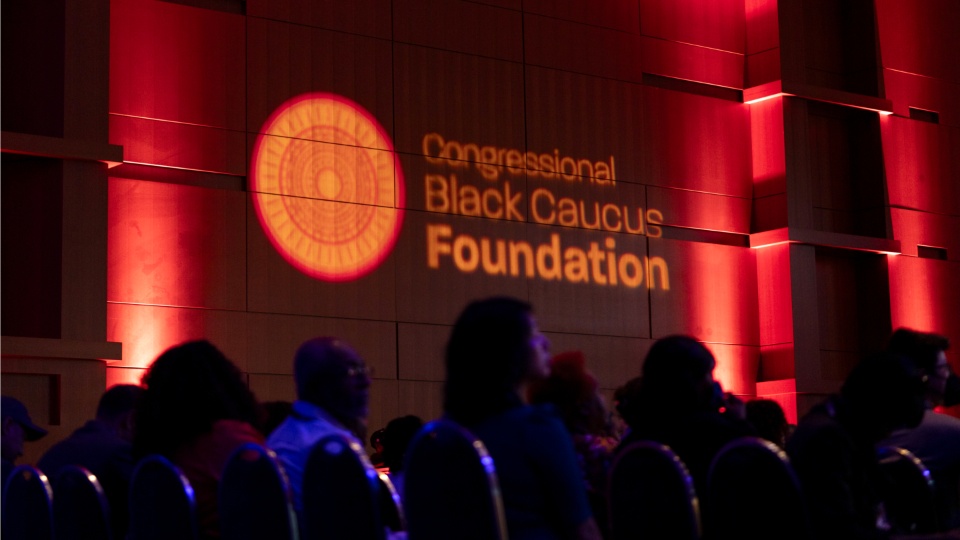
Black elected officials, business leaders, organizers, and advocates from across the country converged on Washington, D.C., in September for the Congressional Black Caucus Foundation’s Annual Legislative Conference, better known as CBC Week.
The week of panels, policy forums, and receptions drew Black attendees from every corner of the nation. Some came to network and look for job opportunities; many came to hear how Black leadership reads the current political moment and what it plans to do to push back against a blatantly white supremacist and fascistic administration.
With the midterm elections looming, much of the conversation at the conference centered on turning out the vote to tip Congress back toward the Democrats, who could then serve as a check on Donald Trump and his allies.
But those calls raised a harder question: Is the Democratic leadership on display at CBC Week willing to go as far as needed to prevent future far-right assaults on the checks and balances that have barely kept this country afloat?
Several conversations touched on rooting out the corruption that Trump’s billionaire allies have brought into government, but that is only part of the picture. Many corporate Democrats have also taken money from billionaire interests and from groups like AIPAC, the pro-Israel lobby that pushes lawmakers toward unconditional support for Israel. Some Democrats, like Pennsylvania Sen. John Fetterman, have gone as far as voting alongside Republicans.
Even the conference itself came under fire: Black activists have called out the CBC Foundation’s ties to Palantir, the AI and data-analytics firm that sponsored this year’s conference. Palantir’s chairman, Peter Thiel, has long backed Trump, and its software has been used for predictive policing in Black communities and by federal agencies to root out diversity programs.
There is also hope that a blue wave would bring real efforts to reverse the Trump policies behind so much of the chaos of the past two years. Kristen Clarke, who headed the Justice Department’s Civil Rights Division as assistant attorney general under President Joe Biden, stressed the need for stronger checks and balances and new civil rights laws to replace the fragile gentlemen’s agreements and unwritten norms that were never backed by concrete legislation.
For Clarke, that includes Supreme Court reform and possible constitutional amendments to block the kind of political maneuvering Trump and his allies have used to push far-right policies through so quickly.
The Democratic Party, meanwhile, is divided. It is split between two factions: the corporate, centrist wing that has dominated the party for decades, and a rising progressive wing that includes candidates aligned with groups like the Democratic Socialists of America (DSA). Black voters find themselves caught in the middle, weighing how well each faction represents the needs of Black America.
Corporate Democrats have repeatedly offered vague promises of affordability, safety, and the protection of Black Americans’ rights, while DSA-aligned politicians have built their base around universal demands like affordable health care and free child care. Yet it remains uncertain whether either faction is equipped to address the specific problems Black people face every day.
That tension has surfaced in a string of Democratic primaries: Jasmine Crockett vs. James Talarico for U.S. Senate in Texas, Abdul El-Sayed vs. Haley Stevens for U.S. Senate in Michigan and, going back to 2025, Zohran Mamdani vs. Andrew Cuomo in the race for New York City mayor.
Some candidates, however, are breaking out of this tug-of-war. In Florida, State Rep. Angie Nixon won the Democratic primary for U.S. Senate in a major upset, defeating Alex Vindman. If she beats Republican Sen. Ashley Moody, she will be the first Black woman to represent Florida in the U.S. Senate. In D.C., progressive Councilmember Janeese Lewis George won the Democratic primary for mayor over the more business-aligned Kenyan McDuffie. Across the country, progressive Black candidates are winning big, and they are doing well with Black voters.
The divide is most visible in the debate over House Minority Leader Hakeem Jeffries. Clarke made clear that she wants Jeffries to become Speaker of the House if Democrats win the majority, which would make him the first Black speaker in the nation’s history.
For many progressives, though, Jeffries represents a continuation of the stagnation and inaction associated with Nancy Pelosi and Chuck Schumer, the longtime leaders of House and Senate Democrats. Jeffries has drawn heavy criticism for his ties to AIPAC and for a private meeting in August with Jared Kushner, Trump’s son-in-law and a chief architect of U.S. policy in West Asia.
His appetite for reaching across the aisle feels outdated at a time when FBI agents have raided the home of Rep. Ilhan Omar and Trump routinely casts Democrats as enemies of the country.
Between the dismantling of diversity, equity, and inclusion (DEI) programs and the wave of redistricting across the South that followed the Supreme Court’s ruling weakening the Voting Rights Act, Black America is under direct attack from this administration and its allies.
That attack has also turned deadly. The police shooting of 1-year-old Kohen Wiley in a Walmart parking lot in Senatobia, Miss.; the killing of Julian Bailey, a 43-year-old D.C. man shot by a U.S. marshal in February; and the still-unexplained death of 18-year-old Nolan Wells on a Mississippi barrier island all show not only the violence inflicted on Black people, but also the lack of real justice and accountability through legal channels.
Meanwhile, a right-wing online machine pumps out anti-Black propaganda, especially after a Black person is killed. These attacks run from the top of the federal government down to the right-wing followers that perpetuate racist actions.
The crisis facing Black Americans is economic as well as political. Black women’s unemployment rate reached 7.3% this year, roughly twice the rate for white women, and Black women have been hit especially hard by the administration’s cuts to the federal workforce. In D.C., Black unemployment averaged 9.5% in 2025, more than two and a half times the rate for white workers.
At a CBC Week panel led by the National Council of Negro Women, it was clear that economic security—better wages and quality health care—is a top policy priority for the leaders in the room.
That panel became a brainstorming session on how to push back against the Trump administration. Building coalitions with unions and the labor movement, investing in Black institutions and lifting up Black media and the Black press were just some of the ideas offered. The central message was still to get people to the polls for the midterms, but panelists stressed that political engagement has to continue after Election Day, whatever the results.
Despite these calls, it remains an open question whether centrist and corporate Democrats will commit to any meaningful strategy to reverse the damage done under Trump. With their business interests sometimes overlapping with those of Republicans, there is real concern that even a blue wave would produce another lackluster Democratic response to Trump and his agenda.
The most striking thing about CBC Week was the setting itself. D.C. remains under federal occupation, with National Guard troops patrolling the streets near the Walter E. Washington Convention Center, where the conference took place, and the deployment is now set to last through Trump’s term.
Yet there was little to no discussion of where D.C. fits into the broader fight Black leaders are calling for. That a historically Black-majority city, still home to a sizable Black population, is living under constant militarized watch was a serious omission from the panels.
Asked during the conference what guardrails could ensure that a militarized occupation like D.C.’s never happens again, Clarke and Janai Nelson, president and director-counsel of the NAACP Legal Defense and Educational Fund, gave different answers.
Clarke called for deeper coalition-building among the city’s many voices and nationally, with an emphasis on churches. Nelson was blunt about what D.C. needs so that it is never again attacked the way Trump has attacked it over the past year: “Statehood.”
The task for Black America in this political moment is to make sure the politicians it votes for actually care about the issues affecting Black communities. And when those politicians backslide on their promises and go back on their word, it is up to the people to keep up the pressure, whether or not those politicians were endorsed by the Black leadership gathered at CBC Week.
As with all op-eds and news-analysis articles published by People’s World, the views reflected here are those of the author.
No paywalls at People’s World
We hope you appreciated this article. At People’s World, we believe news and information should be free and accessible to all, but we need your help. Our journalism is free of corporate influence and paywalls because we are totally reader-supported. Only you, our readers and supporters, make this possible. If you enjoy reading People’s World and the stories we bring you, please support our work by donating or becoming a monthly sustainer today. Thank you!
CONTRIBUTOR