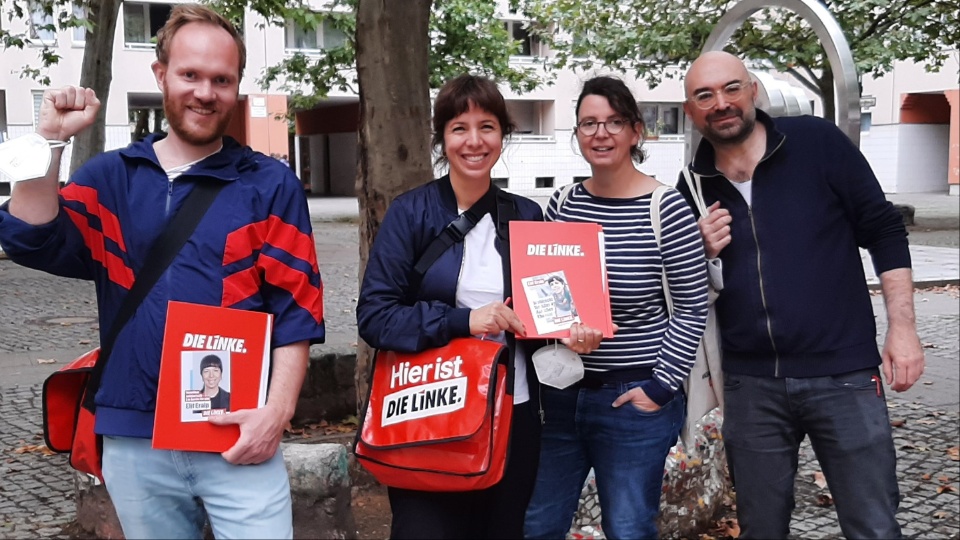
BERLIN—For the first time since German reunification and the fall of the Wall in 1990, a candidate from the Left Party (“Die Linke”) may be elected mayor of Berlin. Elif Eralp, 45, who heads the Left Party’s list for the Sept. 20 Berlin municipal elections, is the daughter of a family of socialist Turkish immigrants and leads in the latest opinion poll.
The party’s campaign, which has deployed some 18,000 volunteers across the city, focuses on the fight against high rents and the demand to lower the cost of living in Berlin. In recent years, prices have risen in a city known for its low cost of living, and the targeted campaign is sweeping residents along with it.
A possible victory in the capital of the Left Party, led by a daughter of immigrants, is a breath of fresh air against the backdrop of rising support for the neo-Nazi Alternative for Germany (AfD) party. The AfD’s dramatic climb has been the main political story in Germany for months.
Like the federal government in the country, the city’s current government is a coalition of the Christian Democratic Party (CDU) and the Social Democratic Party (SPD). The current mayor, conservative Kai Wegner, was forced to withdraw from the race last month after it was revealed he had lied about his response to the massive power outage that hit Berlin in January following an organized act of sabotage.
The blackout left 45,000 residents without electricity and heating for days in the freezing cold. In addition to the lies, on that fateful day, the mayor went to play tennis after he had already learned about the crisis. He was replaced by right-wing candidate Stefan Evers, who led a policy of austerity and cuts as Berlin’s finance minister.
Five-legged race
Berlin is one of the 16 states that make up Germany, and elections to the state parliament are based on forming an inter-party coalition. According to the latest poll published in the newspaper Tagesspiegel, the Left Party is leading in Berlin with 21% of the vote.

It is followed by the ruling Christian Democratic Party (19%) and the far-right AfD (18%). The center-left Greens win 17%, and the Social Democratic Party, which has ruled Berlin for many years, comes in last with a humiliating 12% of the vote. Below the 5% threshold are the populist Sahra Wagenknecht Alliance (BSW) and the liberal Free Democratic Party, both with 3%.
Thus, a very close race is emerging: Five parties with more than 10% support but all with less than 25%. By all estimates, the situation will remain this way until election day.
A possible center-left government (called “red-red-green,” after the party colors) would include the Left Party, the Green Party, and the Social Democrats. This is the coalition that governed Berlin until 2021 and brought certain achievements for the public. A referendum held under its leadership called for the nationalization of more than 3,000 apartments owned by large real estate companies, but the court rejected the result.
That coalition was headed by a representative of the Social Democratic Party, which was the largest party in the coalition, while the Greens and the Left Party were junior partners. This time, if the polls are correct, the Left Party will govern and Erlap will be the mayor.
Socialism in government
The Left Party may win and come to power in Berlin, but the big challenge, as always, will be governing. In Germany, the difficulty is particularly great in the face of strict neoliberal fiscal laws dictated from above. These will force any potential left-wing coalition to operate within a very limited budget and will not allow the city to take out significant loans.
The Left Party will also have to find creative ways to overcome the obstacle of a coalition with forces that are mainly left-wing on paper while facing a central government led by conservatives that hopes for its failure. The Berlin Left Party is therefore closely studying the characteristics of the government of New York City Mayor Zohran Mamdani in the U.S., who governs under similar circumstances.
A left victory in Berlin could end up counterposed to a win by the far right elsewhere, as the AfD may take power in the state of Saxony-Anhalt even before the elections in the capital. The left is presenting a progressive alternative, and this time in Berlin it may succeed.
Zo Haderekh
We hope you appreciated this article. At People’s World, we believe news and information should be free and accessible to all, but we need your help. Our journalism is free of corporate influence and paywalls because we are totally reader-supported. Only you, our readers and supporters, make this possible. If you enjoy reading People’s World and the stories we bring you, please support our work by donating or becoming a monthly sustainer today. Thank you!
CONTRIBUTOR