The circumstances that forced the resignation of New York Mayor James J. “Jimmy” Walker on Sept. 1, 1932, were a mix of shameless political scandal, public investigation, and gubernatorial pressure, all of which laid bare the mayor’s deep involvement in Tammany Hall-style corruption.
Under Walker, city government was for sale, and everyone knew it. Sometimes called the “Midnight Mayor” or “Gentleman Jimmy,” Walker was known for his dapper outfits and late-night cavorting with cronies, call girls, millionaires, and crime kingpins. His administration operated within a culture of payoffs, bribes, favors, and blurred lines between public office and private gain, all committed while bankrupting the city coffers.
Beginning in 1930 with a judicial reform inquiry ordered by New York Gov. Franklin Roosevelt, the exposure of the Walker administration’s graft and racketeering led to a broad “anti-corruption crusade” that ultimately made the mayor’s resignation inevitable.
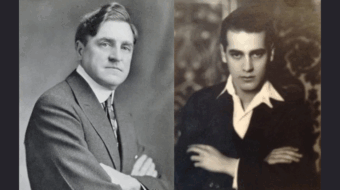
Among the underrated factors in that crusade was Merry Go Round, a brilliant stage play about the human costs of the spoils system, written by 23-year-old Yale Drama School students Albert Maltz and George Sklar. When their professors said it was the best play ever done by Yale students, the two stopped attending classes in New Haven and took their script to New York, where Merry Go Round premiered in April 1932.

The drama opens in the bellboys’ locker room of “a large metropolitan hotel” in an unnamed city. The first line spoken by Pete, a 40-year-old errand boy, sets the tone: “Well, if yuh ask me this town could stand some investigatin’.” Collusion between the mob and the mayor’s office may not have been a new phenomenon, but its daring presentation by Maltz and Sklar had a boldness, due to the youthful outrage of its co-authors, that won over Depression-era theatre critics.
The play’s chief victims are Ed Martin, 23, a handsome, hard-working hotel bellhop who works the night shift, and his wife Peggy, a tough and vibrant young woman of 22. The fact that this wholesome couple can’t get a break in 1932 certainly helped patrons identify with them. But their fate—basically they are destroyed by a tsunami of political sleaze and vice—made the play an excruciating viewing experience.
Much like the rampant and brazen corruption we are witnessing today, the executive and his ruling-party machine get their share of the grift, as do the criminals they conspire with, leaving the “little man” to be sacrificed to mammon because, from the beginning, the “fix was in.”
Beginning on the morning after its April 22 try-out performance at the tiny Provincetown Theatre in Greenwich Village, drama pundits made a forceful case for the play’s timeliness and relevance. Brooks Atkinson, chief drama critic of the New York Times, wrote, “Merry Go Round is an exciting political melodrama chiefly because of its local resemblances.” New York Journal critic John Anderson agreed, “It is a play of blunt attack and ferocious intent.”
Richard Lockridge of the New York Sun called Merry Go Round, “a play with a bite like an angry bulldog’s,” adding that the daring scriptwriters “throw their whole weight against corruption and brutality.” Robert Garland of the New York Telegram described the production as “bitter and brave” but offered a warning: “I heartily recommend it, but not to children or the tenderhearted.”

It wasn’t a play for everyone, but it was a hell of a debut for its two activist authors. In the days following the premiere, they received 12 offers to take it to Broadway. The Cort Theatre on West 48th Street gave them the best contract, and the uptown premiere of the surprise sensation was slated for Tuesday, May 3.
While the sets were being readied for the larger stage, the New York press adopted Maltz and Sklar and stayed on top of their story. On May 1, the two were the subject of a New York Times “Meet the Authors” Sunday feature portraying them as humble prodigies who accidentally took a break from their Yale lessons to casually scribble out a potential blockbuster:
“They (Maltz and Sklar) both think the theatre is most exciting when it is touching on social problems and ‘reflecting the tumult of society.’ A nice phrase that, but it seems to work. The startled telephone bell in the Provincetown Theatre, that home of embattled causes, rang bravely all last week. As for the boys, they will be going back to New Haven shortly. If the telephone calls and the tourists find their way equally well to the Cort, the sky, as the saying goes, will be the limit.”
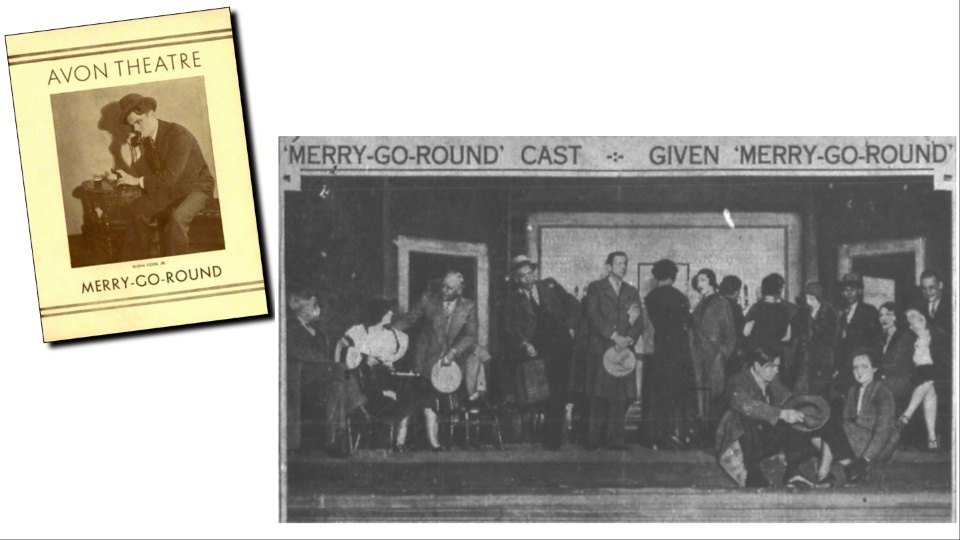
Everyone was rooting for “the boys,” but as it turned out, things had fallen almost too neatly into place. One day before the Times puff-piece appeared, the managers of the Cort announced out of the blue that they would not house the play after all. No reason was given. That Saturday afternoon, the boys’ manager Michael Blankfort seemingly saved the day; he quickly made some calls and moved the show to the nearby Avon Theatre, without even postponing its May 3 opening night.
Then things really got strange. On Wednesday, May 4, instead of a review in the Times culture section, Merry Go Round made the front page. Right under articles about Al Capone being moved to the Atlanta Federal Penitentiary and Mayor Walker’s plan to “raise city revenue” by charging fees for the filing of building plans, there appeared the following headline: “Play on Civic Corruption Halted by Police; Unrenewed Theatre License Cited as Reason.”
Patrons arriving for the show had been met at the theatre door by five policemen and several plain-clothes officers sent there to bar entrance. The “official” excuse for the play’s cancellation was that the owners of the Avon had not asked for a renewal of its license in time. But as the article noted, “Those most interested in the production hinted at political influence.” Obviously, the similarities between Merry Go Round and local politics had proved too hot to handle.
Among bystanders at the closed venue a rumor circulated that “someone” ordered the play stopped. Over the next week, however, city officials held to a different story: The theatre lacked a valid license; it was “a matter of safety,” they said. Attorneys for the Avon pointed out that five other theatres on the same block were operating without up-to-date licenses.
 Nevertheless, Commissioner of Licenses Edward Geraghty insisted on strict compliance, ordering that the building remain closed. In the New York Daily News, critic Burns Mantle fired a warning shot at both Geraghty and Mayor Walker: “If Commissioner Geraghty were wise he would license the Avon Theatre quickly and let the play go on. Otherwise people are quite naturally going to believe the playwrights’ story is inspired by facts rather than tragic fancies.”
Under the headline “Mayor Won’t Act on Closed Play,” The New York Sun declared what everyone knew: “Play Attacks Administration.” The Sun reporter noted that the great civil rights attorney Harry Weinberger had threatened to seek a writ of mandamus to compel Geraghty to grant the license. Though Weinberger was a skilled and serious First Amendment expert, Mayor Walker called this measure a “publicity stunt” while dubiously claiming that he had “no personal knowledge that the show reflects on him or his administration.”
What followed was an unusually rigorous—and unusually visible—pretend inspection. Inspectors tested scenery with open flames, pulled apart drapery, and enforced regulations that had never before been applied. Fire extinguishers were refilled in the presence of department representatives. City officials ordered more than a dozen alterations, including the removal of 50 pricey front-row seats, a change that threatened significant financial losses.

At considerable expense, the theatre’s owners complied. Within a week, the license was granted and the production was allowed to open on Tuesday, May 10. During the week of the license controversy, Maltz and Sklar were boiling with excitement, and their inexperienced agent Blankfort blurted out, “The play’s going to run forever!” All three young men, who would remain friends for a long time after, were wrong. Despite a good audience on opening night, ticket sales dwindled, and she show limped along for only about six weeks before closing.
Merry Go Round, with its signature on-stage image of an innocent man hanged in his prison cell for knowing too much, was simply too intense for Broadway audiences. But it gave its student authors the satisfaction of dominating a major news cycle, along with the intoxicating thrill of exposing Jimmy Walker’s depravity. When Walker resigned under pressure in September, many New Yorkers realized that life had imitated art. The suppression of the play was a clear case of political censorship—the first but not the last infringement on the free speech rights of its leftist authors.
An interesting sequel to the Merry Go Round saga came from a second production at Chicago’s Adelphi theatre in November 1932. This version was touted by the Chicago Tribune as “The play that foretold the downfall of New York’s Jimmy Walker and, for that honest act of prophecy, was officially bullied off the Broadway stage.”
Tribune critic Charles Collins personally objected to the play’s representation of brutal onstage torture but nevertheless touted its appeal:
“If you are a reformer it will arouse your crusader’s rage; if you are a politician or a police officer you will proclaim it an exaggeration of the facts; and if you are a merry playgoer, seeking to refresh your soul, it may depress you.”
In the Chicago Daily News, the reviewer asserted, “Incredible as it may sound, the evening was one of the most powerful in my two years of dramatics reviewing.” Moreover, the play’s significance was not limited to New York:
“Merry Go Round is unconquerable as a play because it exposes with timeliness and scorching accuracy the frequent and secret confederation between politics and organized crime . . . That it rips into New York and not Chicago is very gratifying, but it probes into some spots of Chicago’s memory that are still raw.”
As Maltz and Sklar learned later, the Chicago theatre’s benefactors had contacts among city officials and the Cook County Police Department, who made a point of inviting and sending tickets to Mayor Cermak and others in the top echelons of municipal government. Mayor Cermak, State’s Attorney-Elect Courtney, and several judges and alderman did in fact sit in rapt attention on opening night.
* * * * *
After their turn as the center of attention in both the Big Apple and the City of the Big Shoulders, New Haven seemed parochial to Maltz and Sklar. They never went back to their drama classes. Why? The Yale curriculum required total immersion in theater. Albert and George chose not to ignore the world outside the theater, where there were 15 million unemployed Americans. Maltz and Sklar wanted to write about that world, and they got to work quickly.
Over the next 15 years, they collaborated on another full-length drama and several film scripts while amassing an impressive corpus of award-winning single-authored works on progressive themes. Of course, during the Cold War they were both blacklisted, Maltz famously so as one of the Hollywood Ten. Nevertheless, their careers should inspire us in our own “anti-corruption crusade” against the slime now oozing from the Washington swamp.
On the morning after the Chicago premiere of Merry Go Round, Lloyd Lewis of the Chicago Daily News had high praise for the “searing” and “awe-inspiring” drama. What he was really describing, however, was a feature of everything Maltz and Sklar ever wrote, something especially important at a moment like the present, when tyranny appears to be in the saddle:
“Before it is half done you will think that Shakespeare was never so right as when he said: ‘The play’s the thing in which to catch the conscience of a king.’ And you, the sovereign American voter, are the king.”
* * * * *
We hope you appreciated this article. At People’s World, we believe news and information should be free and accessible to all, but we need your help. Our journalism is free of corporate influence and paywalls because we are totally reader-supported. Only you, our readers and supporters, make this possible. If you enjoy reading People’s World and the stories we bring you, please support our work by donating or becoming a monthly sustainer today. Thank you!
CONTRIBUTOR