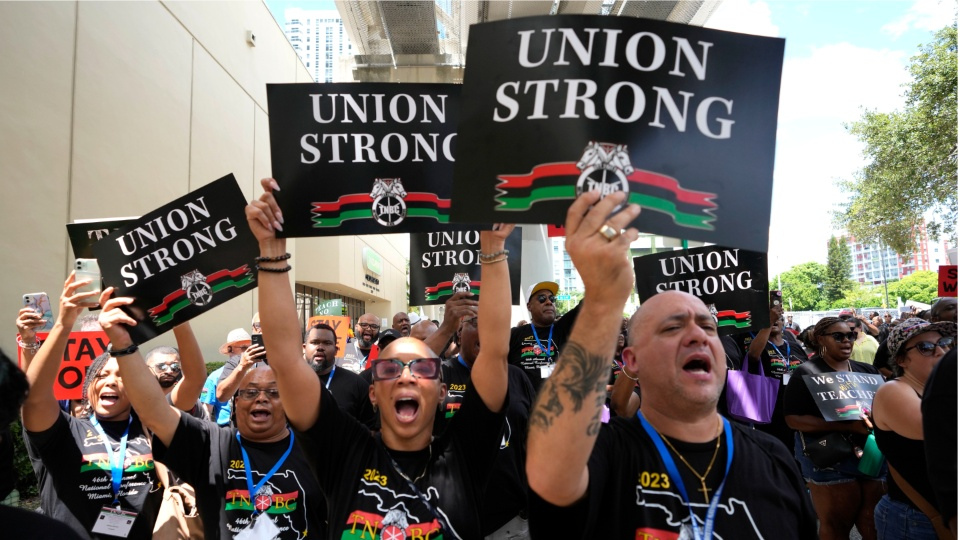
NEW YORK—After 37 years, six U.S. presidents and four union presidents, U.S. government oversight over the Teamsters has come to an end.
But the changes in the union’s structure, including making elections to top offices one-Teamster-one-vote, will remain, according to a final order the union and the U.S. Justice Department agreed to early this year and Judge Loretta Preska of U.S. District Court in Manhattan ratified on September 1.
The Teamsters were one of four unions the GOP George H.W. Bush administration pursued in 1989 using the Racketeer Influenced and Corrupt Organizations (RICO) law. The others were the Laborers, the International Longshoremen’s Association, and the Hotel Employees and Restaurant Employees, now part of Unite HERE.
Led by Rudy Giuliani, then U.S. Attorney for the Southern District of New York, the Justice Department accused the four of excessive influence by organized crime. He demanded independent monitors, independent investigations of allegations of mob influence, followed by cleanup campaigns. He threatened all four with federal trusteeship.
All four unions agreed to consent decrees to avoid trusteeship. The Laborers, like the Teamsters, had to institute one-member, one-vote balloting for senior offices, including the presidency.
In her ruling, which affects only the Teamsters, Judge Preska stated the 1.3-million-member union had put in place such strong anti-corruption controls and had been so effective at weeding out mob influence that the federal monitoring—which cost Teamsters members $4.5 million yearly from their dues—produced only three cases, all of them minor, in the last two years.
Joe Henry, a veteran Teamster and longtime reformer within the union, praised the judge’s decision. “The Teamsters have been doing this” reforming for 35 years, he added.
“But there should have been a mechanism where we could reach out to Congress to get it [the 1989 consent decree] removed long before this. We can’t call it a trusteeship, but in effect that’s what it was.
“And it’s always been about the right to elect your own leaders. That’s a very effective way to curb corruption.”
Henry made one other point: “We both know why this got done now: Sean O’Brien has a close relationship with” U.S. President Donald Trump. Trump had Teamsters President O’Brien address the 2024 GOP convention. Trump knew the power of the image of a blue-collar Bostonian on the TV podium in prime time, regardless of what O’Brien said. O’Brien urged its delegates to court, not hate, organized labor. They ignored him.
Judge Preska cited a report by Barbara Jones, a retired federal judge and the independent review officer overseeing the anti-mob hunt. Jones stated the Teamsters “developed the institutional tools, processes, and procedures necessary to adequately detect, investigate, and resolve instances of major corruption.”
“True history has been made for the Teamsters that begins a new chapter of self-governance and organizational independence to benefit all rank-and-file members and elected leaders,” union President Sean O’Brien exulted after the judge’s ruling.
“This is the end to the longest monitorship of any union, corporation, nonprofit, or public entity in the history of the United States. Our efforts over the past four years to create a culture of vigilance in our union have proven we can police our own.”
O’Brien also stated the controls “are more stringent than [on] any labor organization in the country.” Judge Preska said future corruption could be referred to the Justice and Labor Departments, not the court, “which has no intention of being an indefinite monitor.”
“This historic end to 37 years of federal oversight confirms the Teamsters have the integrity, safeguards and democratic institutions to govern ourselves,” Victor Mineros, president of Teamsters Joint Council 42, covering Nevada, Southern California, Arizona and Hawaii, told People’s World. “It marks a new era of strength, accountability and independence for every Teamster.”
Teamsters for a Democratic Union, which began decades ago as a reform caucus, posted the union’s announcement of the end of the oversight and followed with its own Q&A on the practical impact, stressing the independent monitoring for organized crime influence and corruption would remain.
“Corruption breeds cynicism, alienates our members and weakens our union,” TDU said.
The elections section of the order, which remains in place, makes the Teamsters one of the few unions to elect their top leaders by direct popular vote, not by convention delegates. Others include the Laborers, due to its own consent decree, the NewsGuild, the United Auto Workers, and both big postal unions.
Under the final decree, and in the Teamsters constitution, candidates for the union’s top two offices, President and Secretary-Treasurer, must get at least 5% of Teamsters convention votes to run in the following popular election.
At this year’s convention, only incumbent President O’Brien and incumbent Secretary-Treasurer Fred Zuckerman crossed that threshold. Each got 91.5% and were automatically re-elected. The other elections have all been contested.
In 2024, O’Brien had also asked to address the Democrats, but instead, party nominee Kamala Harris met with O’Brien, the union executive board, and selected members. Over protests from its biggest local in New York City and several regions, the Teamsters were one of the few unions that stayed neutral in the presidential race. The others backed Harris.
And O’Brien pushed former Rep. Lori Chavez-DeRemer, R-Oreg., a Teamster’s daughter, as Labor Secretary. Trump agreed. DeRemer has since resigned in disgrace.
And just recently, O’Brien endorsed Trump’s tariffs on foreign films shot for U.S. release, arguing production should stay in the U.S.
Federal oversight of the Teamsters and other unions drew protests from the AFL-CIO at least three times during the years of the now-ended prior consent decree. Its last resolution on the subject supported clean and democratic unions but pointedly noted the use of the anti-racketeering law against unions contrasted with its lack of use against corporate corruption, a pattern that’s continued through Republican and Democratic administrations.
We hope you appreciated this article. At People’s World, we believe news and information should be free and accessible to all, but we need your help. Our journalism is free of corporate influence and paywalls because we are totally reader-supported. Only you, our readers and supporters, make this possible. If you enjoy reading People’s World and the stories we bring you, please support our work by donating or becoming a monthly sustainer today. Thank you!
CONTRIBUTOR