

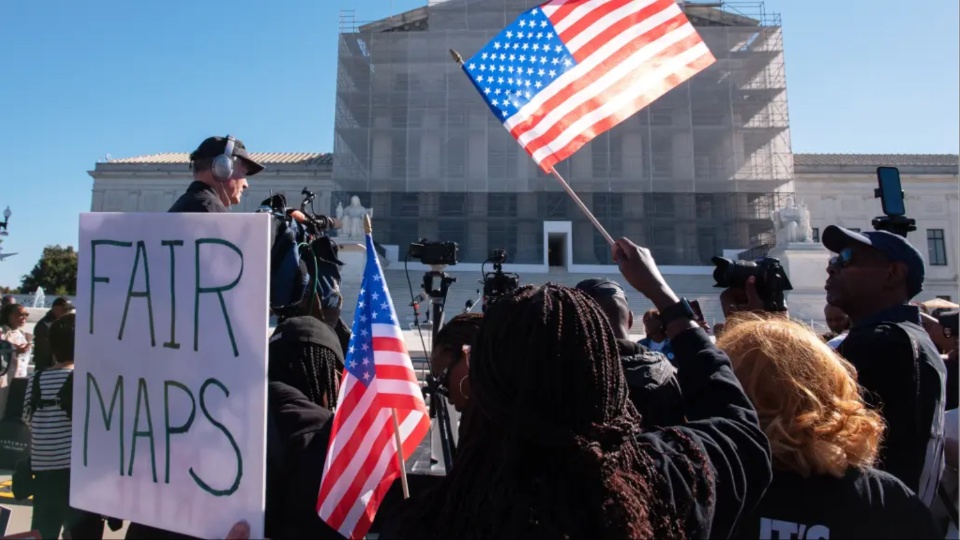
3.5% is a data point that has become popular among people who want to build a movement to defeat authoritarianism and reconstruct democracy in the United States. It comes from great research by Erica Chenowith at Harvard University on nonviolent movements for social change – work we cited in our 2024 book, White Poverty.
After studying people’s movements across the globe in different cultural contexts and at different moments in history, Chenoweth has concluded that a social movement that wins the active support of around 3.5% of a society’s population wins its demands. The prospect of organizing a hundred million voters into a moral fusion movement in the United States is daunting, but it turns out that the movement itself doesn’t need to be anywhere near that size. Because movements move people far beyond their immediate reach. By accelerating the active engagement of a relatively small portion of the population, a moral fusion movement can change the political possibilities for everyone.
It’s true. We always have more power than we realize.
But it’s also true that we all like to use numbers to reinforce what we already believe. Every number tells a story, but it never tells the whole story.
Take, for example, the authoritarian Nazi regime that controlled Germany from 1933-1945, a story we’ve spent considerable time reflecting on here this summer. The numbers are sobering. From the very beginning of Hitler’s regime, the Nazis set up concentration camps in Germany. While the first official one was at Dachau, empty basements and warehouses were re-purposed as concentration camps from early in 1933. These were not death camps for Jews. Those emerged later, and primarily on the Eastern Front after Germany invaded Poland. Concentration camps were the “re-education” centers the Nazis used to punish their opposition and instill fear in the German people. They were populated by trade unionists and Communists, Social Democrats who had held political office and clergy who objected to Nazi extremism. Most Germans interned in concentration camps were not killed, but the Nazis held hundreds of thousands of Germans in these camps.
Eric Boem, a German-Jewish man who fled Germany and served in the US Army, added up the numbers after World War II to try to understand the resistance. “Over a period of 12 years, almost 3,000,000 Germans were in and out of concentration camps and penitentiaries for political reasons,” he noted. In 1930’s Germany, that was almost 5% of the population – and that’s just the people who were arrested and detained. While those who opposed the regime were not nearly as active or vocal as many Germans wanted to claim after war, we know from the research of the German Resistance Memorial Center that many underground networks and individual acts of resistance were never detected by the Gestapo. If there were three times as many Germans who actively opposed the regime as were arrested for doing so, that would mean more Germans resisted the Nazi Party than ever joined it. (At its peak, the party had 8.5 million members.)
Still, the Nazis held power and terrorized the world, murdering more than 11 million people and waging a war that killed tens of millions more.
Whenever we pay attention to the numbers it’s clear that opposition to evil alone is not enough to stop it. By definition, authoritarian regimes do not have popular support. They instill fear, flood the public with propaganda, and try to subvert elections because they know most people do not want the policies that almost exclusively benefit authoritarians and their wealthy allies.
Good historians of the American South have long noted that most people – Black and white – did not benefit from the authoritarianism of plantation capitalism. White supremacy did not reign for centuries because most people wanted it. It stayed in power because the oligarchs who benefited from the system were successful in preventing their opposition from organizing a movement that could reclaim the tools of government.
We are the heirs of giants who figured out how to nonviolently build power that could move people from opposition to transformation. They were school teachers and beauticians, share croppers and preachers, college students and military veterans. Many of them were geniuses in their own right, but they were, as as group, neither generously financed nor especially well trained in any particular technique of social change. They were everyday people who exhibited incredible courage and used simple tools to do one thing incredibly well: they built a movement that would vote.
From the time of the first sit-ins 1960 until the major legislative changes that transformed America in the late 1960s and early 1970s, millions of new voters registered and participated in elections across the South. In Mississippi alone, Black voter participation went from 7% to 70% in a decade. It did not happen because of any one voice or one campaign. It took millions of people who opposed a regime embracing a vision that inspired them to take sustained action to build a movement that would vote.
Poll numbers suggest that the vast majority of Americans oppose the extremism that surrounds us. But opposition is not enough. We have been inviting people to organize marches to the polls in their communities ahead of the midterm elections because we know a movement that votes for a better vision of our common life is the only thing that has the power to stop authoritarianism. Wherever you are, we hope you’ll take time today to learn how you can help organize a march to the polls that will mobilize infrequent voters in your area to take back the tools of our government.
Our Moral Moment w/ Bishop William Barber & Jonathan Wilson-Hartgrove
As with all op-eds published by People’s World, the views reflected here are those of the author.
We hope you appreciated this article. At People’s World, we believe news and information should be free and accessible to all, but we need your help. Our journalism is free of corporate influence and paywalls because we are totally reader-supported. Only you, our readers and supporters, make this possible. If you enjoy reading People’s World and the stories we bring you, please support our work by donating or becoming a monthly sustainer today. Thank you!
CONTRIBUTOR




MOST POPULAR TODAY

Warnings sound: Trump ready to stage what amounts to a full-fledged coup
Workers walk: Almost 100K California employees struck for a day
Grenada marks 40 years since the assassination of revolutionary leader Maurice Bishop

As Israeli lawmaker advocates rape of Palestinians, U.N. report details detainee torture
In spring 1894, the jobless marched on Washington from every direction