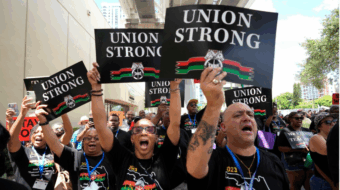
It’s Monday, September 7th, 2026—Labor Day—and the corner of Trumbull and Abbott Streets in Detroit’s Corktown is alive with celebration. Music is playing, the sun is shining, and thousands of Detroit’s workers are smiling as they rep their unions: the UAW, Teamsters, SEIU and IBEW, to name a few.
Soon they’ll be marching in the street, hundreds of locals coming one after the other, interspersed with marching bands and the roaring motorcycles of the UAW’s Solidarity Riders.
Today is the day of the worker, a time to celebrate our wins and reflect on the sacrifices made to get us where we are. We have further to go, but we ride on the waves of the past that encourage us forward. Nowhere is there a better visual reminder of that history than seeing more than 10,000 union members and supporters take to the streets on their nationally recognized day of rest.

Although Detroit has been holding Labor Day parades since 1884, today’s labor movement faces more challenges than ever in its fight to improve conditions for workers and create cross-union solidarity on a broadening slate of issues.
Among the marchers were some up-and-coming political hopefuls in the impending elections: Abdul El-Sayed (U.S. Senate for Michigan); Jocelyn Benson (the Democratic candidate for governor), and Debbie Dingell (U.S. Representative for Mich. District 6).
As the march came to an end, the parade wrapped up with a round of speeches from labor leaders, many calling for support of the candidates running for office and stressing the importance of the upcoming midterms.
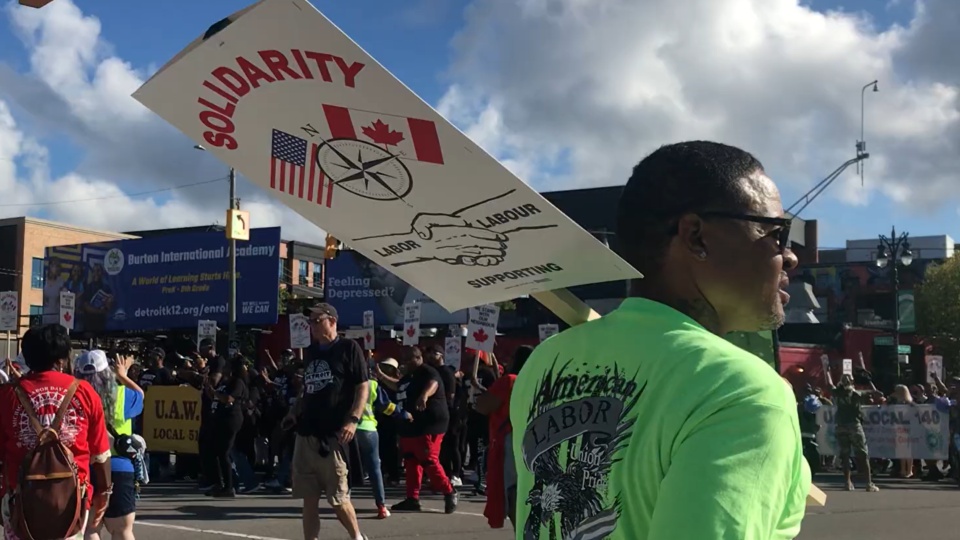
The Trump administration has placed tariffs on Canadian imports in an apparent attempt to alienate the U.S. from a key trade partner at the immense expense of the working class. These tensions were further escalated by the administration in August, when tariffs were increased to 50%, resulting in a response of equal tariffs on the U.S. from Canada. Hundreds of signs in the crowd called for solidarity between American labor and Canadian labour, highlighting a key struggle facing workers on both sides of the Detroit River.
Shawn Fain of the UAW aptly stated in his speech: “There is no question the billionaire class and the corporate class and the politicians they own want to break the labor movement. But I’ll let you in on a truth that we all know: Solidarity is the weapon they fear the most.” Several of those in the crowd wanted to make that solidarity obvious when showing support for Canadian workers.
Campus battles in Ann Arbor
About 45 miles away in Ann Arbor, labor unions—mostly associated with the University of Michigan (U of M)—gather for a picnic at County Farm Park. There’s plenty of food to share on a perfect late summer day in Michigan.
Solidarity between the many unions that exist within the university’s vast systems feels especially potent considering that as of 2024, 37% of full-time jobs in Ann Arbor were tied to the University of Michigan. That’s the same year Michigan Medicine, part of U of M’s system, recorded seeing over 5.2 million patients.
U of M routinely ranks as one of the largest employers in the state of Michigan, and none of the work it does could be accomplished without the members of unions represented at the day’s festivities.
Like the Detroit parade, Ann Arbor’s event invited a round of speeches from local labor organizers and, like Detroit, they also included elected officials and midterm hopefuls. Alethia Battles (candidate for Washtenaw Co. Probate Court judge), Rima Mohammad (currently seated and re-running Ann Arbor Board of Education trustee), and Debbie Dingell (U.S. Representative for Mich. District 6) all made remarks.
Many speakers called for support of specific local causes, such as an upcoming protest to mark the one-year anniversary of U of M’s decision to end gender affirming medical care for minors. As both a large employer and a major provider of healthcare services to residents, speakers said this represents a troubling trend of capitulation to the Trump administration’s increasing demands to roll back protections and services to vulnerable communities—including the family members and loved ones of the very workers who make this state what it is.

A stark reminder about what it means to be an organized worker in the U.S. today came from a report by Kaitlin Karmen of Graduate Employees’ Organization, the graduate student union at U of M. After years of increased tensions between GEO and the university, where the union has successfully applied pressure for improved compensation, benefits, and protections, the federal government is stepping in with a grand jury subpoena.
The order demands a shocking level of personal information related to the union and its members, including member and officer rosters, minutes for general and executive meetings, financial transactions, and the information belonging to anyone who has worked for GEO.
Although the subpoena does not explicitly state the grounds for it, it is clear this is related to members’ activities surrounding opposition to the ongoing genocide against Palestinians. It’s not the first time steps have been taken to intimidate activists of this kind in Washtenaw County.
While they face new threats from the government for what seems to be constitutionally-protected political speech, GEO is still in the midst of bargaining with the university for a new contract. Karmen says this has been going on since November, with the university now calling for “fact finding,” a conflict resolution process used when mutual agreement cannot be made between a union and employer. It is not unusual for an employer to weaponize the fact-finding process in an effort to drastically weaken a union’s bid for things like adequate pay raises.
The escalation against GEO and its members by both the university and the federal government spotlights what can happen when unions are fighting battles on multiple fronts and push for solidarity on issues extending beyond traditional workplace concerns.
What does Labor Day mean to workers?
While Labor Day has its origins in the movement, the decision to name it as the official workers’ holiday by President Grover Cleveland in 1984 was actually intended to distance the American labor movement from international solidarity with socialist and workers’ movements who had been marking May 1 as International Workers’ Day.
Specifically, the choice of the first Monday in September was meant to erase the events of the Haymarket Affair of 1886 and the fight for the 8-hour work day from labor’s consciousness, creating distance between unions and political change. But, when asked “What does Labor Day mean to you?” this is what union members at events in Michigan had to say:
“I think it stands for all of the fights and battles and progress that’s been made over centuries, over all this time. All the battles we’ve fought. All the rights we have as workers due to all that effort and bloodshed. It’s a commemoration of that fight.” – Emma Kenny, HVDSA
“I am a strong believer in community, and the necessity to talk to other unions, to talk to other workers, and to try to make the connections that are really important and not the easy connections only. It’s tougher when a union isn’t as politically engaged in issues [such as Palestine]. But those conversations are so important because, to build a really strong worker collective that actually has the power to make the changes that we need to make, you need that solidarity. You have to get people working in the right direction. You have to do political education. And it’s a hard process, but it’s a necessary one here.” – Kaitlin Karmen, GEO AFT Local 3550
“Labor Day gives us as workers a really wonderful opportunity to get together, to talk about our issues, and to build the solidarity that we need to take on the collective bosses.” – Dominique Bouavichith, USU AFT Local 284
“Labor Day, to me, means free time. One of the things that [socialism is] about is fighting for free time because capitalism is constantly trying to take our free time from us as much as possible. And so, it’s a day of rest for those who get it off. But I think that speaks to the larger problem that there’s actually tons of people who don’t have Labor Day off. [These events are] always political rather than just social as well. You’re always looking to talk to people and get updated. I would have liked to have seen more local politicians [from Ann Arbor] here.” – Dave Zeglen, LEO AFT Local 6244
“For me, Labor Day is an opportunity for us to really say thank you to the labor movement of the past to the folks who made [things like] the five-day work week [and] better working conditions, who paved the way for where we are now, but also an opportunity for us to envision where we can go next.” – Ryan Bartholomew, independent city council candidate for Ann Arbor’s Ward 3
With the link to this history enduring, where does the labor movement go marching from here? After speaking with attendees at both events and experiencing the incredible energy of those gathered, the answer seems clear: forward, together, with as much love and trust in our fellow worker as we can muster.
No paywalls at People’s World
We hope you appreciated this article. At People’s World, we believe news and information should be free and accessible to all, but we need your help. Our journalism is free of corporate influence and paywalls because we are totally reader-supported. Only you, our readers and supporters, make this possible. If you enjoy reading People’s World and the stories we bring you, please support our work by donating or becoming a monthly sustainer today. Thank you!
CONTRIBUTOR