PARIS—“I’m always on the side of the people, of those who fight to defend their livelihoods, of those fighting for the dignity to feed their children and pay their bills,” declared Fabien Roussel, national secretary of the French Communist Party (PCF) to a crowd of thousands last weekend. “I know which side I am on when there are barricades.”
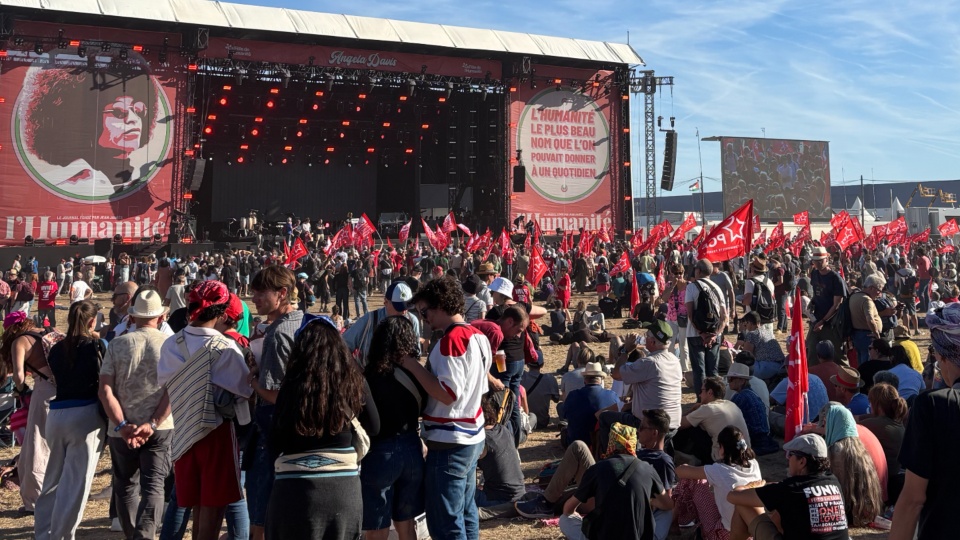
Roussel spoke at the 91st edition of Fête de L’Humanité, the festival of the PCF-affiliated daily newspaper L’Humanité, held from Sept. 11 to 13. The event drew over 500,000 people from across France and around the world for festivities, music, and political discourse and was the venue at which Roussel officially declared his candidacy for the French presidency in 2027.

The theme of the festival recalled the 1936 declaration of the Popular Front, a broad anti-fascist coalition of Communist, Socialist and democratic forces united against the rise of fascism in Europe. Through mobilization of unions, mass demonstrations, and electoral struggle, the Popular Front defeated an insurgent far-right movement.
Holding the government accountable to its election promises, unions and workers continued to mobilize and agitate for their demands, winning the cornerstones of modern labor and democratic rights in France.
Facing the renewed threat of a far-right parliamentary majority in snap elections in 2024, France’s major union federations united to call for the formation of the “New Popular Front (NFP),” by which left-of-center forces would field a single unified parliamentary list and a shared political program. The previous alliance had broken down during the European Parliament elections, prompting French President Emmanuel Macron to dissolve parliament despite the threat of a far-right takeover.
The NFP—composed of the Communist Party (PCF), the Socialist Party (PS), the populist France Insoumise (LFI), Greens (EELV), and other minor parties—won an upset victory and a plurality in the National Assembly, denying a majority to both the fascist National Rally (RN) and Macron’s neoliberal allies.
However, the alliance was unable to install its consensus candidate for prime minister nor counter-balance the immense power of the French presidency, leading to the current period of political instability, austerity, militarization, and rising far-right sentiment.
With the next presidential elections now on the horizon, RN leader Marine Le Pen—convicted of embezzlement along with dozens of other party leaders, but allowed to run due to legal technicalities—stands as a clear frontrunner in recent opinion polls.
By returning to the iconography of the Popular Front, the Fête de L’Humanité, organized jointly by the PCF and L’Humanité, demonstrated the path out through a broad unity of forces under working-class leadership.
The festival
The festival grounds were packed with stalls for vendors, every PCF regional chapter in the country, political allies of the popular front, and a large portion dedicated to delegates from international organizations.
Stages named for Angela Davis, Nina Simone, and Josephine Baker hosted the musical talents of many Black, LGBTQ+, and activist artists. Meanwhile, the festival’s streets and stalls were filled with fresh food, impromptu performances of karaoke and dance, carnival attractions, and more.

Smells of French cheeses, Senegalese poulet yassa, Sudanese lentil stew, and countless other staple street foods wafted through the breeze. The sounds of different instruments and musical traditions swirled, while spontaneous marches carried them through the crowds.
The festivities and politics were inseparable. Stands of the PCF not only raised money for the party itself but for various solidarity efforts underway in their federations. The CGT, one of France’s largest unions, held debates and circulated organizing information in a massive central space, often attracting curious passers-by carrying food and drinks.
Singers and dancers would use breaks in their sets to appeal for the protection of Black and transgender lives or to start chants of “Free Palestine” in the crowds.
Numerous nonprofit and issues organizations aligned with the popular front were also in attendance, including a range of LGBTQ+, environmental justice, and civil rights organizations. Some volunteers issued flyers to attendees highlighting a “right-to-kill” law, recently approved by the French legislature, that would give police across the country a higher degree of discretion when carrying out shootings and far less scrutiny in court.
Others shared graphics with ways to support Cuba against the U.S. blockade, information about the closure of local hospitals, and pamphlets on new domestic agricultural initiatives. The PCF, often a political anchor for these efforts, was featured as part of various coalitions on much of the literature.
The unfolding economic crisis
Hot on the minds of PCF members and festival-goers were the questions of France’s increasingly militarized economy, economic dependence on the United States, and its relationship to the rest of the world.
France is undergoing a process of deindustrialization, with the outsourcing of certain industries beyond the borders of the European Union, and a rebalancing of existing production within the EU to suit prevailing transnational monopolies.
At the same time, in its attempts to shore up falling rates of profit across existing domestic industries, the Macron government has waged a fierce assault on workers’ rights. Its forced passage of a regressive pension reform in 2023 sparked general strikes which brought millions into the streets. Though some elements of its implementation are temporarily stalled, France’s unions are continuing the struggle to restore and advance social guarantees for workers.

Meanwhile, France’s large network of nuclear reactors have turned the country into an energy creditor within the EU, prompting massive private investments into energy-intensive military production and AI development. With the support of Macron, data center and AI development companies in France have received over $108 billion USD in foreign capital investments from conglomerates primarily based in the United States, Japan, the UAE, and the EU.
The Macron government has welcomed these investment proposals, despite their ecological and political consequences. Though the French extreme right favors the subordination of France to U.S. imperialism and militarization, the RN has voiced opposition to data centers on opportunistic and populist grounds.
As some PCF members emphasized, these AI and military investments, as well as their attachment to the American dollar and general purchasing power, challenge France’s economic sovereignty while destabilizing its politics.
At the same time, they noted that neocolonial policies upheld by both liberal and conservative governments in France have undermined self-determination of other countries around the world, from across the African continent to Kanaky (New Caledonia), French Guiana, and other overseas territories. The anti-colonial movements in these regions work closely with the PCF, including through a shared parliamentary group in the National Assembly.
A “communism of conquests”
On the second day of the festival, more than 40,000 attendees packed into the lawn of the Angela Davis stage for Roussel’s address. Flanked by dozens of party leaders, he lambasted the military and economic policies of the Macron government, highlighted the need to nationalize key sectors of the French economy, and called for international solidarity with countries waging a fierce struggle against imperialism—Cuba and Palestine, in particular.
Roussel was nominated to run in the presidential election by the 40th Congress of the PCF on the line of a “communism of conquests” laid out in the Congress’s main programmatic document. His candidacy is an expression of party unity, mobilizing party members, chapters, elected representatives, and their allies towards a common platform and goal.
His 2022 presidential bid secured more than 800,000 votes (2.3%) and was the first time in 15 years that the party had fielded an independent presidential campaign.
Roussel emphasized that the presidential campaign is far from the only focus of the PCF, though. At the festival and in days following, he reiterated the call for mass street demonstrations against the Macron government and for the declaration of a state of emergency over the growing pressures on the country’s energy sector.
Calls for unity, moments of tension
Though Roussel headlined the festival’s program, several other presidential candidates, as well as parties intending to field their own candidates, were also present. Jean-Luc Mélenchon, the leader of LFI making his fourth bid for the presidency, drew a large crowd for a speech on the opening day. Mélenchon currently polls in second place, behind Le Pen and narrowly ahead of neoliberal candidates.
The PS, which is organizing a primary of center-left candidates and receiving double-digit support in polls, also maintained a presence at the festival. Presidential candidates of the EELV and minor Trotskyist parties also made appearances throughout the three days.

The presence of such a broad range of political organizations sparked moments of conflict. Some activists from the LFI staged a protest outside of the PS stall. Others led chants against Roussel and the PCF, which was rebuked by PCF members and some significant LFI representatives themselves.
The relative crowd sizes for Roussel and Mélenchon became a subject of controversy among activists on social media after LFI members posted side-by-side images of a portion of Roussel’s audience before the commencement of his speech and aerial images of Melenchon’s tent in the middle of the festival. This was even picked up by local news media outlets when LFI members scurrilously accused the PCF of using AI to fabricate pictures of the crowd.
A window of hope
Despite points of tension, the message of unity against fascism carried forward by the PCF, L’Humanité, and a range of headlining musical acts that brought hundreds of thousands together at many times throughout the festival.
During concerts, thousands of attendees wearing Roussel shirts and Mélenchon jerseys joined together for chants of “Siamo tutti antifascisti!” (“We are all anti-fascists!”) while waving Palestinian and Kanaky flags. The closing event, with the message of advancing shared working-class demands and defeating the fascist right, packed hundreds of thousands around the Angela Davis stage.
A sense of optimism prevailed in smaller moments, too. Children darted through the crowd during Roussel’s speech, playing games together while their parents chanted and cheered. In the form of raised fists, smiles, hugs, and handshakes, solidarity traveled from one corner of the country to another and across languages, borders and seas.
As the PCF, L’Humanité, the CGT, and other progressive forces look to next year’s elections and after, the festival made clear that the spirit of working-class unity is here to stay.
No paywalls at People’s World
We hope you appreciated this article. At People’s World, we believe news and information should be free and accessible to all, but we need your help. Our journalism is free of corporate influence and paywalls because we are totally reader-supported. Only you, our readers and supporters, make this possible. If you enjoy reading People’s World and the stories we bring you, please support our work by donating or becoming a monthly sustainer today. Thank you!
CONTRIBUTOR