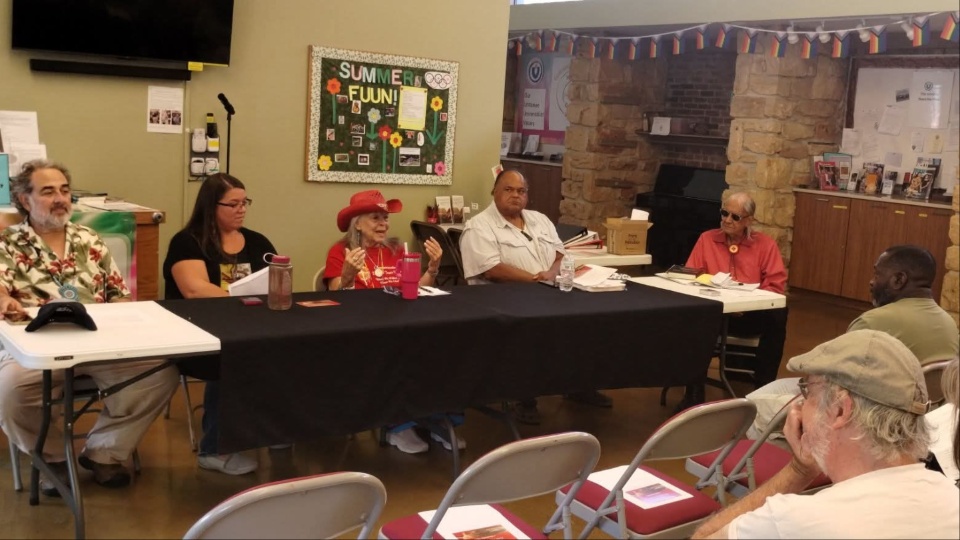
NASHVILLE—The Indigenous Peoples Coalition (IPC) on Sept. 12 commemorated 250 years of Indigenous resistance in the United States and recognized Tennessee as the birthplace of that fightback. The meeting began with a presentation on the Cherokee War that began on July 20, 1776.
The gathering was well attended by Indigenous, Black, and white participants and featured a panel discussion that included Melba Checote-Eads, a citizen of the Muscogee Creek Nation and a longtime resident of Middle Tennessee; Sabrina Buer, Cherokee and Shawnee, a member of the American Indian Movement (AIM) and a professor at Tennessee Tech University; Larry Davis, community activist of Cherokee descent and a member of the IPC from Lewisberg, Tenn.; and Paulino Solorzano of Indigenous Nicaraguan heritage and also a member of the IPC.
The purpose of the meeting was to recognize Tennessee as the birthplace of two-and-a-half centuries of indigenous resistance and to chart a path forward to confront the current politics of the Trump administration. The commemoration featured an analysis of the Cherokee War and its causes.
The Cherokee War began in East Tennessee and was the first so-called “Indian War” fought by the newly minted United States against an Indigenous nation. It began just two weeks after the Declaration of Independence was signed on July 4, 1776.
The cause of the war was the illegal encroachment by thousands of white squatters on Cherokee land in violation of treaties with the colonial governments. Cherokee leadership had made numerous complaints to the colonial governments demanding the removal of the squatters to no avail. The war began as an eviction action.
The Cherokee Nation sent eviction notices to the offending settlers giving them 40 days to relocate. After the notice period had expired, the Cherokee leadership sent war companies headed by the redoubtable Dragging Canoe to evict the squatters.
The Cherokee forces were attacked by the squatters, and the war was on. It continued for 18 long years and has been called not only the first but also the longest “Indian War” in American history. It was noted that the War reached Middle Tennessee, enveloping the environs of present-day Nashville, when white settlers invaded the area in December 1779.
Each panelist gave a poignant presentation. Checote-Eads spoke of the tragic history of the Muscogee Creek Nation, highlighting the travails of the colonial era. Buer noted the repressive, recent laws of Tennessee to suppress the teaching of truthful and factual history.
Davis recounted the racism of the rural area where he resides and the atrocious actions of ICE in his county, a mere 50 miles south of Nashville. His account made it sound like parts of rural Tennessee were untouched by the civil rights movement of the 20th century. Solorzano spoke with emotion advocating for greater involvement in current struggles.
The discussion next revolved around how best to confront the current political crisis. There was great animation from the participants when the prospect of the collapse of the United States was presented. The meeting concluded by the forming of an Ad Hoc Action Committee that was committed to demonstrations, meeting with public officials and political bodies, and further addressing social justice issues both locally and nationally.
No paywalls at People’s World
We hope you appreciated this article. At People’s World, we believe news and information should be free and accessible to all, but we need your help. Our journalism is free of corporate influence and paywalls because we are totally reader-supported. Only you, our readers and supporters, make this possible. If you enjoy reading People’s World and the stories we bring you, please support our work by donating or becoming a monthly sustainer today. Thank you!
CONTRIBUTOR