This week, eight months after he’d gone out to get some diapers for his children, Martin Soto finally came home. A Peruvian father seeking asylum in the US, Soto had no criminal record or arrest warrant. He was kidnapped by masked men and put in a concentration camp where guards served him maggot-filled food. Soto organized a hunger strike inside Delaney Hall in Newark, New Jersey, while he wife, Gabriella, helped build a community outside of people who refused to accept the abuse of power that ICE continues to carry out in our names. On Labor Day, I talked with Gabriella at the People’s Vigil outside Delaney Hall.
As Americans begin to go to the polls for early voting, Gabriella’s clarity is needed: if you’re pro-family, then you should keep families together.
Every Republican member of Congress voted to fund the extreme enforcement operations and construction of concentration camps that tore Gabriella’s family apart this year. It’s important to recall how dramatically Republicans have turned against immigrants in recent history. As the standard bearer of the GOP at the end of the 20th century, President Ronald Reagan said, “Our nation is a nation of immigrants…. I believe in the idea of amnesty for those who have put down roots and who have lived here even though some time back they may have entered illegally.” As recently as 2010, Richard Land, who served as spokesperson for Southern Baptists on issues of public policy, spoke in favor of outreach to immigrants, saying, “Hispanics are religious, family-oriented, pro-life and entrepreneurial. They are hard-wired social conservatives unless they are driven away.” Even within the religious and political alliance that used the culture wars to pit Christians against their “secular” and “liberal” neighbors, immigrants were, until recently, often framed as potential allies.
So what changed? An honest look back at the politics of immigration in 20th century America reveals that, despite a pro-immigrant consensus among political leaders, a backlash against the browning of America has been building for a long time. Just as the moral outcry against racism in the 1960s led to greater protections for African-Americans in the Voting Rights Act of 1965, so too did the political climate of the 1960s produce the Immigration and Nationality Act, which was signed by President Johnson the same year. Since the 1920s U.S. immigration policy had been based on an explicitly racist quota system, which limited immigrants from many non-white countries based on perceived dangers to the “American” gene pool that had been identified by the pseudo-science of eugenics. White supremacy was written into American immigration codes just as much as it was made law in poll taxes and literacy tests. Many of the same organizations that opposed Brown and the Voting Rights Act also began to develop a case against immigration as soon as the 1965 Immigration Act became law.
Founded in 1937 by champions of eugenics, the Pioneer Fund was one avenue through which this backlash against immigration was organized. While its resistance to integration was based on a well-documented belief in the inherent inferiority of African-Americans, the Pioneer Fund worked hard to distance itself from an explicitly racist past after the 1960s. By the late 1970s, it began investing in the Federation for American Immigration Reform (FAIR), a network founded by retired ophthalmologist John Tanton to preserve American culture via a “European-American majority.” While Tanton often met with Ku Klux Klan leaders and avowed white nationalists, he was careful to make his case against immigration in terms of culture, not race. Indeed, Tanton’s crusade against immigrants was always about the culture wars.
The terrorist attacks of September 11, 2001, created an opportunity for Tanton’s FAIR network, which by then included a think-tank, the Center for Immigration Studies, and a lobbying arm, NumbersUSA, to play on the fears of Americans who felt vulnerable. Despite the fact that the Saudi Arabian members of Al Qaeda who carried out the attacks on the World Trade Center and the Pentagon were clearly driven by an extreme ideology, many Americans who had little experience with Muslims or other immigrants saw in both groups a broader potential threat. When, just seven years later, the fragile pro-immigrant consensus of the post-civil rights era elected America’s first black President—Barack Hussein Obama, whose father was from Kenya—anti-Black, anti-Muslim and anti-immigrant sentiments combined to create a reactionary populism that would turn the Republican Party against immigrants. Two resources proved essential to the extreme-right coalition that formed to take control of the party: one was the anti-immigrant policy agenda that had been created by Tanton’s FAIR network. The other was the myth of a so-called “Christian nation.”
No single person has been more committed to making the case that America was founded as a Christian nation than political activist David Barton. “For the past thirty years,” evangelical historian John Fea writes, “Barton… has provided pastors and conservative politicians with inaccurate or misinterpreted facts used to fuel the Christian Right’s politics of nostalgia.” If nostalgia for the culture of an America controlled by white men was to be socially acceptable, social conservatives since George Wallace had known they had to talk about culture, not race. But Barton offered them a way to frame nostalgia for white culture as the longing for an American past that never was.
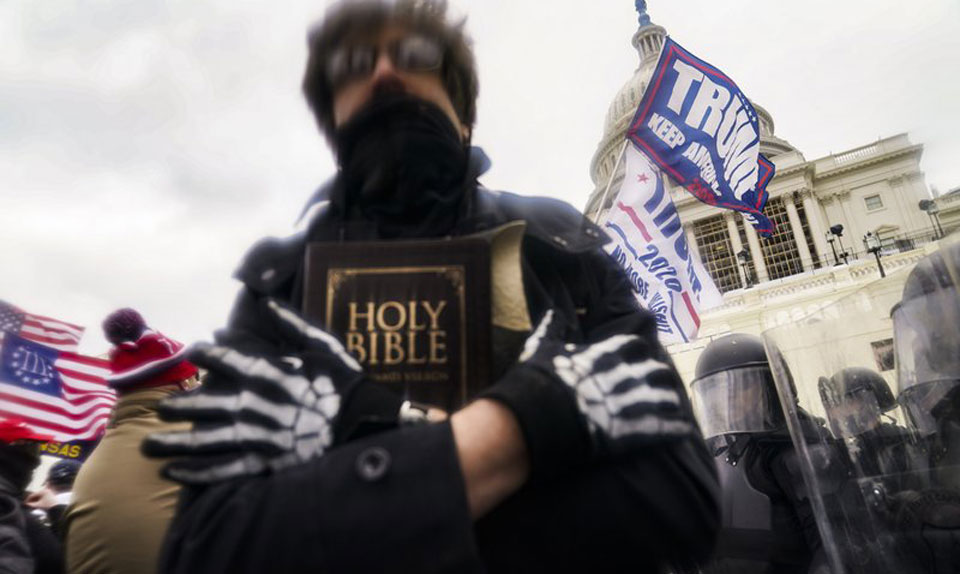
It’s no accident that Barton calls the LLC he founded to sell his message in multimedia formats through conservative religious broadcasters and Christian homeschooling networks “WallBuilders.” Long before the Trump campaigned on the promise that he’d build a wall across the Southern border of the U.S., Barton had baptized the anti-immigrant sentiment as a monument to Christian nationalism. Just as Nehemiah was called to rebuild the walls of ancient Jerusalem, Christian nationalists imagined a wall on America’s Southern border as a concrete act to restore a Christian nation.
If “Make America Great Again” really meant stemming the tide of demographic changes that had begun with the social winds of the Civil Rights Movement and the swell of non-white immigrants after 1965, that wasn’t how people steeped in the Religious Right heard it. When they shouted “Build that Wall!” they weren’t thinking about the electoral future Republican operatives feared so much as the mythical past Barton and others had taught them to imagine.
It wasn’t images of the Soto family separated by ICE that animated them. It was, instead, the memory of Mayberry, where Andy Griffith sat on the front porch strumming his guitar and singing the hymns they’d all learned growing up in church. Religious nationalism made xenophobia palatable by making it the necessary condition of standing up for values that were supposedly under threat. The irony, of course, was that if anyone from Mayberry had ever had the chance to get to know Martin and Gabriella, they would have found they had far more in common with them than they did with political operatives like John Tanton and David Barton, who rarely associated with the “common folk” of small town, rural America who they claimed to defend.
One reason many white evangelicals in the Republican Party’s conservative coalition held out so long against the nativism of Tanton’s FAIR Network is that the Bible speaks so directly about God’s concern for immigrants. While an issue like abortion or voting rights isn’t directly addressed in Scripture, there are literally dozens of texts in the Bible about how we should treat the immigrant, alien, or stranger among us. In fact, after the identity that comes from being people called into covenant with the Creator of the universe, the fact that we are immigrants is probably the second most fundamental identity statement about the people of God in Scripture.
The Bible doesn’t exhort us to welcome immigrants simply because it is the ethical or just thing to do. God’s people welcome immigrants as a way of remembering that we, too, were once in the same situation. “The foreigner residing among you must be treated as your native-born,” the legal code of Leviticus says. “Love them as yourself, for you were foreigners in Egypt.”
But in American history there is a long tradition of exegesis to explain away the Bible’s inconvenient truths. When the revivals of the Second Great Awakening first burned across the American South, many white people who experienced God’s saving grace alongside Black people—sometimes even from the mouths of Black preachers—saw that the same God who brought Israel out of bondage in Egypt had made a new reality possible in Christ. As Paul wrote to the Galatians, “there is no longer… slave or free… for we are all one in Christ Jesus.” (Gal 3:28). But this plain truth of Scripture, which animated a moral movement for the abolition of slavery in the 19th century, also challenged the systems that most people considered normal life in the antebellum South. “If slavery be a sin,” a Mississippi preacher wrote in 1836, “then, verily, three fourths of all the Episcopalians, Methodists, Baptists and Presbyterians, in eleven states of the Union, ‘are of the devil.” Plantation owners paid a host of biblical scholars and preachers to write sermons, pamphlets and books that assured white Southerners that they were, in fact, the true Christians.
Today’s “Christian nationalism” draws on this tradition of slaveholder religion to read the Bible in defense of an anti-immigrant policy agenda. Quoting a song from Deuteronomy about God’s faithfulness to Israel after the Exodus, David Barton has argued that when God “set the boundaries of the peoples according to the number of the sons of God” (32:8) in the ancient Near East, a divine blessing was also bestowed upon the borders of the United States and the laws that currently regulate them. Barton doesn’t explain why God’s will wasn’t transgressed when the United States fought a war with Mexico to establish the current boundary or, for that matter, when European settlers first took the land from its indigenous inhabitants. He borrows a line from Moses as a proof text for FAIR’s talking points.
But this so-called “Christian nationalism” can never be dismissed as simply the ignorant reading of sloppy exegetes. Like the slaveholder religion that preceded it, the anti-immigrant movement has scholars who have done their homework. Old Testament professor James Hoffmeir, who has taught at both Wheaton College and Trinity Evangelical Divinity School, wrote an entire book on the “immigration crisis,” in which he claims to offer a balanced assessment of “both sides.” He goes on to make an historical argument that the Hebrew word ger, which is variously translated in English as “stranger,” “alien,” “sojourner,” and “foreigner,” cannot mean “illegal immigrant” because, in the ancient world, the ger always had permission to dwell in another’s land. But Martin Soto did have permission to pursue asylum in the US. This didn’t help. Having used the Bible to justify their attack on immigrants, those who claim to defend family values are, as Gabriella noted, separating families.
Christian nationalism is a heresy not only because it makes people mean to neighbors we’re called to love, but also because it reinforces a nativism that lies about who we are. In the Bible’s prophetic witness, this idolatry is explicitly connected to public policy that hurts immigrants, widows, and children. God cries out against the political violence that always accompanies the idolatry of nationalism: “You city that brings on herself doom by shedding blood in her midst and defiles herself by making idols… See how each of the princes of Israel who are in you uses his power to shed blood. In you they have oppressed the foreigner and mistreated the fatherless and the widow” (Ez. 22:3, 6-7).
In the New Testament, Jesus embodies this prophetic witness when he teaches in Matthew 25 that we welcome Him—God in human flesh—when we welcome the stranger. Christian nationalists often dismiss this text and the broader prophetic witness by claiming that care for immigrants, like works of charity for “those less fortunate than ourselves,” are individual responsibilities, not the work of governmental policy. So Matthew 25 doesn’t inform their public policy agenda. But Jesus explicitly confronts the idolatry of policy violence in Matthew 25 when he says nations will be judged (v.32) by how we treat the stranger, the hungry, the sick and imprisoned.
In Luke 4, when Jesus offers his first sermon in his own hometown, the texts says that “all spoke well of him and were amazed at the gracious words that came from his lips” (v.22). His message, from the prophet Isaiah, had been about the fulfillment of God’s promises. But Jesus doesn’t bask in the praise of an approving hometown crowd that assumes those promises are for them. Instead, he tells two stories from I and II Kings about how, in Israel’s history, foreigners had received God’s blessings when the native born had been faithless. “When they heard this,” Luke records, “all in the synagogue were filled with rage” (28). The violence of religious nationalism isn’t new. Jesus’ neighbors tried to throw him off a cliff when he confronted their nativism with an alternative political memory.
But this memory of God blessing outsiders fosters a radical hospitality in Scripture that exhorts followers of Jesus’ Way to “show hospitality to strangers, for by so doing some people have shown hospitality to angels without knowing it” (Heb.13:2). This welcome is never offered out of paternalistic largesse; it flows, rather, from an expectation that God’s messengers are people like Matin and Gabriella Soto. They come to us not because they need our help, but because we need to learn with them what it means to be a community where all can be well.
This fall, they are here to teach us that the people who say they are pro-family cannot be trusted with the power of a seat in the U.S. Congress.
Our Moral Moment w/ Bishop William Barber & Jonathan Wilson-Hartgrove
As with all op-eds published by People’s World, the views reflected here are those of the author.
We hope you appreciated this article. At People’s World, we believe news and information should be free and accessible to all, but we need your help. Our journalism is free of corporate influence and paywalls because we are totally reader-supported. Only you, our readers and supporters, make this possible. If you enjoy reading People’s World and the stories we bring you, please support our work by donating or becoming a monthly sustainer today. Thank you!
CONTRIBUTOR