

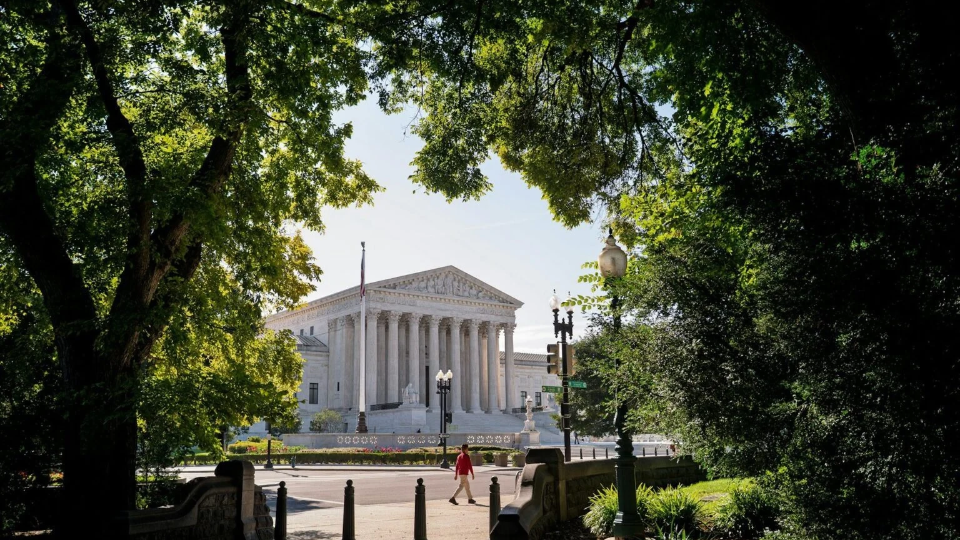
WASHINGTON—Three of the nation’s largest unions—the Teachers/AFT, the National Education Association and the Service Employees—are siding with the state of Colorado in a Supreme Court case involving a Catholic preschool there, and two parents, who demand that it be allowed to discriminate against LGBTQ kids on the basis of religion, and still get state funds.
And the two teachers’ unions also warn that if a pre-school can use freedom of religion to discriminate against LGBTQ kids, it sets a precedent for similar discrimination by other government programs and in other states.
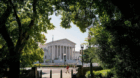
St. Mary Catholic Parish v. Lisa Roy—Colorado’s Department of Early Childhood Education director—which the justices will tackle on Election Day, tests whether freedom of religion, including using it to discriminate, overrides other rights in the U.S. Constitution.
If past is prologue at this Supreme Court, the answer from the six-justice GOP-named majority is likely to be “yes.” In prior cases involving freedom of religion versus other rights, the majority has ruled for religion over all.
This case involves the St. Mary’s Catholic preschool in Littleton, Colo., and Colorado’s program offering state-paid tuition for pre-K kids. But to get the tuition subsidy, a preschool must sign a non-discrimination agreement. The agreement commits the preschool to not discriminate against children based on race, ethnicity, religious affiliation, sexual orientation, gender identity, lack of housing, income, or disability of the kids or of their parents.
St. Mary’s and two parents want the subsidy for their 4-year-old daughter anyway, even though the preschool explicitly says it will not admit LGBTQ kids, and even though the parents object to having their daughter sit in the same classroom with them. Forcing her to do so, the parents say, would violate their freedom of religion to raise her according to the tenets of their faith.
The GOP Donald Trump administration’s base hates LGBTQ people. The administration itself sides with the preschool and the parents. Its Justice Department will join St. Mary’s and the parents in the November 3 oral argument. The three unions side with Colorado. AFT and NEA filed their own joint friend-of-the-court brief, and SEIU signed onto one authored by the National Women’s Law Center.
Unions, interested organizations and lawmakers often file friend-of-the-court briefs to show the justices where they stand on a particular controversy. The jurists occasionally cite them in either oral argument or in their written rulings or dissents. The U.S. Conference of Catholic Bishops filed a friend-of-the-court brief siding with St. Mary’s, although 27 prominent Catholic lay parishioners filed their own brief siding with Colorado, for example. Right-wing interest groups sided with St. Mary’s.
The NAACP and the NAACP-LDF—its legal defense fund, which beat Jim Crow in Brown vs Board of Education in 1954—also sided with Colorado. Their friend-of-the-court brief reminded the justices of the history of using private schools to discriminate against Black people.
NEA and AFT contend St. Mary’s demands the justices “compel Colorado to fund preschool providers who refuse to comply with state law. Colorado’s universal preschool program (UPK) asks only that those who accept public funds abide by the same rules as everyone else, including providing equal access to all children regardless of sexual orientation or gender identity.”
The two unions also point out St. Mary’s is free to discriminate if it doesn’t take the subsidies. But that undermines the goal of universal education for pre-K kids, the brief notes. So St. Mary’s “seeks a special waiver from those [nondiscrimination] requirements.
“In practical terms,” St. Mary’s and the parents seek the right to get the pre-K subsidy “while denying services to three- and four-year-old children because of their or their parents’ identities. Nothing in the Constitution requires Colorado to abandon its interest in universal access to preschool and instead subsidize such discrimination that directly contradicts that interest.
“Anti-discrimination laws enable the state to remove obstacles—such as discrimination in admissions—that can prevent the most vulnerable students” from getting an education. Since the subsidies are available to both public and private schools, the state is “furthering the fundamental goal of publicly funded education open to all,” the two unions stated.
The two big educators’ unions also point out that if the justices open the door to discrimination in the name of freedom of religion in a pre-K school, it’s a precedent to using the same reason to justify discrimination in other government programs—and by other states.
Allowing discrimination by gender status “would undermine the ability of the state to enforce laws protecting the civil rights of its citizens and would threaten a host of other government-funded, mixed-delivery programs,” open to public and private institutions and enterprises. “In Colorado and elsewhere, many” mixed-delivery programs “contain similar nondiscrimination requirements.
“If religious entities have an unconditional right to public funds free of neutral, generally applicable rules the government may impose, such programs will become untenable, and states will pull back from them,” the two unions warned.
Thirty-eight constitutional and education law scholars joined the two unions in their friend-of-the-court brief. The scholars “believe strongly in upholding a proper role for courts in enforcing constitutional rights where majoritarian democratic processes may have caused violations of the rights of disfavored minorities,” the brief said. In plain English, if lawmakers permit discrimination, courts should step in and stop it.
“All preschools are welcome to participate in UPK,” the universal pre-K state subsidy program, says the National Women’s Law Center brief, which the Service Employees joined. “They retain their autonomy to hire the staff they choose and to teach the curriculum they prefer, including religious practices and tenets. Preschools that do not wish to participate may operate independently without receiving state funding and without complying with UPK’s requirements.”
St. Mary’s “argue(s) a provider that accepts public funds designated to expand preschool access for all children should be permitted to exclude a four-year-old, or any other child, merely because of how that child’s family is structured. Their position flies in the face of the Colorado legislature’s intent in enacting UPK to ensure universal access for all children.”
The NAACP reminded the justices not just about Brown vs Board of Education, which outlawed segregated schools—and segregation in general—as unconstitutional, but about a 1983 decision involving right-wing Bob Jones University, a Christian evangelical institution that banned Black people until 1971 and after 1975 banned those Black people with a spouse or significant other of a different race.
In that case, the justices ruled, 8-1, that because Bob Jones discriminated by race, the IRS could yank its status as a tax-exempt institution.
“It would be wholly incompatible with the concepts underlying tax exemption to grant tax-exempt status to racially discriminatory private educational entities,” the justices ruled then.
“Religion has long been used as a purported justification for invidious discrimination of all types, including racial discrimination,” the NAACP’s brief told the justices for this case. The justices “repeatedly recognized the government can restrict unlawful discrimination even if that discrimination comes cloaked in religious garb.
“Religious justifications do not allow business owners and other actors in the economy and society to deny protected persons equal access to goods and services under a neutral and generally applicable public accommodations law.”
No paywalls at People’s World
We hope you appreciated this article. At People’s World, we believe news and information should be free and accessible to all, but we need your help. Our journalism is free of corporate influence and paywalls because we are totally reader-supported. Only you, our readers and supporters, make this possible. If you enjoy reading People’s World and the stories we bring you, please support our work by donating or becoming a monthly sustainer today. Thank you!
CONTRIBUTOR

MOST POPULAR TODAY

Warnings sound: Trump ready to stage what amounts to a full-fledged coup

Workers walk: Almost 100K California employees struck for a day

Grenada marks 40 years since the assassination of revolutionary leader Maurice Bishop

In spring 1894, the jobless marched on Washington from every direction
NEA, AFT, SEIU join Colorado to fight discrimination against LGBTQ people