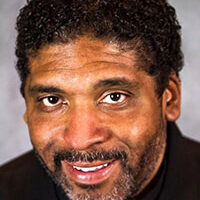
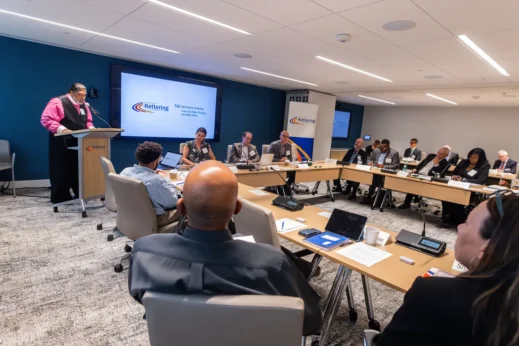
On Monday of this week, we joined a diverse group of religious leaders outside the White House to launch A Pledge for Moral Defiance. This campaign grew out of a gathering of national religious leaders that Bishop Barber convened at the Kettering Foundation in Washington, DC, this summer, where representatives of national denominations and religious bodies heard from some of the world’s best scholars of authoritarianism and religious nationalism, then deliberated together about what this means for our communities. Jonathan led a drafting committee to turn the group’s thoughts into “An Encyclical On Our Authoritarian Crisis,” which is being sent to the local congregations of all the national religious bodies this week as a teaching document to encourage people to understand this moment and join the pledge.
Any visitor to our nation’s capital in 2026 can see that something has changed. When we gathered there this summer – and again when we were outside the White House on Monday, we witnessed uniformed officers of the National Guard patrolling the streets and parks. The White House is obscured by temporary fencing and barriers, suggesting a state of emergency. Propaganda banners hang from federal buildings, bearing the image of the sitting President as if he were the lifelong ruler of a totalitarian regime.
These visual cues are more than mere symbols; they are signs of radical changes in the policy and practice of our government. The executive branch has ignored the power of Congress to levy tariffs and make war, and Congressional leadership has conceded to these abuses of power. The Supreme Court has ruled that the Voting Rights Act is no longer needed, and state legislatures have responded with gerrymanders designed to take seats from Black and Brown representatives in the American South. The President’s personal lawyer has been confirmed as Attorney General by the US Senate and the Department of Justice has ceased to prosecute corruption, instead targeting the perceived enemies of the administration. Immigration and Customs Enforcement has become the largest law enforcement agency in the world, with a national network of concentration centers. Beginning with the present administration’s second term in 2025, scholars who study the erosion of democracy warn of a radical acceleration in autocratic practices.
We read about these radical changes from media trying to report “both sides” in a conflict where people are not playing by the same rules. While we know the facts, it can be hard to discern the truth. Nevertheless, we experience its impact in the communities we know and serve. Masked men have raided our neighborhoods and sacred spaces, taking people we know and love without due process. Neighbors who have nonviolently challenged this radical practice have been gunned down in the street. Families who depend on nutrition assistance to feed children while they work low wage jobs have lost their benefits as we have all watched grocery prices rise. Members of our communities who were able to have healthcare for the first time in recent years have lost coverage as the federal budget cuts that passed Congress in 2025 have begun to reach our states in 2026. While most Americans feel shell shocked and squeezed, we witness the blatant corruption of public funds being funneled to political insiders and the President’s family and friends using public office to gain billions of dollars. The bizarre celebrations of America’s 250th anniversary, broadcast from flashy sets and a gilded Oval Office, ring hollow.
But these are only the external signs of our present crisis. Too often they are not named clearly in our faith communities because religious leaders fear we will be seen as partisan or attacked as “too political” if we tell the truth about what everyone can see. For generations, our practice of the separation of church and state in the United States has entailed our commitment to neither speak for or against political parties or candidates. There is wisdom to this position as a way to create space for the debates that exist within a healthy democracy between people who share the same community of faith. But the authoritarian movement we face does not aim to win an open debate in our communities. Like an abusive partner who tries to take over a counseling session or a bully who hijacks a committee meeting, authoritarianism claims to be the arbiter of truth and demonizes any who object to its lies. If we do not name this basic fact of our present crisis, we lie.
As people who’ve promised to preach the truth, we must challenge lies. The 2020 election was not stolen. Immigrants are not criminals and rapists, corrupting our communities. Poor people are not deadweight dragging our country into debt. It does not harm an economy to insist that corporations pay a living wage or that all people deserve healthcare. We do not need a strongman to save us from his manufactured crisis. These are lies that have been repeated to accelerate our present crisis.
That we ourselves struggle to tell the truth is an internal symptom of our shared crisis. As lying is normalized in public life, it becomes difficult to know and speak the truth anywhere. When corruption is flaunted at the highest levels of government, we struggle to explain to children why stealing from a neighbor is wrong. If people are disrespected by public figures because of who they are, the norms that make shared life possible in our rich and diverse communities begin to fray. While this is not unique to our present crisis, it is a consistent pattern of authoritarian movements in human history that they do more than shatter existing political norms. Authoritarianism interrupts the shared practices that remind us who we are. It not only makes it difficult to perceive the truth; it aims to obscure the distinction between truth and falsehood. Authoritarians want us to believe that they define truth.
How has a nation that fought the Nazis in Europe and waged a Cold War in the name of freedom, all the while celebrating the dissidents who challenged these authoritarian regimes, failed to name and effectively resist the rise of an authoritarian movement in our midst? We deceive ourselves if we do not remember that this ideology has been among us all along. While many Americans have always resisted authoritarianism, its lies fueled the imagination of our European ancestors during the genocide that our Native American elders call the first chapter of our shared story. Authoritarianism propped up the institution of race-based chattel slavery that fueled the rise of the US economy as a competitor with 19th-century European imperial powers. A delegation of Nazi lawyers traveled to the United States to study Jim Crow laws in the 1930s and found their “one drop” rule for racial purity to be too extreme. In the most basic sense, authoritarianism has been able to mount an assault on the tools of our government in the 21st century because it has been here all along. Yes, the United States helped defeat the Nazis in the 1940s. But our ideas of Manifest Destiny and “separate but equal” also inspired Nazi expansionism in the name of Lebensraum and antisemitism in the form of the Nuremberg Laws. The ideology we seek to name and resist has always been with us, making its demand for our allegiance.
It is worth noting that Germany in the 1930s and the United States in the 2020s also share this in common: we are democracies where an authoritarian movement gained control of the government through an election. Public opinion polls in the United States today reveal that two thirds of Americans do not support the authoritarian actions we describe here and the lies told to justify them. This is reassuring, but we must not forget that the same was true of public opinion in Germany in 1933 – two thirds of Germans did not support Nazi extremism when Hitler came to power. Authoritarians do not seek to persuade a majority. They exploit the vulnerabilities of imperfect democratic institutions to take control of government, then use those tools against the majority of the population to consolidate their power. The only thing that can reverse such democratic capture in a broad-based moral movement of citizens to reclaim the tools of our government.
Scholars of authoritarianism tell us that movements like the one that now controls our government consistently manufacture threats that position them as savior, then claim moral authority to defend democracy. They do not position themselves as the enemy of democracy, but as its defenders. While “pro-democracy” coalitions try to maintain the status quo, authoritarians exploit vulnerabilities to sow division and exploit the conflicts they encourage to justify emergency measures.
The authoritarianism we face is fueled by a cultural and religious movement that blames some neighbors for the hardships that others experience and provides divine sanction for extreme measures to remove those who have been stigmatized from among us. Violent attacks on immigrants, indigenous communities, Black and Brown voters, queer and trans people, poor people, some women, and disabled neighbors are not transgressions that this authoritarian movement excuses; they are actions that authoritarians claim are for the good of the (their) people, in defense of (their version of) democracy, and in the service of (their professed version of) a divine plan.
As religious leaders, we understand that religion is central to the particular authoritarian movement that we face.
This moral analysis of the challenge we face led us to take seriously the responsibility of religious leaders – and especially of Christian clergy – to make clear which side we are on in a moment of crisis. This coming weekend, we will join our colleagues to teach from the encyclical we’ve written together and invite people to sign the Pledge for Moral Resistance.
Our Moral Moment w/ Bishop William Barber & Jonathan Wilson-Hartgrove
As with all op-eds published by People’s World, the views reflected here are those of the author.
No paywalls at People’s World
We hope you appreciated this article. At People’s World, we believe news and information should be free and accessible to all, but we need your help. Our journalism is free of corporate influence and paywalls because we are totally reader-supported. Only you, our readers and supporters, make this possible. If you enjoy reading People’s World and the stories we bring you, please support our work by donating or becoming a monthly sustainer today. Thank you!
CONTRIBUTOR